🪐 Mercury facts for beginners
🌌 What It Is
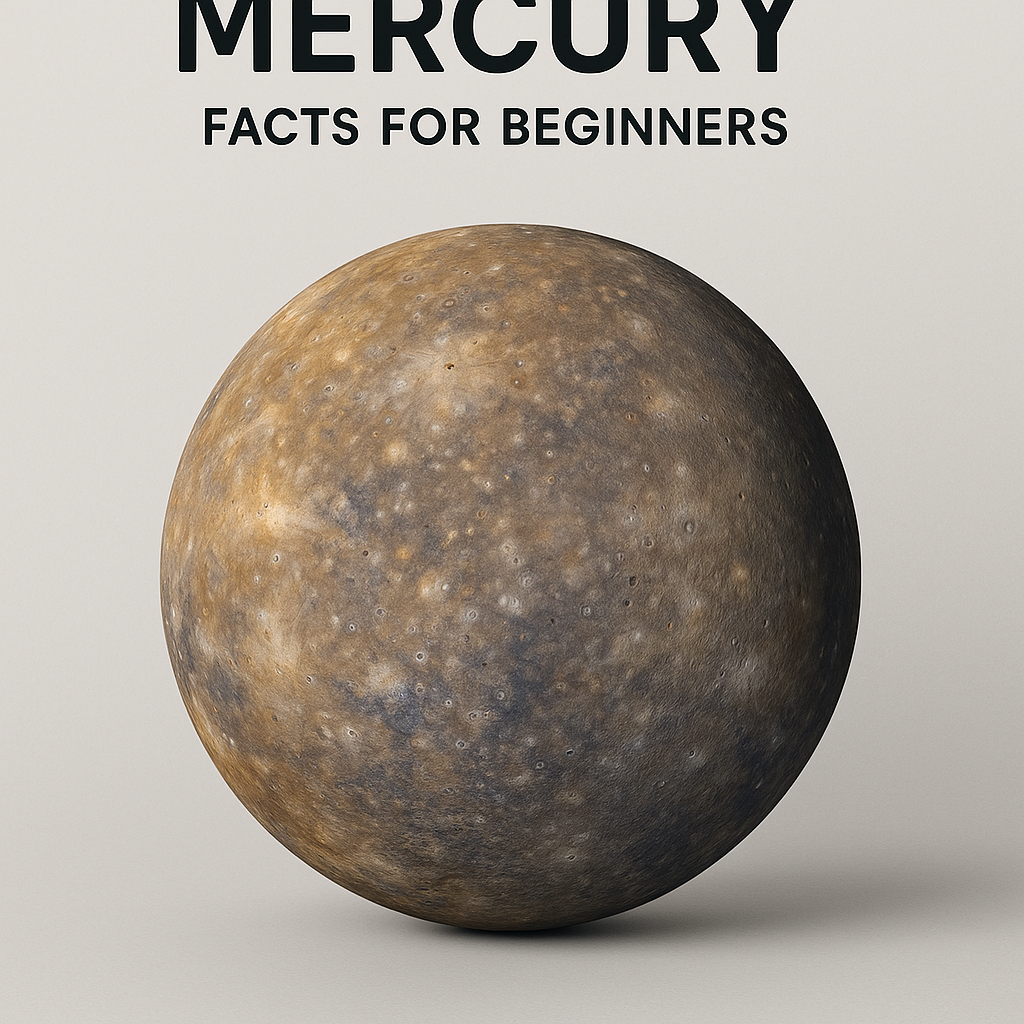
Mercury is the smallest planet in our Solar System and the closest one to the Sun. As a planet, it belongs to the category known as terrestrial planets, which means it has a solid, rocky surface. This distinguishes it from the large gas giants like Jupiter and Saturn.
Understanding Mercury is important because it helps scientists learn more about the formation and behavior of rocky planets. In this article, you'll discover fascinating facts about Mercury's characteristics, position in space, and more.
Known for its swift orbit around the Sun, Mercury offers a unique insight into the dynamics of our Solar System’s innermost regions. You'll find that while it shares some similarities with Earth, it also has stark differences.
📍 Where It Is and How Far Away
Mercury resides in the inner part of our Solar System, orbiting closest to the Sun among all the planets. It lies approximately 58 million kilometers from the Sun, about one-third the distance between the Earth and the Sun. This proximity to the Sun significantly influences its temperature and environment.
This distance means that Mercury orbits the Sun quickly. A year on Mercury, which is the time it takes to complete one orbit around the Sun, lasts just 88 Earth days. However, despite its closer proximity, the contrast between its daytime and nighttime temperatures is extreme.
Its location means it receives much more sunlight than Earth. As a result, the planet experiences intense heat during its daytime, while its nights are frigid due to the thin atmosphere that lacks significant heat retention.
🧱 Size, Mass, and Gravity (Made Simple)
In terms of size, Mercury is the smallest planet in our Solar System, even smaller than some of the larger moons that orbit other planets. It has a diameter of about 4,880 kilometers, which is roughly the length of the continental United States.
Mercury's mass, or the amount of material it contains, is also relatively low, about 5.5% of Earth's. Because it is smaller and less massive, it has weaker gravity compared to Earth's. If you were standing on Mercury, you would weigh significantly less than you do on Earth.
The lower gravity means that jumping on Mercury would allow you to rise higher than you would on Earth. This is due to the weaker gravitational pull of the planet on your body.
🌡️ Atmosphere and Weather
Mercury possesses an extremely thin atmosphere, known as an exosphere, composed of atoms blasted off its surface by solar wind and micrometeoroid impacts. This lack of a substantial atmosphere means that weather, as we understand it on Earth, is virtually nonexistent on Mercury.
The thin atmosphere contributes to dramatic temperature swings on the planet's surface. Daytime temperatures can soar up to 430 degrees Celsius (800 degrees Fahrenheit), while nighttime temperatures can drop to minus 180 degrees Celsius (minus 290 degrees Fahrenheit).
Mercury's rapid orbit and slow rotation, which we will discuss later, mean it does not have a rotational atmosphere system like Earth. Instead, temperature changes depend almost entirely on direct sunlight exposure.
🪨 Surface and Interior
Mercury's surface is rocky and heavily cratered, resembling our Moon. This appearance comes from the absence of significant surface erosion processes like water flow and atmospheric interaction. It has many impact craters formed by collisions with asteroids and comets.
The planet's surface also features vast plains and cliffs that stretch for hundreds of kilometers, called scarps. These scarps were created by the planet cooling and contracting over time.
Inside, Mercury is thought to have a large iron core that makes up a significant portion of its volume. This core contributes to its magnetic field, an unusual characteristic for a planet without a substantial atmosphere.
🌀 Rotation, Orbit, and Seasons
Mercury's rotation period is unique. It rotates about its axis once every 59 Earth days, which is much slower than its orbit around the Sun. Because of this, a single day from sunrise to sunrise on Mercury takes 176 Earth days.
The planet's orbit is elliptical, meaning it is not a perfect circle. This shape of the orbit results in varying distances from the Sun during its revolution, affecting the amount of sunlight the surface receives.
Mercury's axis has almost no tilt, meaning it does not experience significant seasonal changes like Earth. The slight axial tilt does mean that some regions near the poles remain permanently shadowed and extremely cold.
🧲 Magnetic Field and Radiation
Mercury has a magnetic field similar to Earth's, though much weaker. It is believed to be generated by its partially molten iron core. This magnetic field creates a magnetosphere around the planet that can deflect solar wind particles.
Though weaker, Mercury's magnetic field still plays a crucial role in protecting its surface from solar radiation. However, due to its proximity to the Sun, the planet is subjected to intense solar wind and radiation compared to Earth.
This environment makes it challenging for spacecraft to explore Mercury and necessitates careful planning for missions to withstand harsh conditions.
🌙 Moons, Rings, and Neighbors
Mercury is unique in that it has no moons or ring systems. Its proximity to the Sun and lack of a substantial atmosphere or gravitational influence likely contribute to this absence.
Having no natural satellites makes Mercury's gravitational interactions simpler than those of larger planets with multiple moons. However, this also means less influence from tidal forces and simpler orbital dynamics compared to planets like Jupiter.
Mercury's immediate neighbor in the Solar System is Venus, which lies further out from the Sun. Together, these inner planets make up part of the rocky planet group in our celestial neighborhood.
🔭 How We Know (Missions and Observations)
Our understanding of Mercury comes from both telescopic observations from Earth and data collected by spacecraft. Ground-based telescopes can observe Mercury passing in front of the Sun or follow its movements in the sky, but detailed surface data requires space missions.
The first spacecraft to visit Mercury was Mariner 10, which flew by in the 1970s and provided the first close-up images of the planet. More recently, the MESSENGER mission orbited Mercury, analyzing its surface composition, magnetic field, and exosphere.
These missions collected vital data using instruments that measured surface chemistry, magnetic readings, and gravity, enhancing our understanding of the smallest planet in our Solar System.
❓ Common Questions and Misconceptions
Is Mercury a star? No, Mercury is not a star. It is a terrestrial planet in our Solar System.
Can you stand on Mercury? Yes, Mercury has a solid surface, so you could stand on it, although the temperatures and radiation levels would be very challenging for humans.
Is Mercury habitable? The extreme temperatures and lack of a breathable atmosphere make Mercury uninhabitable for humans.
Why is Mercury that color? Mercury appears grey because of its rocky surface and the absence of an atmosphere that would scatter light or add color.
Does it have seasons like Earth? No, Mercury has no significant seasons, as its axis is barely tilted relative to its orbital plane.
Are there storms on Mercury? No, there's no significant atmosphere to support weather systems like storms.
Could Mercury ever have had water? While the surface is bone-dry, some ice exists in permanently shadowed craters near the poles.
📌 Summary
- Mercury is the smallest planet and closest to the Sun.
- It resides in the inner Solar System, about 58 million km from the Sun.
- Mercury has a small size with weak gravity; you'd weigh less there.
- The thin atmosphere leads to extreme temperature changes.
- The surface is rocky and cratered, with a large iron core inside.
- It has a fast orbit but a slow rotation, leading to long days.
- A weak magnetic field exists due to its iron core.
- No moons or rings, unlike the gas giants.
- Data from Mariner 10 and MESSENGER have informed us greatly.
- Mercury’s lack of moons and extreme environment make it unique.