🪐 Ceres Facts for Beginners
🌌 What It Is
Ceres is a fascinating celestial body located in our Solar System and offers an intriguing subject for beginners interested in astronomy. It holds the title of being the largest object in the asteroid belt, the region of space between Mars and Jupiter.
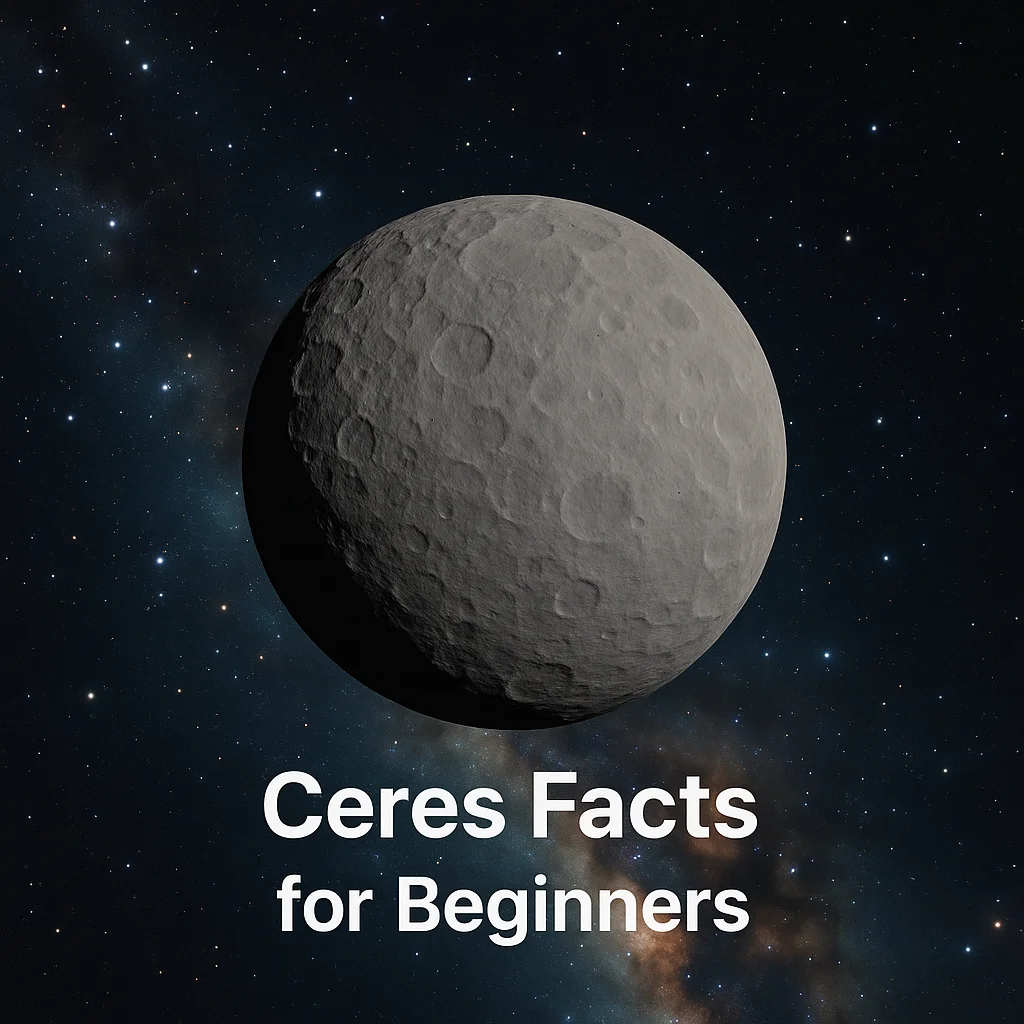
Though not classified as a fully-fledged planet, Ceres earned its distinction as a "dwarf planet" in 2006 by the International Astronomical Union. This classification places it in the same category as Pluto and Eris, distinguishing it from the larger, rocky terrestrial planets and the gas giants.
In this exploration of Ceres, we'll uncover everything from its size and composition to its atmosphere and surface features. By the end of this guide, you'll have a comprehensive understanding of this intriguing dwarf planet.
📍 Where It Is and How Far Away
Ceres resides within the asteroid belt, positioned mysteriously between Mars and Jupiter. This placement makes it both accessible yet distant in terms of human exploration and observation.
When thinking about distances in space, astronomers often use the term "astronomical unit" or AU, which is the average distance from the Earth to the Sun, about 93 million miles or 150 million kilometers. Ceres sits approximately 2.7 AU from the Sun, significantly increasing its distance from Earth and drastically impacting its environment.
The light from the Sun takes a few minutes to reach Ceres, resulting in lower temperatures and less sunlight than what we experience. These factors collectively influence the possibility of weather and surface conditions on Ceres.
🧱 Size, Mass, and Gravity (Made Simple)
Ceres, though the largest object in the asteroid belt, is smaller than Earth's Moon, with a diameter of about 590 miles or 940 kilometers. Imagine it as about as wide as the state of Texas.
Its mass is only a tiny fraction of Earth's, resulting in significantly weaker gravity. Surface gravity on Ceres is about 3% of Earth's, meaning a person would feel very light if they could stand on its surface.
This low gravity results in a different experience compared to Earth, where jumping results in much higher leaps and carrying weights is considerably easier.
🌡️ Atmosphere and Weather
Ceres has a very thin atmosphere, almost negligible compared to Earth's. It's composed primarily of water vapor, likely from surface ice sublimating, or turning directly from a solid to a gas.
Since it lacks a substantial atmosphere, typical weather patterns with clouds, winds, or storms, like those on Earth, are absent on Ceres. The lack of atmosphere also means there is little to no protection from solar radiation.
These conditions, combined with its distant orbit from the Sun, result in extremely cold temperatures that would make human habitation challenging without specialized equipment.
🪨 Surface and Interior
The surface of Ceres is replete with craters, much like our Moon, and contains some of the largest in proportion to its size. One of its most notable features is Occator Crater, which houses bright spots suspected to be salt deposits.
Beneath the surface, Ceres is believed to have an icy mantle surrounding a rocky core. This structure suggests the presence of water, crucial for understanding its potential for hosting microbial life.
These surface and interior characteristics are shaped by Ceres' history of impacts and possibly past geological activity, offering clues about the early Solar System.
🌀 Rotation, Orbit, and Seasons
A day on Ceres, defined by its rotation period, lasts about 9 hours, much shorter than a day on Earth. Its orbit around the Sun takes about 4.6 Earth years to complete, defining its year length.
Ceres has a small axial tilt, which means it experiences minor seasonal changes compared to Earth. These subtle shifts impact its surface temperature distribution only slightly.
The specifics of its rotation and orbit provide insight into the dynamic nature of celestial bodies in the asteroid belt.
🧲 Magnetic Field and Radiation
Unlike planets with molten iron cores or strong magnetic fields, Ceres lacks a significant magnetic field. This absence results in its inability to shield itself from solar radiation and cosmic rays.
The lack of a magnetic field suggests that Ceres does not have a molten metallic core, which is an interesting aspect when considering the differentiation and history of this dwarf planet.
Despite this, understanding the radiation environment is crucial for planning future exploration missions regarding instrumentation and protective measures.
🌙 Moons, Rings, and Neighbors
In contrast to some other dwarf planets and planets with numerous moons or ring systems, Ceres does not have any known natural satellites or rings.
This characteristic raises questions about the gravitational influence in its vicinity and how it differs from other celestial objects, offering unique insights into its formation and evolution.
The lack of moons and rings also emphasizes the unique and varied characteristics found elsewhere, exuding the diversity of celestial bodies within our Solar System.
🔭 How We Know (Missions and Observations)
Much of what we know about Ceres comes from spacecraft missions and telescopic observations. NASA's Dawn spacecraft, which visited Ceres, provided a wealth of data, capturing detailed images and analyzing its surface composition.
These missions have allowed scientists to create detailed maps and models, revealing Ceres' topography and composition, contributing significantly to our understanding of dwarf planets.
Together with Earth-based telescopic observations, these missions have unveiled secrets about Ceres' surface, helping refine our models of the asteroid belt’s largest resident.
❓ Common Questions and Misconceptions
Is Ceres a star? No, Ceres is a dwarf planet, not a star. Stars produce light through nuclear fusion, unlike Ceres.
Can you stand on Ceres? Yes, theoretically, you could stand on Ceres, though you'd feel very light due to its weak gravity.
Is it habitable? Currently, Ceres is not considered habitable for humans, lacking a substantial atmosphere and having extreme temperatures.
Why is it that color? Ceres appears grayish due to its rocky surface, with bright spots that are likely salt deposits.
Does it shine like a planet? Ceres reflects sunlight, so it can be seen with telescopes, but it doesn't shine on its own.
Is it still forming? No, Ceres is not forming but might still be geologically active, as suggested by some surface features.
Does it have water? Evidence suggests Ceres has water ice beneath its surface and possibly liquid water.
Do missions land on Ceres? Not yet; missions like NASA's Dawn have orbited but not landed on Ceres.
📌 Summary
- Ceres is the largest object in the asteroid belt, classified as a dwarf planet.
- It resides between Mars and Jupiter, located about 2.7 AU from the Sun.
- With a diameter of 940 km, Ceres' gravity is much weaker than Earth's.
- Its thin atmosphere consists primarily of water vapor with no large-scale weather systems.
- The surface features craters and bright spots, possibly salt deposits, overlying a rocky core and icy mantle.
- Ceres rotates every 9 hours and orbits the Sun every 4.6 Earth years.
- It lacks a significant magnetic field, exposing it to high radiation levels.
- Ceres has no known moons or rings, setting it apart from many planets.
- Knowledge comes from telescopic studies and missions like NASA's Dawn spacecraft.
- Memorable fact: Ceres was the first object in the asteroid belt to be discovered in 1801.