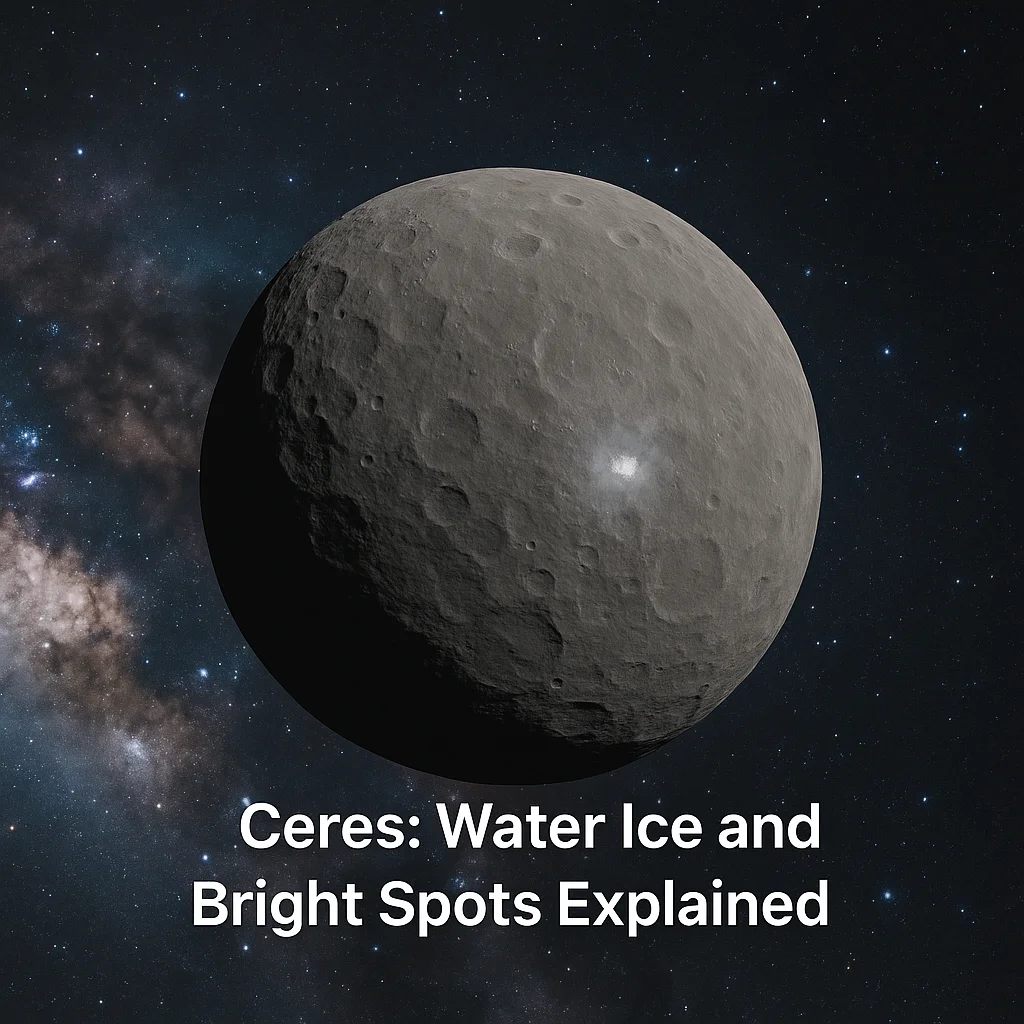
🪐 Ceres: Water Ice and Bright Spots Explained
Ceres, the largest object in the asteroid belt between Mars and Jupiter, is a fascinating celestial body that has captured the interest of scientists and space enthusiasts alike. As a dwarf planet, Ceres holds clues to the early solar system, and its unique features, such as mysterious bright spots and evidence of water ice, make it a captivating object of study.
This article will explore the many aspects of Ceres, providing a beginner-friendly understanding of what it is, where it can be found in space, its size, atmosphere, and much more. By the end, you'll have a clearer picture of why Ceres is considered one of the most intriguing objects in our solar neighborhood.
We'll dive into its defining characteristics, explore the fascinating phenomena observed on its surface, and explain the science behind these discoveries. Whether you're new to astronomy or just curious about the wonders of the solar system, get ready to embark on a journey to understand Ceres.
🌌 What It Is
Ceres is classified as a dwarf planet, a category of celestial bodies that are too large to be considered asteroids but not massive enough to clear their orbit like full-fledged planets. This classification places it alongside other dwarf planets like Pluto and Eris.
Located in the asteroid belt, Ceres represents a key piece of the solar system puzzle. By studying Ceres, scientists hope to learn more about the conditions present during the solar system's formation. Its presence in the asteroid belt also offers insights into the dynamic history and evolution of our planetary neighborhood.
This article will unveil the mysteries of Ceres, focusing on its structure, composition, and the curious phenomena that make it an object of intrigue among astronomers and space missions alike.
📍 Where It Is and How Far Away
Ceres resides in the asteroid belt, a region of space between the orbits of Mars and Jupiter, filled with rocky debris and minor planets. This location places it relatively close to Earth, at least in cosmic terms, but still a considerable distance that challenges our exploration efforts.
On average, Ceres is about 2.8 astronomical units (AU) from the Sun. One astronomical unit is the distance from the Earth to the Sun, so Ceres is roughly three times farther from the Sun than Earth is. This distance significantly influences its temperature, keeping the dwarf planet cold enough for water ice to exist just beneath its surface.
Understanding Ceres' position in the solar system helps us comprehend its environmental conditions and its role in the broader cosmos, making it a subject of enduring scientific curiosity.
🧱 Size, Mass, and Gravity (Made Simple)
Ceres measures about 940 kilometers (approximately 584 miles) across, making it the largest object in the asteroid belt. Although it is substantially smaller than any of the major planets, its size is significant among the many small bodies populating this region of the solar system.
In terms of mass, Ceres contains about one-third of the total mass of the entire asteroid belt. Its gravity, however, is much weaker than Earth's. If you weigh 100 pounds on Earth, you would weigh just around 3 pounds on Ceres, illustrating the dwarf planet's relatively low gravitational pull.
The lower gravity would make standing or walking on Ceres a unique experience. Objects would seem to float more than on Earth due to the weaker gravitational force.
🌡️ Atmosphere and Weather
Ceres has a thin atmosphere, primarily composed of water vapor, which has been linked to the presence of water ice on or near its surface. This atmosphere, however, is not dense enough to support weather patterns in the way we experience them on Earth.
The lack of a substantial atmosphere means Ceres does not have clouds, winds, or storms as seen on Earth. Its atmospheric composition is likely influenced by the sublimation of water ice, driven by the occasional heating from the Sun.
Understanding Ceres' atmosphere provides clues about the dwarf planet's ability to hold water and hints at potential processes that might occur under its surface.
🪨 Surface and Interior
Ceres presents a rocky and icy surface marked by craters, the most notable of which is Occator Crater. This crater is home to the famous bright spots that have puzzled scientists since their discovery, believed to be deposits of salts left behind by evaporating water.
Beneath its crust, Ceres is thought to have a differentiated interior with a rocky core and icy mantle. This structure suggests that Ceres underwent some degree of geological processing, likely involving water.
Understanding the surface and interior of Ceres helps scientists learn more about its potential for hosting water and similar processes that might have been present on other bodies in the early solar system.
🌀 Rotation, Orbit, and Seasons
Ceres takes approximately 9 hours to complete one rotation on its axis, making a day on Ceres much shorter than a day on Earth. Its orbit around the Sun takes about 4.6 Earth years, which means a year on Ceres is significantly longer than our own.
With a relatively small axial tilt of about 4 degrees, Ceres experiences minimal changes in seasons. This near-vertical orientation means that temperature variations due to seasonal changes are not as pronounced as on planets with a greater tilt, like Earth.
The rotation and orbit of Ceres provide insights into its climate and potential history of climate change over eons.
🧲 Magnetic Field and Radiation
Currently, there is no evidence that Ceres possesses a significant magnetic field. The absence of a magnetic field means there is no direct protection from solar and cosmic radiation, which can affect surface conditions and potential missions to the dwarf planet.
While this might limit some aspects of habitability, it doesn't diminish the scientific interest in studying Ceres. Researchers continue to examine its surface and composition for signs of past magnetic activity or interactions with solar winds.
The exploration of Ceres' magnetic properties highlights the diversity among bodies in the solar system and informs us about the planetary formation processes.
🌙 Moons, Rings, and Neighbors
Unlike some other dwarf planets and asteroids, Ceres does not have any known moons or rings. This absence is intriguing given its size and the typical formation processes that lead to moons orbiting larger bodies.
The lack of moons or rings around Ceres might suggest a unique history or different conditions during its formation. It also underscores the diversity in celestial bodies within our solar system.
Understanding why Ceres lacks these features adds to the overall picture of its history and the dynamic processes in the asteroid belt.
🔭 How We Know (Missions and Observations)
A significant amount of our current knowledge about Ceres comes from telescopic observations and space missions. The most notable mission to Ceres was NASA's Dawn spacecraft, which orbited the dwarf planet from 2015 until 2018.
The Dawn mission provided high-resolution images, spectral data, and gravitational readings, offering unprecedented insight into Ceres' composition and structure. It revealed the famous bright spots in Occator Crater and detected water vapor, significantly enhancing our understanding of the dwarf planet.
Such missions demonstrate the power of space exploration to unveil the mysteries of our solar system and deepen our knowledge of bodies like Ceres.
❓ Common Questions and Misconceptions
Is Ceres a star? No, Ceres is a dwarf planet and the largest object in the asteroid belt, not a star.
Can you stand on Ceres? Yes, Ceres has a solid surface, although its low gravity would make standing and moving around an unusual experience compared to Earth.
Is Ceres habitable? While Ceres has water ice, its conditions are not suitable for life as we know it. The lack of a substantial atmosphere and the presence of radiation make it an unlikely habitat.
Why is Ceres called a dwarf planet, not an asteroid? Ceres is large enough to have achieved a spherical shape due to its own gravity, a key criterion for classification as a dwarf planet.
Are there bright lights on Ceres? The bright spots are not lights but highly reflective materials, likely salts left behind by evaporating water, that gleam under the sunlight.
Why does Ceres have bright spots? These are caused by deposits from water-ice sublimation, which leave behind reflective materials that stand out against the darker surface.
Does Ceres have volcanoes? Ceres lacks traditional volcanoes but may have cryovolcanoes, which erupt icy materials instead of molten rock.
Is Ceres moving away from the Sun? Ceres, like other celestial bodies, follows a stable orbit around the Sun, showing no significant changes in trajectory.
📌 Summary
- Ceres is a dwarf planet in the asteroid belt between Mars and Jupiter.
- Located about 2.8 astronomical units from the Sun, it is three times farther than Earth from the Sun.
- It measures about 940 kilometers across, with weak gravity compared to Earth.
- Ceres has a thin atmosphere of water vapor, influenced by surface ice.
- Its surface features include craters and bright spots; it has an icy mantle and rocky core.
- With a 9-hour day and 4.6 Earth-year orbit, Ceres experiences minimal seasonal changes.
- Currently, Ceres lacks a significant magnetic field, offering no shielding from solar radiation.
- It has no known moons or rings, which is puzzling given its size and orbital characteristics.
- Our understanding comes from telescopes and the Dawn spacecraft mission.
- An enduring puzzle, Ceres' bright spots highlight planetary diversity in our solar system.