🪐 Makemake Facts for Beginners
🌌 What It Is
Makemake is one of the many fascinating celestial objects in our Solar System. It is classified as a dwarf planet, which means that while it orbits the Sun and has enough mass to assume a nearly round shape, it hasn't cleared its orbital path of other debris.
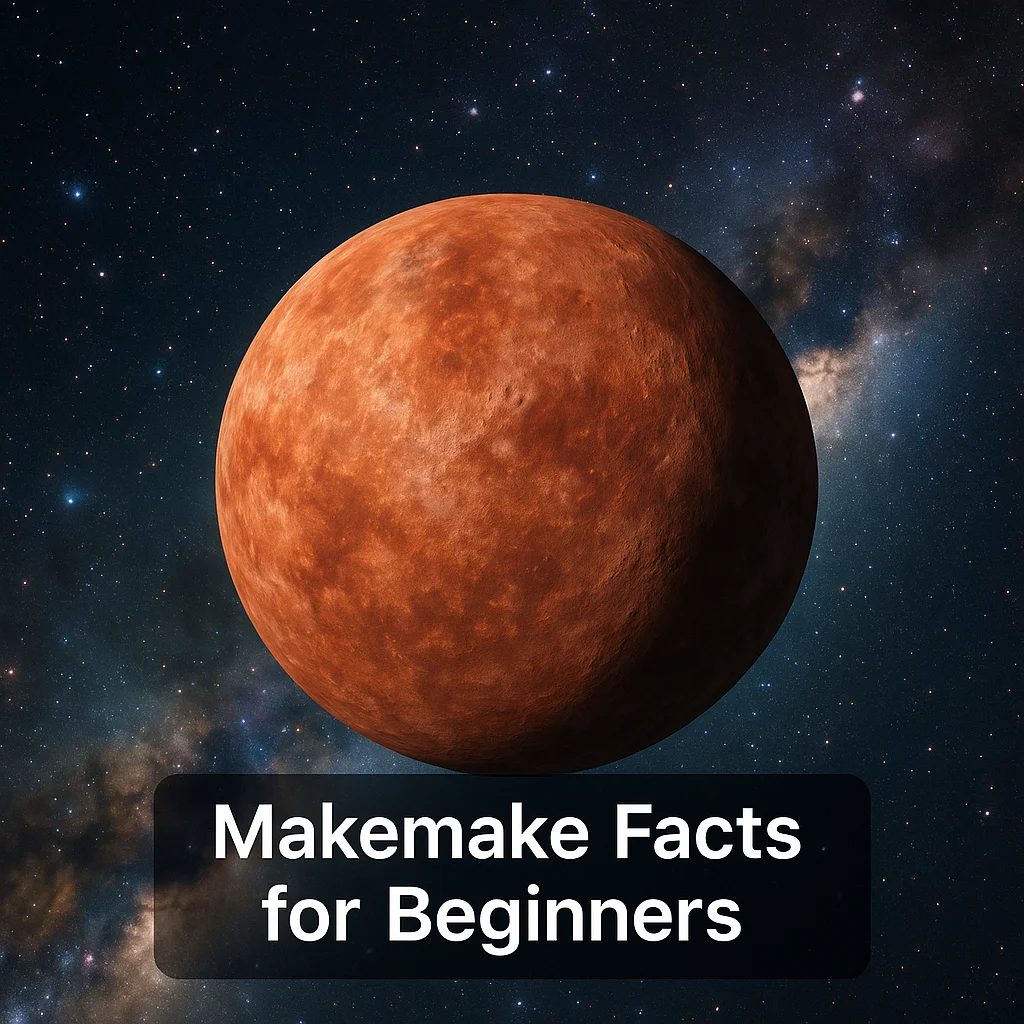
Makemake is part of the Kuiper Belt, a region beyond Neptune filled with small icy bodies. It's known as a "plutoid" because plutoids are icy dwarf planets located beyond Neptune.
In this article, you'll discover the unique characteristics of Makemake, including its size, atmosphere, and orbit. We'll explore how scientists study this distant world and unveil some of the mysteries of this intriguing dwarf planet.
📍 Where It Is and How Far Away
Makemake is situated in the Kuiper Belt, a distant region of the Solar System. It lies beyond the orbit of Neptune, which makes it one of the outermost objects orbiting our Sun.
The distance from Earth to Makemake varies as both planet and dwarf planet move along their orbits. On average, Makemake is about 45.8 astronomical units (AU) from the Sun. To put it simply, one AU is the distance from Earth to the Sun, so Makemake is about 45 times that distance away!
This remoteness means Makemake receives very little sunlight. As a result, its surface temperature is extremely cold, likely hundreds of degrees below freezing year-round.
🧱 Size, Mass, and Gravity (Made Simple)
Makemake is smaller than Earth's Moon but is still considered a significant object in the Kuiper Belt. Its exact size is challenging to determine, but estimates suggest it is about 1,430 kilometers (890 miles) in diameter.
The mass of Makemake is also lesser than that of the Moon, but its size and mass are enough to exert a noticeable gravitational pull. However, the surface gravity of Makemake is much weaker than Earth's; if you could stand on it, you'd weigh much less!
The dwarf planet doesn't have a solid, rocky surface like a terrestrial planet, which affects how gravity is felt. Nonetheless, its mass accounts for an impressive amount of the matter in its vicinity.
🌡️ Atmosphere and Weather
Makemake's atmosphere, if present, is extremely tenuous, meaning it is incredibly thin and faint. It may contain nitrogen with some methane, much like the atmosphere of its dwarf planet cousin, Pluto.
Due to its great distance from the Sun and cold temperatures, any atmospheric gases would be mostly frozen, creating surface frost rather than clouds or weather systems.
Because of the lack of a significant atmosphere and weather patterns, Makemake is a harsh, frigid world. Its environment is dominated by icy landscapes rather than dynamic atmospheric changes.
🪨 Surface and Interior
The surface of Makemake is thought to be coated with methane ice, giving it a reddish-brown coloring. This surface material affects how sunlight reflects off Makemake, making it one of the brighter objects in the Kuiper Belt as viewed from Earth.
With no visible craters or mountains detected yet, Makemake's surface remains a mystery. Ice and possibly organic compounds may cover it, altering its visible light spectrum data.
The interior of Makemake is presumed to be similar to other icy bodies in the Kuiper Belt, possibly consisting of a mix of ice and rocky material. However, without direct observations, scientists can only hypothesize based on its size and surface features.
🌀 Rotation, Orbit, and Seasons
Makemake completes one rotation on its axis in about 7.7 hours, meaning its day is rather short. This quick rotation is common among distant celestial bodies.
The orbit of Makemake around the Sun takes about 310 Earth years. Like other objects in the Kuiper Belt, its path is elongated, which means its distance from the Sun can vary a lot during its orbit.
Makemake's seasons, caused by its axial tilt, would last much longer than those on Earth due to its lengthy orbit, making the concept of seasons vastly different from our terrestrial experience.
🧲 Magnetic Field and Radiation
Little is known about Makemake's magnetic field. Being a small, distant object, any magnetic field it has would be weak compared to Earth’s and may not provide significant protection from cosmic radiation.
Because of Makemake's distance from the Sun, solar radiation would have a minimal impact on its surface and atmospheric characteristics compared to planets closer to the Sun.
Understanding potential radiation levels around Makemake is important for scientists planning future explorations and understanding its space weather environment.
🌙 Moons, Rings, and Neighbors
Makemake has one known moon, provisionally named MK 2, detected in 2016. This moon provides valuable data for scientists, helping determine Makemake's mass more accurately.
The gravitational effects between Makemake and its moon can provide insights into the internal structure and formation history of this dwarf planet.
Makemake has no known ring system, which isn’t surprising given its size and distance. Understanding what it does and doesn't have helps scientists refine theories on how the outer Solar System developed.
🔭 How We Know (Missions and Observations)
Makemake has not yet had a dedicated spacecraft mission. Most of our information comes from powerful Earth-based telescopes and the Hubble Space Telescope.
These telescopes allow scientists to observe Makemake's brightness, color, and motion, helping to reveal its size, composition, and orbit.
Data collected through these observations include spectra, which provide clues about the surface composition, and precise measurements to track its position and motion over time.
❓ Common Questions and Misconceptions
Is Makemake a star? No, it's a dwarf planet, a type of small world in the Solar System.
Can you stand on Makemake? It's primarily composed of ice and rock, but with extremely low surface gravity, standing would feel very different from Earth.
Is Makemake habitable? No, it's far too cold and doesn't have a suitable atmosphere for life as we know it.
Why is Makemake that color? The reddish-brown hue comes from methane ice and possibly tholins, organic compounds created by solar radiation.
Does it have rings? No rings are currently known around Makemake.
How do we know about its moon? The moon was detected using the Hubble Space Telescope, revealing hidden details through high-resolution images.
📌 Summary
- Makemake is a dwarf planet in the Kuiper Belt.
- Located beyond Neptune, it's about 45.8 AU from the Sun.
- Its small size results in low gravity; you'd weigh less.
- Minimal atmosphere with methane; frigid temperatures prevail.
- Surface is icy and likely coated with methane ice.
- Rotates every 7.7 hours; takes 310 years to orbit the Sun.
- Weak magnetic field; minimal solar radiation impact.
- Has one known moon; no rings detected.
- Knowledge obtained mostly through telescopic observation.
- Its moon helps refine scientific understanding of Makemake.