🪐 Pluto’s Moons Explained (Charon and Beyond)
🌌 What It Is
Pluto is a dwarf planet located in the outer regions of our Solar System. It was once considered the ninth planet from the Sun, but it was reclassified as a dwarf planet in 2006 by the International Astronomical Union. This reclassification was due to Pluto not clearing its orbit of other debris.
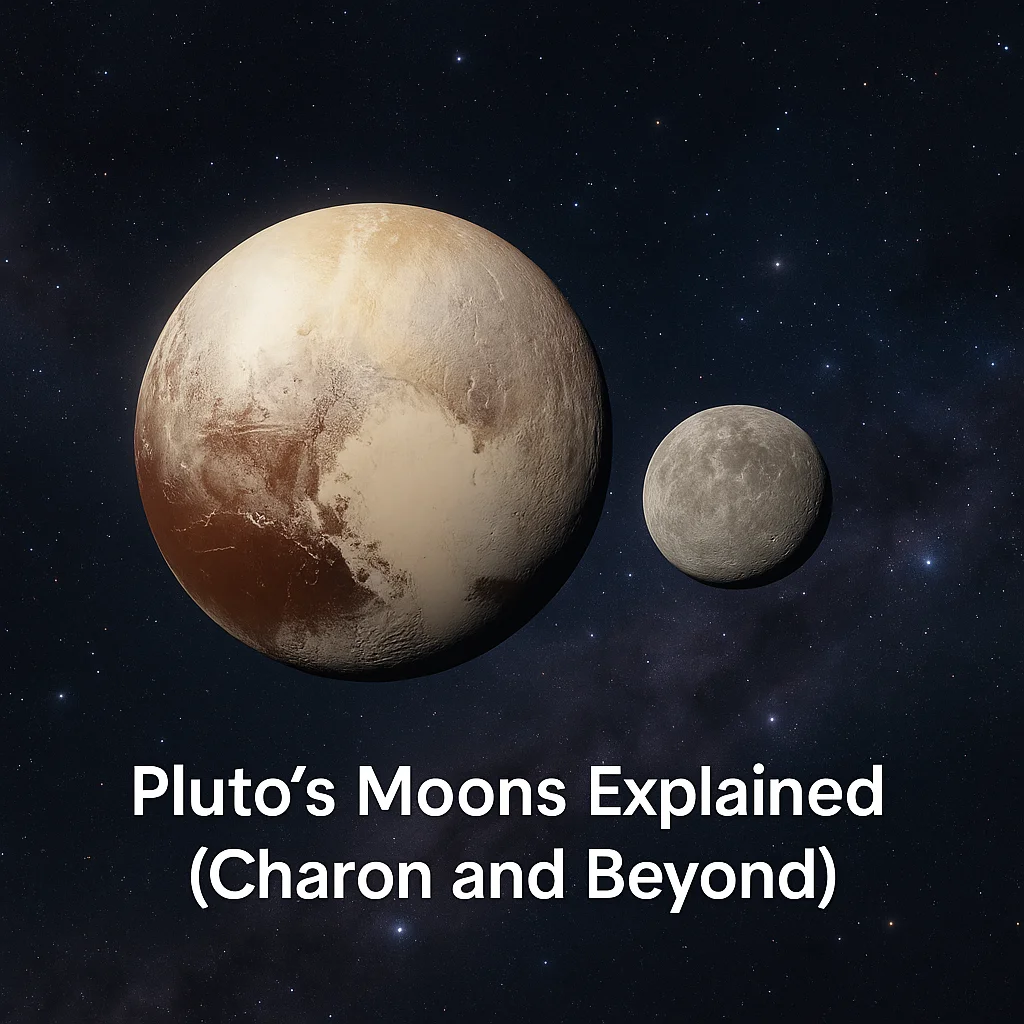
In this article, we'll explore Pluto's moons, with particular focus on the largest, Charon. Pluto is fascinating not only because of its controversial status but also because of its unique characteristics and satellite system.
The dwarf planet helps us understand more about the Kuiper Belt, a region of space beyond Neptune filled with icy bodies and remnants from the Solar System's formation. As we delve into Pluto's moons, we'll uncover what makes them intriguing celestial bodies.
📍 Where It Is and How Far Away
Pluto resides in the Kuiper Belt, making it an outer object of the Solar System. It's located a staggering 3.7 billion miles away from the Sun on average. Due to this immense distance, Pluto takes around 248 Earth years to complete a single orbit around our star.
In terms of light travel time, it takes sunlight about 5.5 hours to reach Pluto. This means that when you look at Pluto through a telescope, you're actually viewing it as it appeared 5.5 hours ago.
This distant orbit means Pluto receives very little sunlight, resulting in frigid surface temperatures averaging around minus 375 degrees Fahrenheit (minus 225 degrees Celsius). Such extreme cold deeply influences its atmosphere and surface conditions.
🧱 Size, Mass, and Gravity (Made Simple)
Pluto is relatively small when compared to Earth, having a diameter of about 1,477 miles—roughly half the width of the United States. Its mass is only around 0.2% of Earth's, which significantly affects its gravitational pull.
With weaker gravity than Earth, a person weighing 100 pounds here would feel like they weigh just 6 pounds on Pluto. This low gravity results in an interesting dynamic with its moons, especially Charon, which is large relative to Pluto's size.
Charon itself is about half the size of Pluto, making the two more of a double dwarf planet system. Together, they orbit a point in space that is actually outside of both bodies, a unique characteristic among the larger objects in our Solar System.
🌡️ Atmosphere and Weather
Pluto's atmosphere is very thin and primarily composed of nitrogen, with traces of methane and carbon monoxide. This atmosphere changes dramatically with the seasons, freezing onto the surface as it moves further from the Sun and sublimating back into a gas as it grows closer.
With its incredibly sparse atmosphere, weather as we experience it on Earth doesn’t occur on Pluto. However, the movement and cycle of atmosphere freezing and thawing can be considered a form of 'weather' on this distant world.
The atmosphere's thinness and the weak sunlight mean there's little heat retention, contributing further to Pluto's icy conditions. As Charon and the smaller moons orbit, their gravitational interactions can even cause slight variations in its atmosphere.
🪨 Surface and Interior
The surface of Pluto is diverse, featuring plains, mountains, and craters. The plains, such as the heart-shaped Tombaugh Regio, consist mostly of nitrogen ice. In contrast, the mountains are believed to be composed of water ice, as hardly anything else would be solid at such low temperatures.
Pluto's surface is shaped by both internal and external forces. Cryovolcanism (volcanoes that erupt with ices) and ice tectonics play a significant role, alongside impact craters from collisions with other space objects.
Beneath its surface, scientists suspect Pluto has a complex interior. It's thought to have a rocky core surrounded by icy layers, with some evidence suggesting a subsurface ocean of liquid water might exist.
🌀 Rotation, Orbit, and Seasons
Pluto rotates once every 6.4 Earth days, which is oddly synchronized with Charon, meaning they always show the same face to each other. This synchronous rotation results from their gravitational interaction.
The orbit of Pluto is highly elliptical, varying its distance from the Sun significantly, which causes pronounced seasonal changes despite its long year. These seasons are extremely slow; each one lasts over 20 Earth years.
Pluto's axis is tilted significantly, similar to Uranus, lying on its side relative to its orbit. This axial tilt, combined with its elliptical orbit, leads to extreme seasonal shifts and unique lighting conditions across its surface.
🧲 Magnetic Field and Radiation
Pluto does not possess a magnetic field as Earth does. This absence means there are no auroras or magnetic protection from solar wind. Its lack of a strong magnetic field is typical for objects of its size and icy composition.
The dwarf planet lacks significant radiation belts, but it does experience some interaction with the solar wind. Without a magnetic shield, its thin atmosphere is gradually being blown away into space, although this process occurs slowly over astronomical timescales.
For robotic spacecraft visiting Pluto, this absence of intense magnetic fields means fewer radiation hazards, making such missions somewhat simpler in terms of shielding requirements.
🌙 Moons, Rings, and Neighbors
Pluto has five known moons, the most significant being Charon. The other four are Hydra, Nix, Kerberos, and Styx, all much smaller than Charon. None of these moons are spherical; they have irregular shapes due to their low gravity and mass.
Charon's size is nearly half that of Pluto itself, making the Pluto-Charon system more akin to a binary system. This strong gravitational interaction shapes both bodies, causing tidal forces that affect their rotation and surface geology.
Unlike other outer planets like Saturn or Jupiter, Pluto has no ring system. This lack of rings may be due to its smaller size and weaker gravitational field, which can’t easily maintain a stable ring system.
🔭 How We Know (Missions and Observations)
Our understanding of Pluto and its moons dramatically increased after NASA's New Horizons mission, which flew by Pluto in 2015. Before this mission, most knowledge came from telescope observations that provided limited detail.
New Horizons sent back high-resolution images and data, revealing Pluto's complex geology and atmosphere. It also mapped Charon and identified surface features never before seen up close.
Spectroscopic studies from Earth-based telescopes continue to provide information about Pluto's composition and atmospheric makeup. These combined data sources deepen our understanding of this distant world.
❓ Common Questions and Misconceptions
Is Pluto a planet? Pluto was once considered the ninth planet, but it was reclassified as a dwarf planet in 2006.
Can you stand on Pluto? While Pluto has a solid surface, its low gravity would make 'standing' quite different from Earth.
Is Pluto habitable? With temperatures at minus 375°F and a thin atmosphere, Pluto is not suitable for life as we know it.
Does Pluto have rings? Unlike gas giants, Pluto does not have a ring system due to its weaker gravity and mass.
Why does Pluto look reddish? Pluto's reddish hue comes from tholins—organic compounds that form when solar radiation interacts with its ice.
How was Pluto discovered? American astronomer Clyde Tombaugh discovered Pluto in 1930 through observations at the Lowell Observatory.
📌 Summary
- What it is: Pluto is a dwarf planet with a complex system of moons.
- Where it is: Located in the Kuiper Belt, far beyond Neptune.
- Size/gravity takeaway: Much smaller than Earth, weak gravity.
- Atmosphere/weather: Thin, mostly nitrogen, changes with distance from the Sun.
- Surface/interior: Icy plains and mountains with potential subsurface ocean.
- Orbit/rotation: Long, elliptical orbit with synchronized rotation with Charon.
- Magnetic/radiation: No significant magnetic field, thin atmosphere slowly escaping.
- Moons/rings: Five moons, no rings, notable binary system with Charon.
- How we know: Primarily via New Horizons and Earth-based observations.
- One memorable fact: New Horizons revolutionized our understanding of Pluto with its 2015 flyby.