🪐 Why Pluto Is Geologically Active
🌌 What It Is
Pluto, once considered the ninth planet in our Solar System, is now classified as a dwarf planet. This change in status occurred in 2006 when the International Astronomical Union redefined what constitutes a planet. Dwarf planets, like Pluto, share characteristics with the larger planets but do not clear their orbits of other debris.
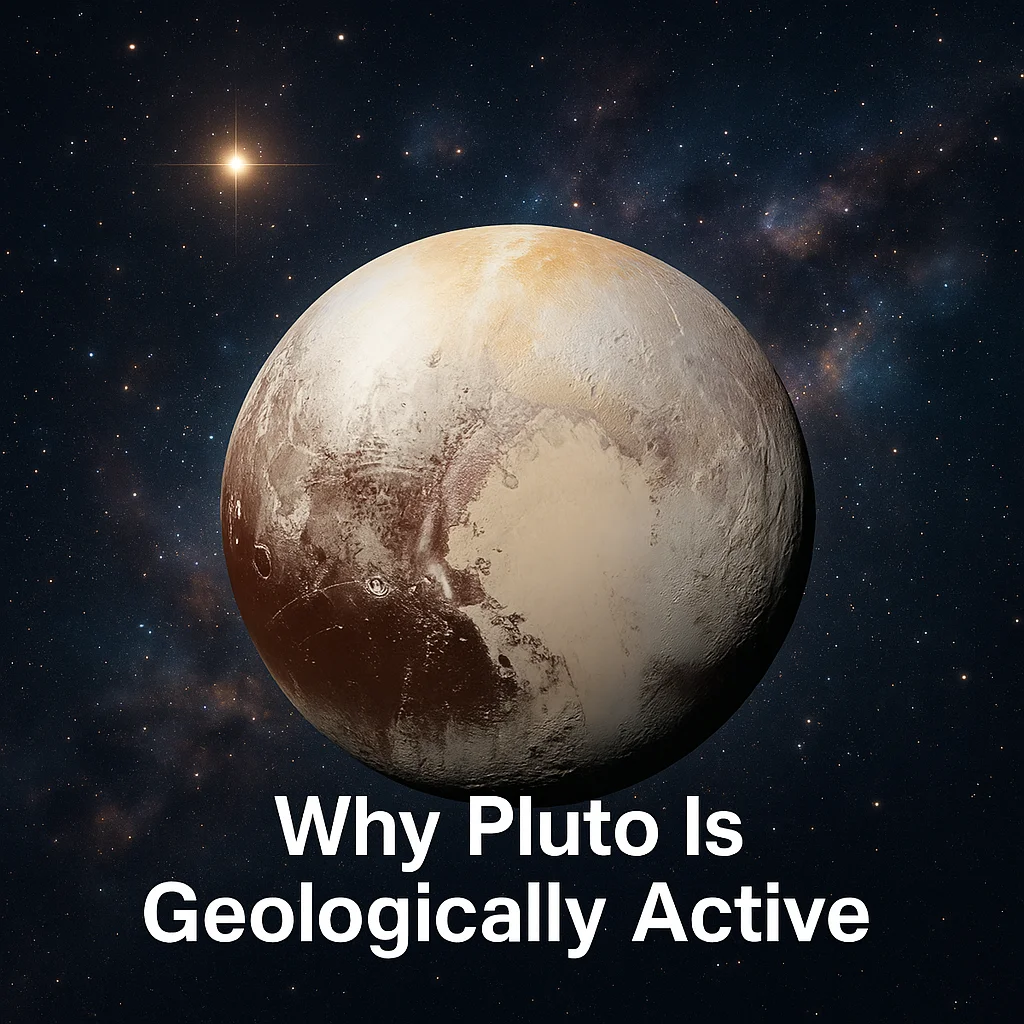
In this article, we will explore why Pluto is considered geologically active. This is a characteristic typically associated with larger planets and moons, making Pluto an object of great scientific curiosity.
By the end of this article, you will have gained insight into the fascinating features of Pluto, from its atmosphere and surface to its position in the Solar System and its impact on our understanding of planetary science.
📍 Where It Is and How Far Away
Pluto is located at the far edge of our Solar System in a region called the Kuiper Belt, a vast area filled with small icy bodies. This places Pluto at an average distance of about 3.67 billion miles from the Sun, or about 39.5 astronomical units (AU). To put it in perspective, one AU is the distance from the Earth to the Sun.
Because of its distance, Pluto receives very little sunlight, contributing to its cold temperatures. It takes light from the Sun approximately 5.5 hours to reach Pluto, which means it exists in a dim environment compared to the inner planets.
The small amount of sunlight and considerable distance from the Sun means that Pluto's surface is extremely cold, with temperatures plunging to as low as -375 degrees Fahrenheit (-225 degrees Celsius).
🧱 Size, Mass, and Gravity (Made Simple)
Pluto is quite small compared to other planets, even smaller than Earth's Moon. It measures about 1,476 miles in diameter, roughly half the width of the United States. Its size and mass make Pluto less dense, suggesting it is composed mostly of ice and rock.
The gravity on Pluto is weak due to its small size and mass. If you weigh 100 pounds on Earth, you would weigh just about 6.7 pounds on Pluto. This reduced gravity means that any activity on Pluto would feel different compared to Earth, with objects and people experiencing less weight.
🌡️ Atmosphere and Weather
Pluto has a tenuous atmosphere made mostly of nitrogen, with traces of methane and carbon monoxide. Unlike Earth, Pluto's atmosphere changes with its distance from the Sun, freezing and falling as snow as it moves further away and thawing as it comes closer.
Occasionally, methane forms hazy layers, creating complex weather patterns despite the harsh environment. The weather on Pluto is influenced by the little sunlight it receives, with its atmosphere stretching out into space and creating unique conditions.
As Pluto travels along its elliptical orbit, the atmosphere will expand and contract over time, creating a dynamic environment that surprises scientists.
🪨 Surface and Interior
Pluto's surface is a mix of mountains, valleys, and plains, including the vast, heart-shaped region known as Sputnik Planitia. This icy plain is made of frozen nitrogen and exhibits evidence of convection, indicating recent geological activity.
The surface features are shaped by a combination of impact cratering and tectonics, along with the effects of cryovolcanism, where a slushy mixture of water and other ices can erupt, pluming onto the surface.
Pluto's interior is believed to be differentiated into a core and mantle, with potential subsurface oceans of liquid water. This internal structure, along with ongoing geological processes, contributes to its classification as geologically active.
🌀 Rotation, Orbit, and Seasons
Pluto takes about 6.4 Earth days to complete one rotation, meaning its "day" is quite long compared to ours. Its orbit around the Sun is highly elliptical, taking 248 Earth years to make one complete trip, thus giving it very long seasons.
Pluto has a tilt in its axis of about 120 degrees, resulting in extreme seasonal variations. This tilt causes one side of Pluto to be exposed to sunlight for extended periods while the other remains in darkness.
🧲 Magnetic Field and Radiation
Although there is currently no definitive evidence that Pluto has a significant magnetic field, its potential effects have been considered, particularly concerning its atmosphere. If a magnetic field exists, it might play a role in atmospheric retention and interaction with the solar wind.
The lack of a strong magnetic field means that high-energy particles from the Sun can more freely strip away Pluto's thin atmosphere, contributing to its unique atmospheric dynamics.
🌙 Moons, Rings, and Neighbors
Pluto has five known moons, with Charon being the largest and most famous. Charon is nearly half the size of Pluto and is tidally locked with the dwarf planet, meaning they always show the same face to each other.
The presence of multiple moons creates complex gravitational interactions, contributing to our understanding of orbital mechanics and natural satellites. Interestingly, no rings have been discovered around Pluto, which provides an intriguing contrast to the gas giants in our Solar System.
🔭 How We Know (Missions and Observations)
Our understanding of Pluto was significantly enhanced by the New Horizons mission, which flew past the dwarf planet in 2015. This spacecraft provided a wealth of data, including high-resolution images and measurements of Pluto's atmosphere, surface, and moons.
Prior to New Horizons, observations made using ground-based telescopes and the Hubble Space Telescope offered glimpses of Pluto and its moons, but the New Horizons mission gave us an unprecedented view of this distant world.
The data collected by New Horizons continues to be analyzed, offering new insights into Pluto's complex geology and atmospheric behavior.
❓ Common Questions and Misconceptions
Is Pluto a planet? While once classified as the ninth planet, Pluto is now categorized as a dwarf planet.
Can you stand on Pluto? Yes, Pluto has a solid surface, but its icy terrain and low gravity would make walking and standing a unique challenge.
Is Pluto habitable? No, the extreme cold and lack of a significant atmosphere make Pluto uninhabitable by Earth standards.
Why is Pluto that color? Pluto's surface displays a range of colors due to various ices and the presence of tholins, organic molecules altered by sunlight.
Does Pluto have rings? No, unlike the gas giants, Pluto has no rings. This lack adds to its uniqueness.
Is Pluto geologically dead? No, evidence from New Horizons suggests ongoing geological activity, such as tectonics and potential cryovolcanism.
📌 Summary
- Pluto is a dwarf planet located in the Kuiper Belt.
- It orbits the Sun at an average distance of 39.5 AU.
- Small and icy, with lower gravity than Earth.
- Thin atmosphere of nitrogen and traces of methane.
- Geologically active surface with plains, mountains, and possible cryovolcanism.
- Long days and years due to its unique rotation and orbit.
- No significant magnetic field detected.
- Has five known moons, including Charon.
- Explored by the New Horizons spacecraft in 2015.
- Pluto challenges our understanding of planetary science.