🪐 How We Detect Exoplanets: Radial Velocity Method
🌌 What It Is
The radial velocity method is a fascinating technique used by astronomers to detect planets outside our solar system, known as exoplanets. It relies on observing the tiny changes in a star's spectrum caused by the gravitational pull of an orbiting planet.
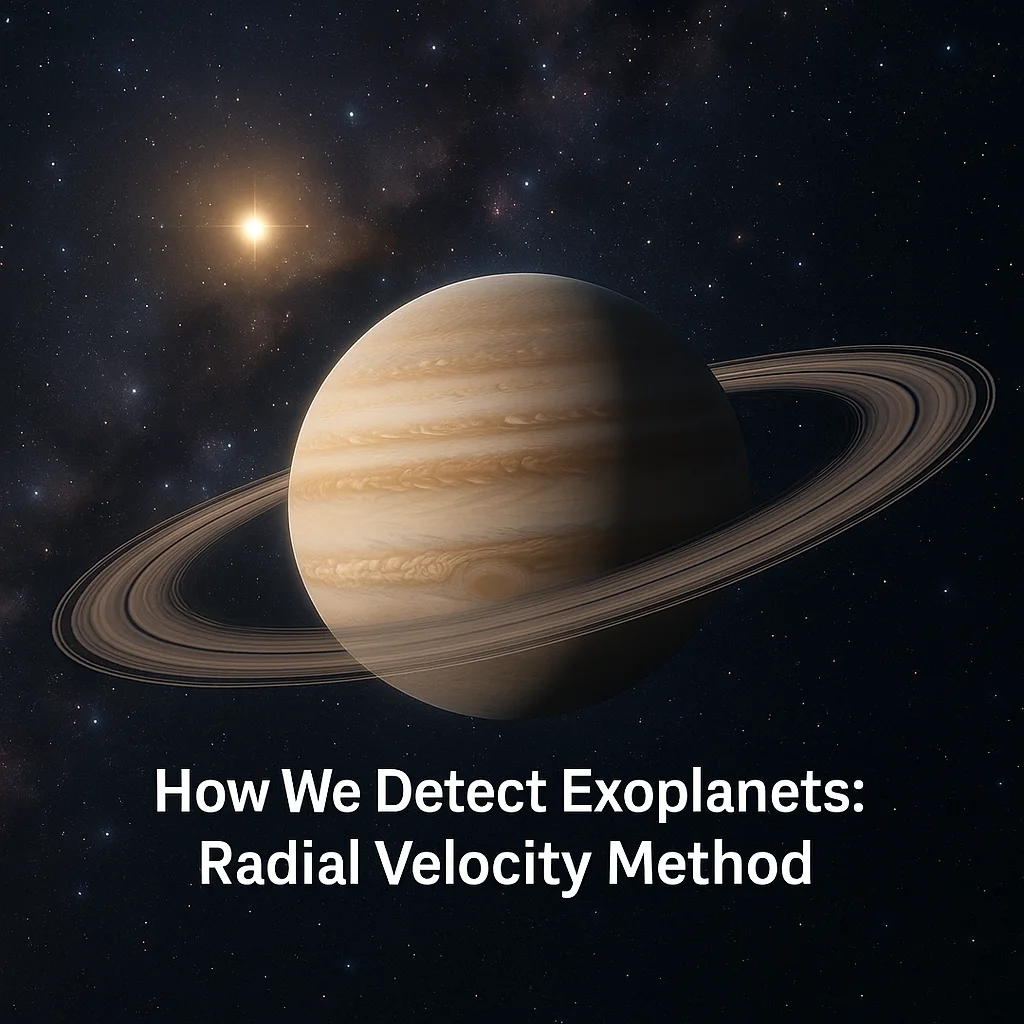
When a planet revolves around a star, it exerts a subtle force on it, causing the star to move in a small orbit itself. This movement leads to shifts in the star's light spectrum known as the Doppler effect. These shifts can tell us if an exoplanet is present, even when we cannot see it directly.
This approach is a cornerstone of exoplanet discovery because it allows us to detect even relatively small planets, expanding our understanding of the diversity and abundance of planetary systems in our galaxy.
📍 Where It Is and How Far Away
Radial velocity measurements are not tied to a specific location in space but are applied to stars throughout our galaxy. By observing these stars, astronomers can infer the presence of planets orbiting them. These planets can be just a few light-years away or hundreds of light-years from Earth.
Light travels extremely fast, at about 186,282 miles per second. A light-year is the distance light travels in one year, which helps us express vast astronomical distances more conveniently. For example, our nearest star, Proxima Centauri, is about 4.24 light-years away, a distance radial velocity can help explore.
The method's precision enables detections of stars' subtle movements, helping scientists estimate the planets' masses and orbits without traveling physically to these stars.
🧱 Size, Mass, and Gravity (Made Simple)
The radial velocity method helps determine an exoplanet's size and mass by measuring the gravitational influence it exerts on its star. Larger and more massive planets induce a stronger pull, making them easier to detect.
Understanding gravity can be tricky, but think of it like the tug-of-war between the star and its planets. The stronger the pull, the more the star moves in response. This consistent cosmic dance allows us to infer an exoplanet's characteristics.
This technique is especially effective in discovering gas giants like Jupiter, as these planets have a significant gravitational impact on their respective stars. Smaller, Earth-like planets are more challenging to detect due to their lesser gravitational influence.
🌡️ Atmosphere and Weather
While the radial velocity method primarily detects planets, it can also suggest the presence of an atmosphere under certain conditions. If a planet has a substantial atmospheric layer, it can slightly alter the star's light spectrum.
Exoplanet atmospheres can vary widely, with chemical compositions differing drastically from Earth's. These atmospheres can contain hydrogen, helium, water vapor, or even exotic chemicals like methane or ammonia.
The temperature and weather on these planets depend significantly on their distance from their star, their atmospheric composition, and their ability to retain heat. Those orbiting close to their stars may have scorching temperatures, while those further away could be icy or temperate.
🪨 Surface and Interior
The radial velocity method does not directly reveal an exoplanet's surface properties, but it provides clues about its size and composition. For instance, a planet much larger than Earth suggests a gas giant with no solid surface.
Understanding an exoplanet's interior structure is even more challenging. However, through its mass and size, we can hypothesize about its internal layers, which might include a rocky core and surrounding gaseous envelopes.
Rocky planets might experience geological activity if internal heat sources like radioactive decay exist. In contrast, gas giants may have dynamic atmospheres with layers of varying density and temperature throughout.
🌀 Rotation, Orbit, and Seasons
Though the radial velocity method primarily provides data on orbits, it can indirectly suggest rotation speeds if Venusian or Martian-like attributes are suspected. Measuring how a planet's gravity affects its star helps determine its orbital period, revealing how long it takes to circle its star.
Planets with shorter orbits are often found closer to their stars and might experience extreme temperatures due to intense stellar radiation. Longer orbits indicate more distant paths, possibly leading to more moderate climates depending on their atmospheric properties.
If a planet exhibits an axial tilt, it could undergo seasons similar to Earth, with varying climates as it orbits its star. This tilt's impact on temperature and weather patterns could influence potential habitability.
🧲 Magnetic Field and Radiation
Detecting magnetic fields on exoplanets is difficult without direct observation, but their presence can sometimes be inferred from the planet's interactions with its star. Planetary magnetic fields protect atmospheres from stellar winds, just as Earth's magnetic field guards us against solar radiation.
If an exoplanet has a magnetic field, it might support auroras, similar to Earth's Northern and Southern Lights. These occurrences result from solar particles interacting with the magnetic field, creating dazzling displays in the sky.
A planet's magnetic properties might affect its potential to harbor life by influencing atmospheric erosion rates and radiation levels, making them critical factors in assessing exoplanetary environments.
🌙 Moons, Rings, and Neighbors
While the radial velocity method excels at detecting planets, it does not directly identify moons or rings. However, the presence of large exoplanets could hint at potential moons or ring systems, as these often accompany massive bodies.
The gravitational interactions between an exoplanet and its moons could create dynamic systems, similar to Jupiter and its moons, where tidal forces shape surface features or impact geological activity.
Astrophysicists often use companion methods like transit photometry to identify exomoons, expanding our understanding of these captivating celestial relationships.
🔭 How We Know (Missions and Observations)
Ground-based telescopes and space observatories have been instrumental in implementing the radial velocity method, with equipment like spectrographs providing crucial data. This technique has been a workhorse for discovering a wide range of exoplanets.
Notable missions include the European Southern Observatory's HARPS (High Accuracy Radial velocity Planet Searcher), which has found numerous exoplanets through this method. HARPS's exceptional precision has made significant contributions to exoplanet research.
The James Webb Space Telescope is expected to refine these discoveries, offering new insights into exoplanetary atmospheres and compositions with its advanced observational capabilities.
❓ Common Questions and Misconceptions
Q: Is it a star? No, the radial velocity method detects planets around stars, not stars themselves.
Q: Can you stand on the planets found? Some exoplanets might be rocky like Earth, where standing is possible, but gas giants lack a solid surface.
Q: Is it habitable? Planetary habitability depends on many factors, such as location, atmosphere, and water presence, not just size.
Q: Why is it that color? A planet's color results from its atmospheric composition, reflections, and surface materials, which radial velocity does not address directly.
Q: Is it close to us? While some detected exoplanets are relatively nearby, most are light-years away.
Q: Can it support life? Potential life depends on conditions like temperature and atmosphere, which need further study beyond initial detection.
Q: Are planets always moving? Yes, planets orbit their stars continuously, causing detectable movements in the star's light spectrum.
Q: Is every star orbited by a planet? Not every star has planets, but discoveries suggest that planetary systems are common.
Q: Can radial velocity find all exoplanets? It is effective for many but struggles with very small or long-orbit exoplanets, requiring other methods for a complete picture.
📌 Summary
- Radial velocity detects exoplanets through gravitational influence on stars.
- Applicable across our galaxy, not tied to specific locations.
- Larger exoplanets are easier to detect due to stronger gravitational pull.
- Offers indirect hints about atmospheric composition and conditions.
- Does not directly reveal surface details but suggests structural characteristics.
- Determines orbital periods, indirectly suggesting rotational speeds.
- Potential for atmospheres with auroras if magnetic fields exist.
- Does not directly find moons or rings but collaborates with other methods.
- Ground-based and space telescopes like HARPS utilize this technique.
- Highlights the diversity of planetary systems, suggesting many are well beyond our solar system.