🪐 Why Finding an Earth-Like Planet Is Hard
🌌 What It Is
Finding an Earth-like planet is a challenging quest that astronomers embark on to search for planets similar to our own. An Earth-like planet is one that shares key characteristics with Earth, such as size, composition, and potentially habitability. These planets are often referred to as "terrestrial" or "rocky" planets, which distinguishes them from gas giants like Jupiter and Saturn.
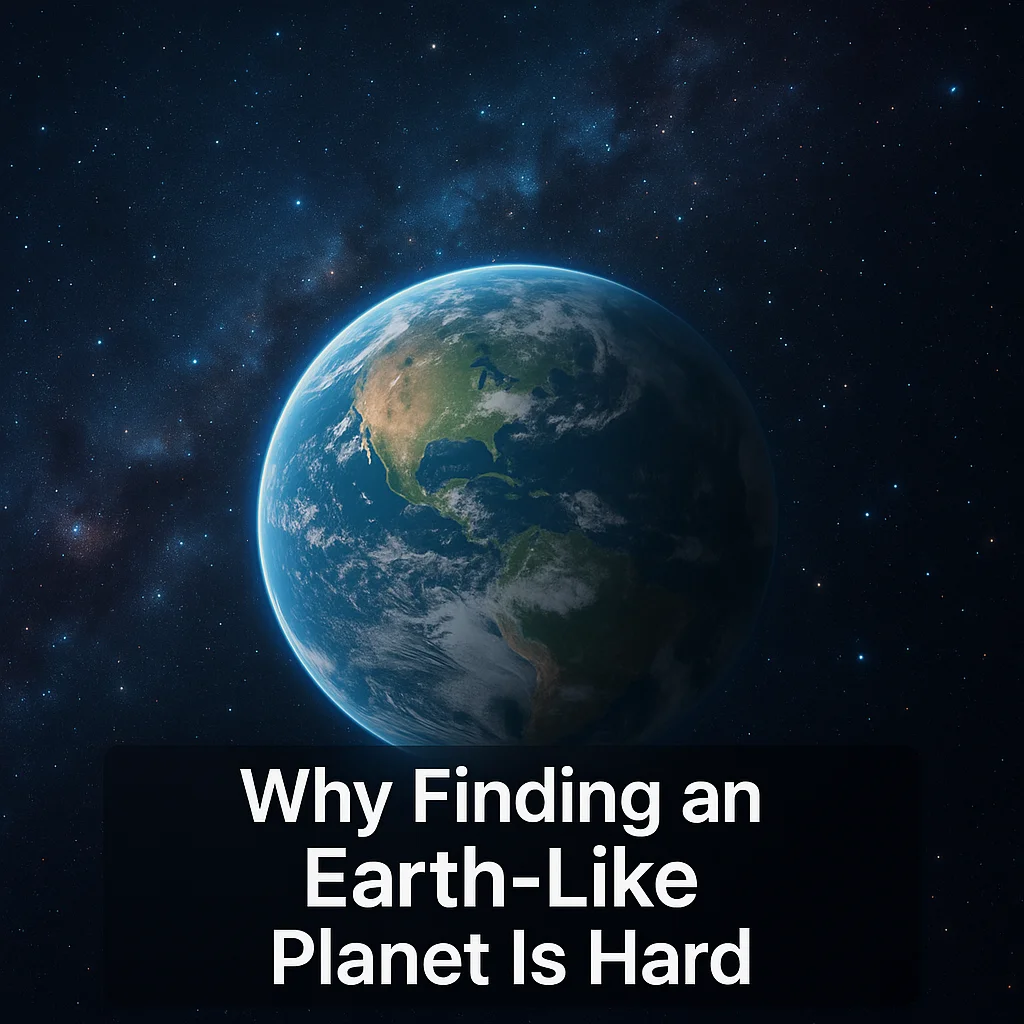
Terrestrial planets are primarily composed of rock and metal, and understanding what makes them Earth-like involves looking at several factors like atmosphere, surface conditions, and distance from their respective stars. In this article, we'll explore why discovering these planets is a complex task and what makes them stand out.
As you delve deeper, you will learn where these planets might be located, how scientists determine their characteristics, and why it's not as simple as finding any planet in the universe.
📍 Where It Is and How Far Away
Earth-like planets can potentially exist in any star system, but they are ideally located within a region known as the habitable zone. This is the area around a star where conditions might be right for liquid water to exist, a crucial factor for life as we know it. Distances in space are often measured in Astronomical Units (AU), with 1 AU representing the average distance from the Earth to the Sun.
The habitable zone is sometimes called the "Goldilocks Zone" because it's not too hot and not too cold. The actual distance of this zone varies depending on the star's luminosity and size. If a planet is too close to its star, it may suffer from extreme heat, while those too far may be too cold, much like the differing climate conditions on Venus and Mars compared to Earth.
Light years are another common measurement used in discussing distant planets. One light year is the distance that light travels in one year. Many of the potentially Earth-like planets discovered so far are dozens to hundreds of light years away from us, making the task of exploration daunting yet fascinating.
🧱 Size, Mass, and Gravity (Made Simple)
When considering Earth-like planets, size and mass play crucial roles. These planets are usually comparable in diameter and mass to Earth. Too small, and they might not have enough gravitational pull to hold an atmosphere; too large, they may turn into gas giants.
Gravity on Earth is what gives us weight. On Earth-like planets, surface gravity depends on their mass and size. If a planet is similar in mass to Earth but larger in size, its gravity might be weaker. Conversely, a smaller but denser planet may have stronger gravity.
On Earth-like planets without a significant atmosphere, you might feel lighter or heavier depending on the planet's gravity. This difference influences everything from how high we could jump to how our bodies function over long periods of time.
🌡️ Atmosphere and Weather
The atmosphere of an Earth-like planet is crucial in determining its potential habitability. It typically consists of a mixture of gases, including oxygen, nitrogen, and carbon dioxide, which support life and climate stability. Atmosphere influences weather patterns and protects the planet from harmful solar radiation.
Weather on an Earth-like planet could be vastly different from what we experience on Earth. Factors such as rotation speed, tilt, and the presence of water can create diverse weather systems, from calm seas to violent storms. Scientists closely examine these atmospheric conditions when evaluating a planet's habitability.
The chemical composition of the atmosphere reveals much about the potential for life. A balance of greenhouse gases can stabilize temperatures, while clouds and rain can help sustain vital water cycles.
🪨 Surface and Interior
Earth-like planets feature rocky surfaces with varied terrain, including mountains, valleys, and possibly even oceans. Surface features are often shaped by geological activities such as tectonic shifts, volcanic eruptions, and meteor impacts.
Looking beneath the surface, these planets might have a layered interior similar to Earth's, with a crust, mantle, and core. The dynamics of these layers can lead to phenomena like earthquakes and magnetic fields.
Understanding the surface and interior of Earth-like planets helps us assess their potential for supporting life, especially if they have plate tectonics, which can regulate carbon dioxide and maintain temperatures suitable for living organisms.
🌀 Rotation, Orbit, and Seasons
The rotation of Earth-like planets, or how they spin on their axis, determines the length of a day. An Earth-like planet that rotates too slowly might experience extreme temperature differences between day and night, while rapid rotation can create intense weather patterns.
Orbiting their star, these planets have years that correspond to the time it takes to complete one full circuit. The shape of their orbit can affect seasonality; those with eccentric orbits might face dramatic climate changes.
Axial tilt, like Earth's 23.5 degrees, is responsible for seasons. Without a tilt, a planet might not experience diverse seasons, affecting ecosystems and weather stability.
🧲 Magnetic Field and Radiation
A magnetic field serves as a protective shield, safeguarding Earth-like planets from harmful cosmic radiation. Generated by the movement of molten elements in the core, it also causes phenomena like auroras.
Radiation belts around a planet affect space weather and can pose hazards to spacecraft and satellites. For Earth-like planets, a strong magnetic field helps preserve the atmosphere, essential for sustaining life.
The presence and strength of a magnetic field are crucial in evaluating how vulnerable a planet is to solar and cosmic radiation, which in turn affects its habitability and potential for hosting life.
🌙 Moons, Rings, and Neighbors
Some Earth-like planets may have moons, which can influence climates and tides. The gravitational interaction between a planet and its moon can stabilize a planet’s rotation, contributing to climatic stability.
While rings might not be common for Earth-sized planets, they add complexity to the planet's system, affecting its gravitational dynamics and offering insights into the planet's history.
The neighborhood around an Earth-like planet includes other celestial bodies and debris. Their presence and interactions help to understand planetary formation and evolution.
🔭 How We Know (Missions and Observations)
Telescopes and space missions play key roles in discovering Earth-like planets. Ground-based telescopes can monitor a star's brightness for signs of transiting planets, while space-based telescopes offer clearer, more detailed views.
Missions like Kepler and TESS have been instrumental in identifying candidates for Earth-like planets. They gather data through various methods, including measuring light and electromagnetic spectra.
Spacecraft provide close-up observations, collecting data on atmospheres, magnetic fields, and surface conditions. Together, these approaches advance our understanding and refine our search methodologies.
❓ Common Questions and Misconceptions
Is it a star? No, Earth-like planets are not stars; they are rocky bodies orbiting stars.
Can you stand on it? On rocky Earth-like planets, yes, if they have a solid surface layer. Gas planets, no.
Is it habitable? Not necessarily. Earth-like doesn't guarantee life-sustaining conditions; many factors influence habitability.
Why is it that color? A planet's color may reflect its atmospheric composition or surface materials.
Does it have rings? Some planet types may have them, but Earth-like ones generally do not.
How do you find them? Through telescopes observing transits and changes in brightness, assisted by space missions.
Are they rare? They are unusual but not exceedingly rare; we continue discovering new candidates.
How do scientists know it's Earth-like? By studying its size, distance from the star, and atmospheric composition.
📌 Summary
- Earth-like planets are rocky planets, sharing similarities with Earth.
- They are located within habitable zones around their stars.
- Comparable size and mass influence their gravity and atmospheric retention.
- Atmospheres are crucial for climate stability and potential life support.
- Surfaces may feature diverse terrains shaped by geological activities.
- Rotation and orbit affect day length and seasonal variations.
- Magnetic fields protect from radiation and solar winds.
- May have moons, which influence tides and rotation stability.
- Discovered through advanced telescopes and dedicated space missions.
- While similar to Earth, not all support life; factors vary widely.