🪐 Exoplanet Atmospheres: How We Study Them
🌌 What It Is
Exoplanets are planets located outside our Solar System. They orbit stars just like Earth orbits the Sun. Scientists study exoplanets to learn about the diversity of planets in the universe.
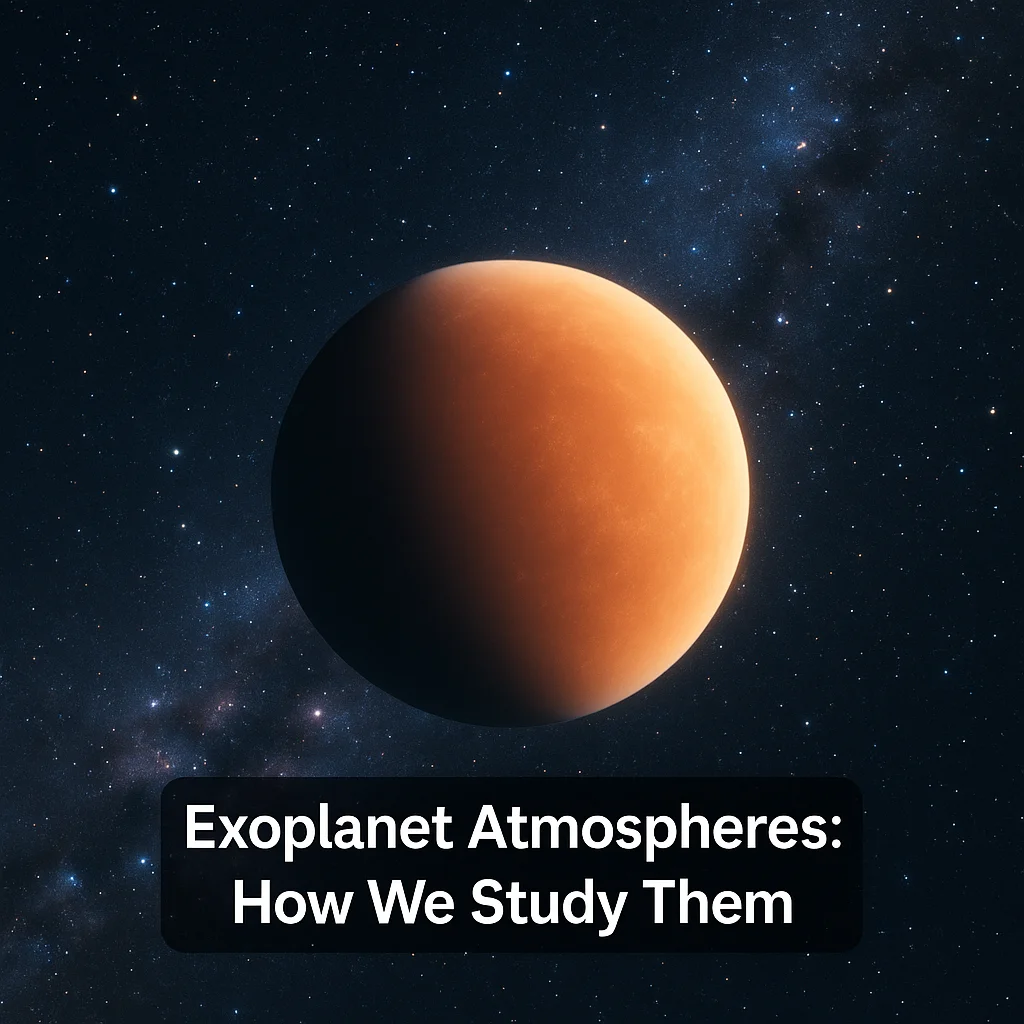
An exoplanet's atmosphere is the layer of gases that surrounds it, similar to Earth's atmosphere which contains air and clouds. The study of these atmospheres helps scientists understand the composition, climate, and potential habitability of these distant worlds.
This article will introduce you to the basics of what exoplanet atmospheres are, how we study them, and why they are important in our quest to understand the universe.
📍 Where It Is and How Far Away
Exoplanets are located beyond our Solar System, orbiting stars in the Milky Way galaxy and sometimes in other galaxies. The nearest known exoplanets are approximately 4 light-years away, orbiting the star Proxima Centauri.
To put this into perspective, a light-year is the distance light travels in one year, which is about 5.88 trillion miles (or 9.46 trillion kilometers). This means exoplanets can be incredibly far from us, making direct study challenging.
Their position in space means they receive varying amounts of sunlight depending on their distance from their host star. This affects their temperature and potential weather patterns.
🧱 Size, Mass, and Gravity (Made Simple)
Exoplanets vary widely in size and mass. Some are small and rocky like Earth, known as terrestrial planets, while others are enormous gas giants like Jupiter. The size and mass of an exoplanet influence its gravity, which in turn affects the thickness of its atmosphere.
Gravity influences whether a planet can hold onto its atmosphere. On smaller planets with weaker gravity, gases can escape into space more easily, whereas larger planets can retain thicker atmospheres.
On a rocky exoplanet with gravity like Earth's, you would "feel" your weight much like you do on Earth. On a gas giant, there is no solid surface to stand on, so the concept of gravity feels different—more about being pulled towards the core amidst thick layers of gas.
🌡️ Atmosphere and Weather
The composition of an exoplanet's atmosphere can include gases such as hydrogen, helium, carbon dioxide, and methane. These components vary based on the planet's distance from its star and its overall makeup.
Weather on exoplanets can be extreme. Some may have winds faster than the strongest earthly hurricanes or clouds made of iron. These variations result from the interaction of sunlight with the planet's atmosphere, its rotation speed, and chemical reactions.
For instance, a planet close to its star might have super-heated atmospheres, promoting violent winds and massive storms, while those further away might be cooler and more stable.
🪨 Surface and Interior
Rocky exoplanets can have diverse surfaces shaped by impacts, tectonics, and volcanoes—much like Earth or Mars. The presence of liquid, like lava or potentially water, can also sculpt these surfaces.
On gas giants, there isn't a traditional solid surface. Instead, these planets have layers of gases that transition into a liquid-like state at great depths. At the core, it's believed there might be a solid core of rock or metal.
The interiors of exoplanets are challenging to study directly, but scientists use models based on their size and mass to predict what they might be like.
🌀 Rotation, Orbit, and Seasons
Exoplanets rotate on their axes, creating day and night cycles, and they orbit their stars, defining their "year". The length of a day or a year varies widely from planet to planet.
The tilt of an exoplanet's axis relative to its orbit can create seasons, similar to how Earth's axial tilt causes winter and summer. Planets with extreme tilts may experience severe seasonal changes, while others with minimal tilt have uniform climates.
Some exoplanets may even have retrograde rotation, which means they spin in the opposite direction to their orbit, creating unique climate dynamics.
🧲 Magnetic Field and Radiation
A magnetic field is an invisible shield that protects a planet's atmosphere from solar and cosmic radiation. Earth's magnetic field creates phenomena like auroras and helps to sustain life.
Exoplanets with strong magnetic fields are better at retaining their atmospheres, which is crucial for protecting potential life forms from harmful radiation.
Radiation belts, similar to Earth's Van Allen belts, can form around planets, trapping charged particles. These are of interest as they affect spacecraft and atmospheric conditions.
🌙 Moons, Rings, and Neighbors
Some exoplanets have moons or ring systems, much like the planets in our Solar System. These natural satellites can provide valuable insights into the planet's history and dynamics.
Gravity plays a key role in these systems. Moons can affect tides and resonate with the planet's orbit, sometimes even stabilizing the planet's axial tilt, contributing to a stable climate.
If an exoplanet lacks moons or rings, this can also be informative, indicating aspects of its formation and evolutionary history.
🔭 How We Know (Missions and Observations)
We study exoplanets using telescopes and spacecraft. Ground-based and space telescopes capture images and spectra, which are used to infer atmospheric compositions and other properties.
Famous missions like the Kepler Space Telescope and the James Webb Space Telescope have significantly increased our understanding by finding thousands of exoplanets and analyzing their atmospheres.
Data collected from these missions help scientists determine the size, composition, temperature, and potential habitability of exoplanets.
❓ Common Questions and Misconceptions
Many people wonder: "Are exoplanets stars?" No, they're planets orbiting stars, not producing their own light like stars do.
"Can you stand on an exoplanet?" It depends on whether the exoplanet has a solid surface. Gas giants and some ice giants lack a traditional surface.
"Are all exoplanets habitable?" Few may have conditions suitable for life as we know it, with many having environments far more extreme than Earth.
"Why is an exoplanet a particular color?" The color depends on the atmospheric composition and how it reflects or absorbs light from its star.
"Do exoplanets have weather?" Yes, dramatically different from Earth's, with possible high winds and extreme temperatures.
"Why are exoplanets important to study?" Understanding exoplanets helps us learn about planetary systems' diversity and potential for life beyond Earth.
📌 Summary
- Exoplanets are planets outside our Solar System, orbiting other stars.
- They are located interstellar distances away, measured in light-years.
- Sizes range from small, rocky bodies like Earth to large gas giants.
- Atmospheres vary but can have dramatic effects on climate and surface conditions.
- Rocky exoplanets have diverse surfaces, while gas giants feature deep layers of gases.
- Day lengths and years vary widely, influenced by rotation and orbit.
- Magnetic fields, where present, protect atmospheres from radiation.
- Some exoplanets have moons or rings, affecting planetary dynamics and stability.
- Observations come from telescopes and missions like Kepler and James Webb.
- Exoplanets offer insights into planetary diversity and life's potential in the universe.