🪐 Super-Earths Explained
🌌 What It Is
Super-Earths are a type of exoplanet, which are planets located outside our Solar System. These planets are generally larger than Earth but smaller than ice giants like Neptune and Uranus. Despite their name, super-Earths do not necessarily have conditions similar to Earth; they can be rocky like Earth or composed of gases.
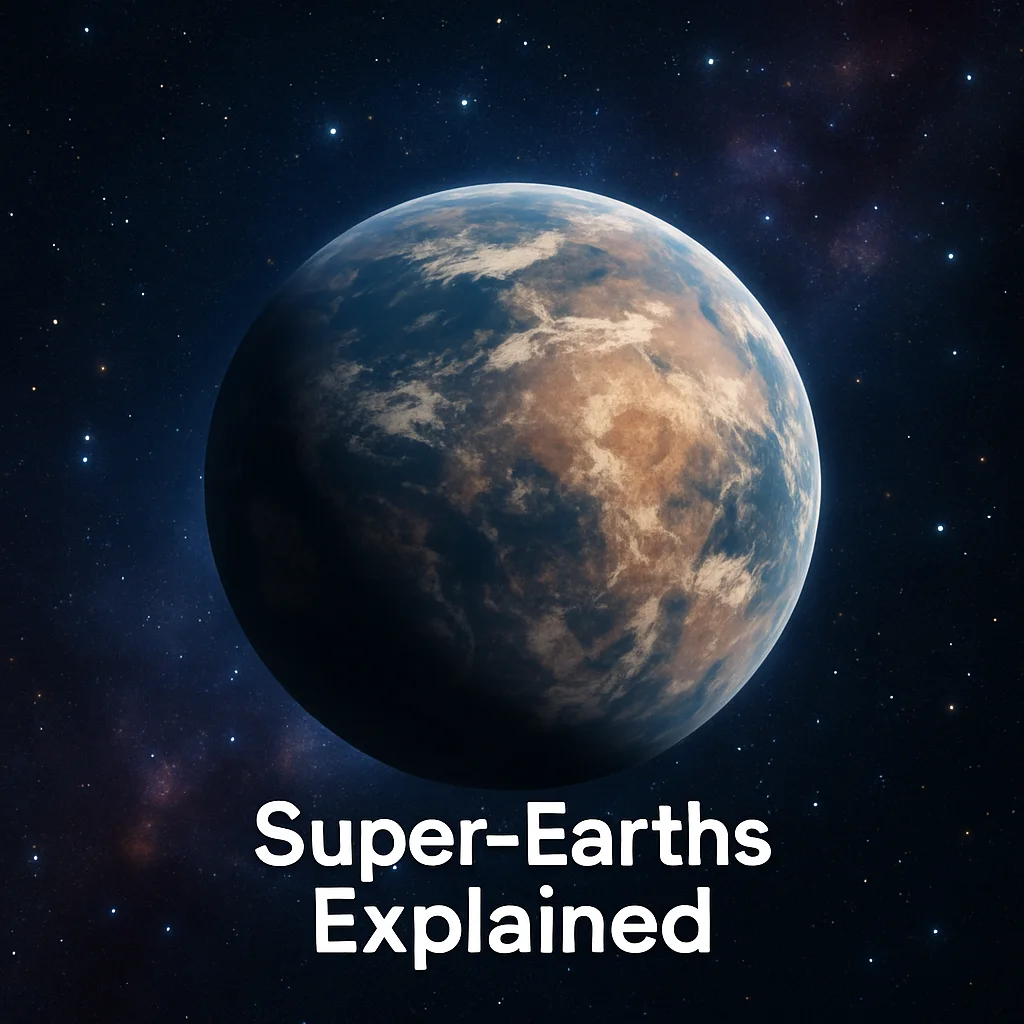
The term "super-Earth" refers primarily to the mass of the planet. These worlds are typically between one to ten times the mass of Earth. By planetary classification, they can be considered terrestrial or gas planets, depending on their composition and atmospheric characteristics.
In this article, you will learn what super-Earths are, where they are located in our galaxy, their physical characteristics, and how scientists observe them. We'll also explore common questions and misconceptions about these fascinating planets.
📍 Where It Is and How Far Away
Super-Earths can be found throughout our galaxy. They do not belong to our Solar System but orbit other stars as exoplanets. The nearest planetary systems containing super-Earths can be many light-years away from us. For instance, Proxima Centauri b is one of the closest known exoplanets at just over four light-years from Earth.
Distances to super-Earths are often measured in light-years, with one light-year being the distance light travels in one year. This is equivalent to about 5.88 trillion miles or 9.46 trillion kilometers. In comparison, the average distance from Earth to the Sun, called an Astronomical Unit (AU), is about 93 million miles or 150 million kilometers.
The position of a super-Earth in its solar system can greatly impact its environmental conditions, such as sunlight and temperature. Planets located in the habitable zone, where liquid water might exist, are of particular interest to scientists looking for potential life-sustaining conditions.
🧱 Size, Mass, and Gravity (Made Simple)
The size of a super-Earth varies, but generally, these planets are larger than Earth. They can have diameters up to twice that of Earth, and because they are more massive, they usually have stronger gravitational pull. However, the gravity on a super-Earth's surface would depend on both its size and mass.
For instance, a planet twice the size of Earth might feel much heavier due to increased gravity. If you weigh 100 pounds on Earth, you could weigh significantly more on a super-Earth. However, a person’s experience of gravity would also depend on the planet's composition.
If a super-Earth has no solid surface, it affects how gravity is perceived. You can't stand on its surface like Earth or Mars. Instead, you would descend through its gaseous atmosphere and potentially reach a dense core or mantle, where immense pressure and gravity come into play.
🌡️ Atmosphere and Weather
A super-Earth's atmosphere can consist of various gases, such as hydrogen, helium, and possible traces of other elements. The composition affects the planet's climate and weather patterns. Some super-Earths may have thick cloud layers and intense storms.
Weather on super-Earths can vary drastically based on their position in the solar system, axial tilt, and atmospheric makeup. Planets closer to their star might experience higher temperatures and harsh winds, while those farther away might have cool, temperate climates.
The weather is driven by sunlight, the planet's rotation, and chemical composition. Atmospheric dynamics, including convection currents and global circulation patterns, can create diverse weather patterns, from calm atmospheres to volatile storms.
🪨 Surface and Interior
Super-Earths with rocky surfaces could have various features, like mountains, valleys, craters, and possibly volcanoes, shaped by geological processes. Factors such as tectonic activity could continuously reshape their surfaces.
For gaseous super-Earths, their interiors are layered like gas giants in our own Solar System. There may be a transition from gas to liquid or a rocky core. Without a clear surface, these super-Earths resemble more miniature versions of Neptune, with atmospheres blending into their interiors.
The interiors of super-Earths, whether rocky or gaseous, involve complex layers, potentially including a solid core surrounded by silicate, metal, or other materials. Studying these layers helps scientists understand their compositions and histories.
🌀 Rotation, Orbit, and Seasons
A super-Earth's rotation period, or "day," could range from a few hours to several days, varying widely. Its orbit period, or "year," might also differ greatly depending on its distance from its star, much like the varying lengths of a day and year on different planets in our own Solar System.
Axial tilt can influence a super-Earth's seasons. A significant tilt could mean more pronounced seasons, while a minimal tilt might result in a more stable climate year-round.
Some super-Earths may exhibit retrograde rotation, rotating in the opposite direction to their orbit around the star. This could affect weather patterns and atmospheric dynamics, adding complexity to the climate system observed on these planets.
🧲 Magnetic Field and Radiation
Many super-Earths may possess magnetic fields, generated by movements in their molten cores. These fields play a crucial role in protecting the planet from solar and cosmic radiation, much like Earth’s magnetic field shields us.
Magnetic fields can give rise to auroras when charged solar particles interact with a planet's atmosphere. Radiation belts formed by trapped particles could also impact any nearby satellites or spacecraft.
An understanding of magnetic fields and radiation is important for assessing the habitability of super-Earths. Effective fields could mean better protection from harmful space radiation, which is a key consideration for potential life.
🌙 Moons, Rings, and Neighbors
Super-Earths might host moons, though detecting these satellites across light-years is still challenging. Their presence could affect tidal forces and geological activity, similar to how Earth's moon influences tides.
If a super-Earth has a ring system, it would likely be composed of rock and ice, though observing rings demands advanced techniques. A planet's gravitational pull might trap debris in orbit, forming spectacular ring systems.
The presence of neighboring planets within the same system can create gravitational influences, possibly stabilizing or destabilizing the orbits of super-Earths. Studying these interactions helps scientists learn more about planet formation and system dynamics.
🔭 How We Know (Missions and Observations)
Scientists study super-Earths using telescopes and spacecraft. Telescopes measure light, spectra, and direct imaging to learn about a planet’s atmosphere and orbital characteristics. Ground-based and space telescopes like Hubble and the upcoming James Webb Space Telescope contribute significantly to this research.
While no spacecraft have visited super-Earths yet, missions to distant worlds within our Solar System provide valuable data applicable to exoplanet studies. Comparative planetology helps bridge the knowledge gap between our Solar System and distant planetary systems.
Data from these observations, such as images and spectroscopic analysis, offer insights into atmospheric composition, surface temperatures, and potential signs of water or biological activity through biosignatures.
❓ Common Questions and Misconceptions
Q: Is a super-Earth a star? No, super-Earths are planets, not stars. They do not emit their own light but rather reflect the light of their companion star.
Q: Can you stand on it? Some super-Earths have solid surfaces allowing one to stand, but others are gaseous with no clear surface.
Q: Is it habitable? Not all super-Earths are habitable; this depends on their atmosphere, surface conditions, and distance from their star.
Q: Why is it that color? A super-Earth’s color is influenced by its atmosphere, surface, and how sunlight interacts with them.
Q: Is it bigger than Jupiter? Super-Earths are smaller than Jupiter, falling between Earth and Neptune in size.
Q: Do they have rings? Some might have ring systems, though detecting them requires advanced technology.
Q: Are they common? Yes, super-Earths are relatively common in the galaxy, found frequently around other stars.
Q: Do they have water? Some super-Earths may have water, especially if located in the habitable zone, but direct evidence is sparse.
Q: How are they discovered? Super-Earths are mainly discovered via transit observations and radial velocity measurements.
Q: Can we visit them? Traveling to super-Earths isn't possible with current technology, as they are light-years away from us.
📌 Summary
- Super-Earths are exoplanets larger than Earth but smaller than Neptune.
- Located outside our Solar System, they orbit other stars.
- They can be more massive, with stronger surface gravity than Earth.
- Atmospheres may vary, leading to diverse weather patterns.
- Rocky surfaces could feature mountains and valleys, while gaseous varieties lack a solid surface.
- Rotation and orbit periods vary, impacting potential seasons.
- Some have magnetic fields, shielding against harmful space radiation.
- Moons or rings, if present, influence dynamics; interactions with neighbors help stabilize orbits.
- Discovered through telescopes and missions, studying them reveals more about exoplanetary systems.
- Super-Earths are common, with potential for water if in the habitable zone.