🪐 Moon Phases Explained Simply
🌌 What It Is
The Moon is Earth's natural satellite, orbiting our planet and exhibiting various phases as it reflects sunlight. These phases are a cycle of appearances, from new moon to full moon and back, controlled by the Moon's position relative to Earth and the Sun.
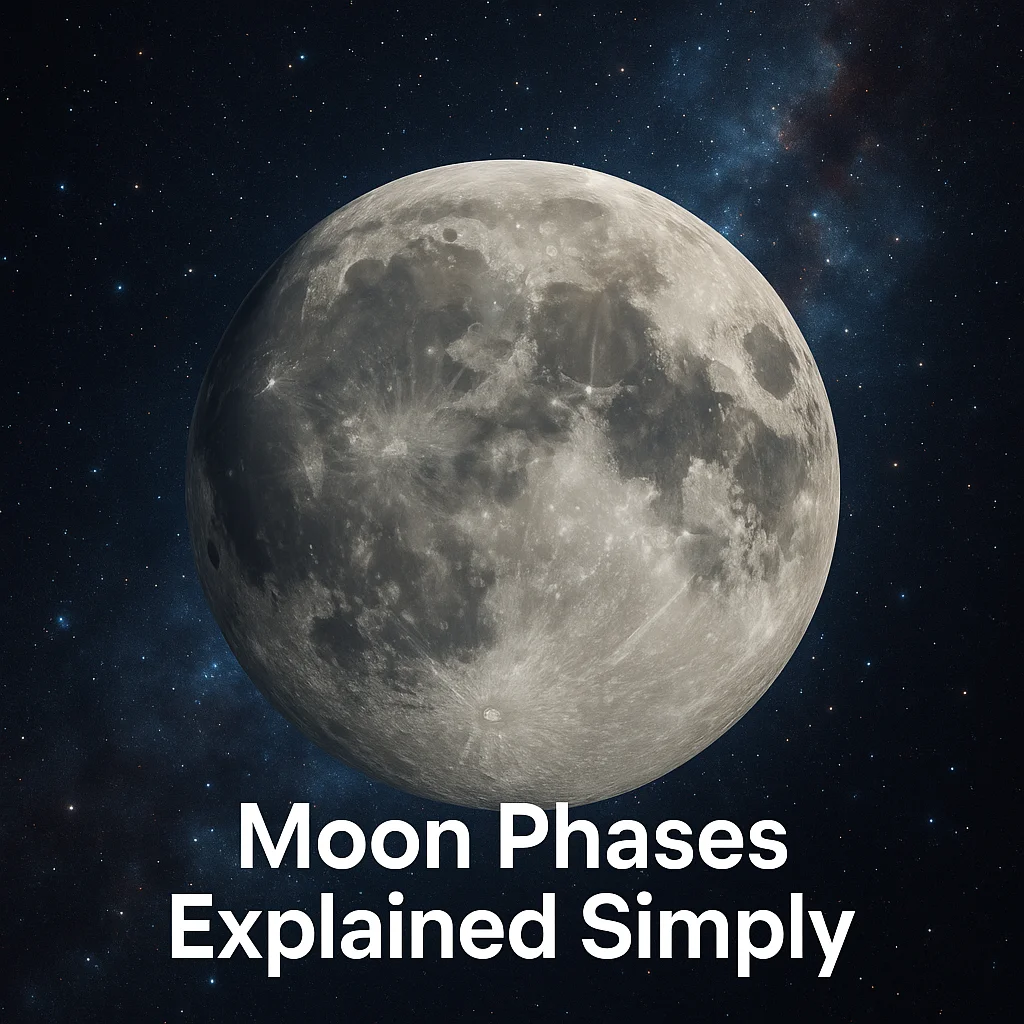
Understanding the Moon's phases helps us comprehend how sunlight illuminations change due to its movement. As it orbits Earth, different parts of it become lit by the Sun, leading to the visible phases we observe from our position on Earth.
This article will guide you through the fascinating journey of the Moon's phases, introducing key ideas like waxing, waning, and the lunar cycle. By the end, you'll have a clearer picture of how and why the Moon appears as it does in the night sky.
📍 Where It Is and How Far Away
The Moon resides in close proximity to Earth, making it the closest large celestial body to us. It orbits at an average distance of about 384,000 kilometers (239,000 miles), which is roughly equivalent to 30 times the diameter of Earth.
Despite this seemingly vast distance, the Moon is close enough that its gravitational influence affects Earth's tides. Its orbit is not a perfect circle but slightly elliptical, causing variations in its distance during its orbit.
This positioning plays a crucial role in the Moon phases, as we observe different portions of its surface illuminated by the Sun at various angles during its 27.3-day orbit around Earth.
🧱 Size, Mass, and Gravity (Made Simple)
The Moon is much smaller than Earth, with a diameter of about 3,474 kilometers (2,159 miles). To visualize, if Earth were the size of a basketball, the Moon would be like a tennis ball.
Despite its smaller size, it has a significant gravitational force—about one-sixth that of Earth's. This means if you weigh 60 kg (132 lbs) on Earth, you would weigh only 10 kg (22 lbs) on the Moon.
The reduced gravity means that moving and jumping are much easier on the Moon, which is evident from videos of astronauts bounding across its surface during their missions.
🌡️ Atmosphere and Weather
The Moon has an extremely thin atmosphere, known as an exosphere. Unlike Earth's atmosphere, the Moon's contains no air or weather patterns. It lacks the necessary elements to support life as we know it.
Without a substantial atmosphere to retain heat, temperatures on the Moon vary dramatically. Daytime temperatures can soar as high as 127°C (260°F), while at night, they can plummet to -173°C (-280°F).
This stark temperature contrast is due to the lack of a moderating atmosphere, which on Earth, redistributes heat through wind and weather patterns, preventing such extremes.
🪨 Surface and Interior
The Moon's surface is covered with craters, due to impacts from asteroids and comets over millions of years. Its landscape is also characterized by plains called maria, formed from ancient lava flows.
Below the surface, the Moon's structure consists of a crust, a mantle, and a small core. Unlike Earth, the Moon does not have active tectonic plates or significant volcanic activity.
The absence of substantial geological activity means that the features we see today, including the famous craters, have remained relatively unchanged for billions of years.
🌀 Rotation, Orbit, and Seasons
The Moon takes approximately 27.3 days to complete one full orbit around Earth and an equal time to rotate once on its axis. This synchronous rotation means we always see the same side of the Moon—known as the near side.
Because it rotates and orbits at the same rate, there are no traditional seasons on the Moon. Its axial tilt is only about 1.5 degrees, compared to Earth's 23.5 degrees, so the Sun's angle does not shift much throughout its orbit.
The concept of days and nights on the Moon differs significantly from Earth. Each "day" on the Moon lasts about 14 Earth days, followed by a "night" of equal length.
🧲 Magnetic Field and Radiation
The Moon does not have a global magnetic field like Earth, but some regions of its surface are magnetized. These localized fields are due to past geological events and are weak compared to Earth's field.
Without a significant magnetic field or atmosphere, the Moon is exposed to solar and cosmic radiation. This affects the surface and potential considerations for future human habitation.
Spacecraft and technology designed to operate on or near the Moon must be equipped to handle this radiation to avoid damage and ensure successful missions.
🌙 Moons, Rings, and Neighbors
The Moon does not have any smaller moons or a ring system like some other planets. It is a singular entity orbiting Earth, making it a singular focal point for study and exploration.
Gravitational interactions between Earth and the Moon result in noticeable tidal effects on Earth, influencing oceanic tides and even slightly affecting Earth's rotation over time.
This unique Earth-Moon relationship is an excellent example of gravitational forces at work, demonstrating the complex dance between celestial bodies in space.
🔭 How We Know (Missions and Observations)
Our understanding of the Moon has been enhanced through telescopic observations and missions such as the Apollo landings, which provided a wealth of information about its surface and composition.
Telescopes from Earth have allowed scientists to observe its phases and surface features, while missions have given us valuable samples and data directly from the Moon itself.
Data collected includes images, rock samples, and scientific measurements, all contributing to our understanding of its history and evolution.
❓ Common Questions and Misconceptions
A common question is whether the Moon is a star. It is not; it is a rocky satellite reflecting sunlight.
Can you stand on the Moon? Yes, its solid surface allows walking, as demonstrated by astronauts.
Is the Moon habitable? While intriguing, it's inhospitable due to lack of atmosphere and extreme temperatures.
Why does the Moon appear to change shape? This is due to its phases, caused by the angle of sunlight.
Can the Moon glow on its own? It cannot; it only reflects the Sun's light.
Why do we see only one side? The Moon's synchronized orbit ensures one face is constantly visible.
Is a "dark side" always dark? No, the far side receives sunlight, but we never see it from Earth.
📌 Summary
- The Moon is Earth's natural satellite, reflecting sunlight as it orbits.
- Located close to Earth, it orbits at about 384,000 kilometers away.
- Smaller than Earth, with 1/6th its gravity, making it lightweight.
- No atmosphere or weather, causing extreme temperature fluctuations.
- Characterized by craters and maria, with little geological activity.
- Rotates in synchrony with Earth, showing the same face always.
- No global magnetic field, exposed to cosmic and solar radiation.
- No moons or rings, affects Earth through tidal interactions.
- Explored through telescopes and missions like Apollo, enhancing knowledge.
- Interesting fact: it has no "dark side"; all regions experience sunlight.