🪐 The Moon’s Surface: Maria and Highlands
🌌 What It Is
The Moon, Earth's natural satellite, is a fascinating celestial object that people have gazed at for centuries. It's an essential part of our Solar System and orbits our planet, illuminating the night sky. The Moon's unique surface features, such as maria and highlands, offer intriguing insights into its history and formation.
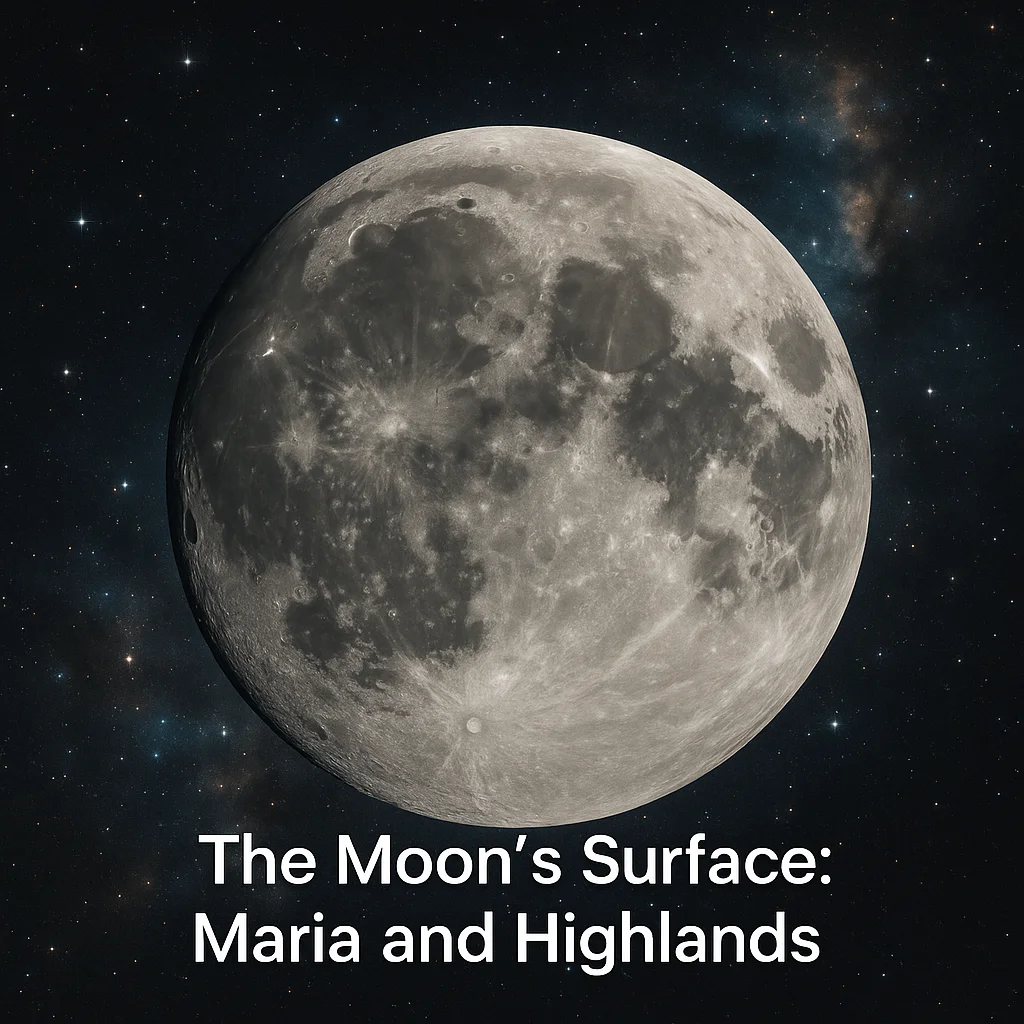
In this article, we will explore the characteristics of the Moon's surface, focusing on the maria (large, dark, basaltic plains) and highlands (light-colored, mountainous regions). We aim to provide a beginner-friendly understanding of how these features were formed and what makes them so special.
As with other celestial bodies, understanding the Moon's surface involves studying its composition and the processes that have shaped its landscape. By the end of this article, you'll have a clearer picture of how maria and highlands contribute to the Moon's distinct appearance and the scientific stories they tell.
📍 Where It Is and How Far Away
The Moon is Earth's closest celestial neighbor, orbiting our planet at an average distance of about 384,400 kilometers (approximately 238,855 miles). Although this distance can vary slightly due to its elliptical orbit, it remains the most accessible astronomical object for study.
For perspective, this distance is roughly 30 times the diameter of Earth. Light takes about 1.28 seconds to travel from the Moon to Earth. Its proximity means that the Moon significantly affects Earth's tides and is easily observable with the naked eye.
The Moon's position in relation to the Sun influences the phases we see from Earth, such as new moon, full moon, and the various crescent stages. Without a substantial atmosphere, it also experiences extreme temperature variations, ranging from scorching sunlight to freezing darkness.
🧱 Size, Mass, and Gravity (Made Simple)
The Moon is about 3,474 kilometers (approximately 2,159 miles) in diameter, making it the fifth-largest satellite in the Solar System. Its mass is around 7.35 x 10^22 kilograms, much smaller compared to Earth. Despite its size, it still exerts a noticeable gravitational pull on our planet.
Gravity on the Moon is roughly one-sixth that of Earth's. This means that a person weighing 60 kilograms (about 132 pounds) on Earth would weigh only 10 kilograms (about 22 pounds) on the Moon. This reduced gravity not only affects future lunar exploration plans but also plays a role in the formation of the Moon's surface features.
The Moon's lack of atmosphere allows for a closer examination of its gravity's impact, which contributes to the distinct characteristics between the maria and highlands, as gravity influences the distribution and movement of materials on its surface.
🌡️ Atmosphere and Weather
The Moon lacks a substantial atmosphere, often described as a vacuum. This means there are no weather patterns like those found on Earth. The ultra-thin layer that exists contains trace gases like helium and neon, but it's so tenuous that traditional weather does not occur.
Without an atmosphere to distribute heat, temperatures on the Moon's surface vary drastically between day and night. In sunlight, temperatures can reach as high as 127 degrees Celsius (260 degrees Fahrenheit), while in darkness, they can plummet to minus 173 degrees Celsius (minus 280 degrees Fahrenheit).
These extreme temperature fluctuations have significant implications for both the surface and any potential future human habitation. The absence of weather and erosion processes also means that the lunar landscape remains relatively unchanged over long periods, preserving its ancient features.
🪨 Surface and Interior
The Moon's surface is an archive of its history, marked by craters, large dark plains, and bright highland regions. Maria, the dark, flat areas, were formed by ancient volcanic activity. Scientists believe these lava flows occurred due to the Moon's early volcanic activity, which gradually filled large basins.
Mare (singular for maria) appears less cratered, as these volcanic plains are younger than the more heavily cratered highlands. Highlands are the lighter-colored, mountainous regions surrounding the maria, composed mostly of anorthosite rock, which is rich in a mineral called plagioclase.
While the surface layer preserves the stories of impacts and volcanic activities, the Moon's interior is thought to be composed of a small core, a mantle, and a crust. Understanding these layers helps scientists learn more about its geologic past and how its features came to be.
🌀 Rotation, Orbit, and Seasons
The Moon takes about 27.3 days to complete one orbit around Earth and the same amount of time to rotate once on its axis. This synchronous rotation is why we always see the same side of the Moon from Earth.
While Earth experiences distinct seasons due to its axial tilt, the Moon doesn't have significant seasons. Its axial tilt is only about 1.5 degrees, resulting in a lack of substantial seasonal variation. The concept of a "moon year" aligns with its orbit, but without atmosphere or seasonal changes, the experience is starkly different from Earth.
Occasionally, the Moon's slightly elliptical orbit can lead to phenomena such as lunar eclipses and varying apparent sizes in the sky, which captivate both amateur astronomers and researchers alike.
🧲 Magnetic Field and Radiation
Unlike Earth, the Moon does not have a global magnetic field. However, scientists have detected small, localized magnetic fields in certain lunar regions. These patches are remnants of an ancient lunar dynamo that may have occurred billions of years ago.
Due to the lack of a strong magnetic field, the Moon is more exposed to cosmic radiation and solar wind. This radiation exposure is an important consideration for planning future lunar missions and ensuring the safety of astronauts.
The intermittent magnetic regions can cause interactions with solar wind particles, creating small-scale features similar to miniature auroras, though they differ greatly from those seen on Earth.
🌙 Moons, Rings, and Neighbors
The Moon is Earth's only natural satellite and does not have any moons of its own. There are no ring systems similar to those seen around planets like Saturn. Its solitary existence has intrigued humanity for millennia, serving as a constant companion in our sky.
The gravitational relationship between Earth and the Moon is evident in Earth's tides, caused by the Moon's pull on our oceans. This interaction is a fascinating example of gravitational influences between celestial bodies, highlighting the importance of the Moon in our daily life.
Despite being without neighbors in the form of secondary moons or rings, the Moon's singular presence provides abundant opportunities for scientific study and exploration.
🔭 How We Know (Missions and Observations)
Our understanding of the Moon has been greatly enhanced by a combination of telescopic observations and space missions. Telescopes provide valuable surface details from Earth, while spacecraft offer in-depth analysis by traveling to and orbiting the Moon.
Famous missions like NASA's Apollo program provided groundbreaking data by landing astronauts on the Moon's surface, enabling them to collect samples and conduct experiments. Luna, a series of Soviet missions, and more recent robotic missions, continue to deepen our knowledge.
Data collected from these missions include images, rock samples, and measurements of gravity and magnetic fields. This wealth of information allows scientists to piece together the Moon's history and ongoing processes with increasing accuracy.
❓ Common Questions and Misconceptions
A common question is whether the Moon is a planet; it's not, as it orbits Earth and not the Sun directly. Some wonder if you can stand on the Moon, and the answer is yes, though only with the help of a space suit due to a lack of atmosphere.
People often ask if the Moon is habitable. While it doesn't have life-sustaining conditions, its resources might support future lunar bases. Queries about its color during certain events, like eclipses, are frequent; the reddish hue is caused by Earth's atmosphere filtering sunlight.
Some misconceptions involve the belief that the Moon has its own light. It actually reflects sunlight. Others think it's untouchably distant. Despite this seeming vastness, it's the most reachable celestial body for human exploration.
A persistent myth is that of a "dark side" of the Moon. All sides receive sunlight at different times due to its orbit; it remains "dark" only to Earth-bound viewers.
📌 Summary
- The Moon is Earth's natural satellite, featuring maria and highlands.
- It orbits about 384,400 kilometers from Earth, affecting tides and lighting up the night sky.
- Less massive than Earth, with gravity causing a weight reduction effect of one-sixth.
- The Moon lacks a significant atmosphere, leading to extreme temperature changes.
- Surface features include dark maria formed by lava and bright highlands abundant in craters.
- It takes roughly 27.3 days to orbit and rotate, showing one face to Earth.
- The Moon lacks a global magnetic field but has localized magnetic patches.
- It has no moons or rings but influences Earth's tides significantly.
- Telescope observations and missions like Apollo have expanded our Moon knowledge.
- The Moon's visible features have inspired myths and misunderstandings, like the notion of a dark side.