🪐 Tides Explained: How the Moon Moves Oceans
🌌 What It Is
Tides are the rise and fall of sea levels caused by the combined effects of the gravitational forces exerted by the Moon, the Sun, and the rotation of the Earth. While both celestial bodies play a role, the Moon has the most significant influence on tides. Understanding tides is crucial for navigation, fishing, and coastal activities.
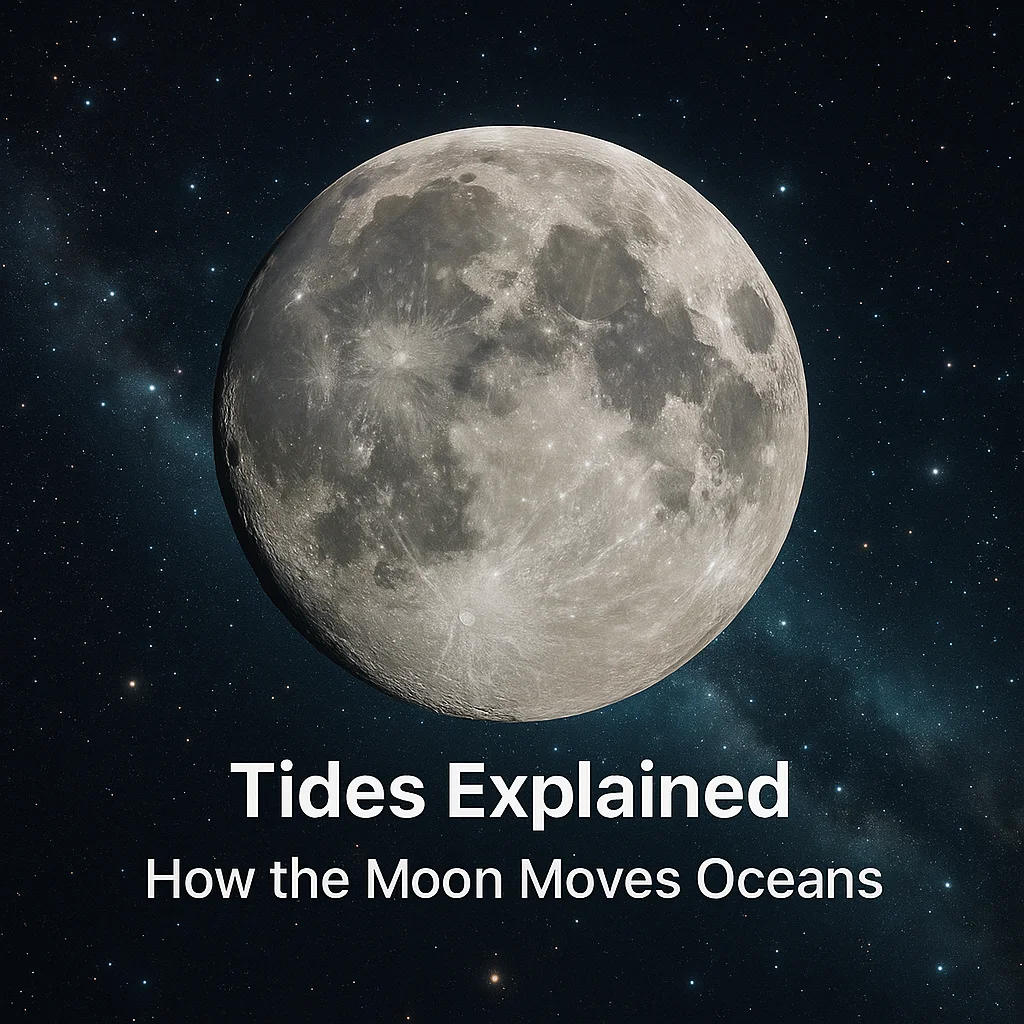
The gravitational attraction between the Earth and the Moon creates bulges in the Earth's oceans. These bulges lead to variations in sea-level known as high and low tides. In this article, we will explore the mechanisms behind tides and how the Moon is responsible for these oceanic movements.
We'll also touch upon the Moon's position relative to Earth, its gravitational impact, and common questions related to tides. This beginner-friendly guide will help you grasp why tides occur and the Moon's role in this fascinating natural phenomenon.
📍 Where It Is and How Far Away
The Moon orbits around Earth at an average distance of approximately 238,855 miles (384,400 kilometers). To put it into perspective, this distance is about 30 times Earth's diameter, or about 1.3 light-seconds away. It's close enough for the effects of its gravity to be very noticeable on Earth.
The position of the Moon in its orbit can affect various factors, including the timing and height of tides. When the Moon is directly overhead or on the opposite side of the Earth, it causes the strongest gravitational pull, resulting in higher tides.
The Sun also plays a role, but since it is about 93 million miles (150 million kilometers) from Earth—much farther than the Moon—its effects are less potent, although still significant. When the Sun, Moon, and Earth align, they create especially high tides known as "spring tides," occurring during full and new moons.
🧱 Size, Mass, and Gravity (Made Simple)
The Moon isn't very large compared to Earth. It has a diameter of about 2,159 miles (3,474 kilometers), roughly one-fourth the size of Earth. Despite its relatively small size, its mass—about 1/81 of Earth's—enables it to exert considerable gravitational pull on our planet.
This gravitational force is responsible for the ocean's tidal bulges. When the Moon is overhead, the sea is pulled toward it, creating a high tide. When it is further away, the pull weakens, and the ocean levels drop, producing a low tide.
Gravity works subtly but consistently, creating predictable tidal patterns. Although the Moon's gravitational pull isn't strong enough to have a noticeable effect on the solid ground we stand on, its influence on the oceans is clear and significant.
🌡️ Atmosphere and Weather
The Moon does not have a significant atmosphere like Earth. It has only a very thin layer of gases referred to as an exosphere, composed mainly of hydrogen, neon, and traces of other elements. This lack of a substantial atmosphere means there are no weather patterns or clouds on the Moon.
Because it doesn't have a protective atmosphere, temperatures on the Moon can vary wildly. During the lunar day, temperatures can rise dramatically, while at night, they can drop far below freezing. This extreme temperature shift is due to the absence of an atmospheric blanket to moderate the climate.
In contrast, Earth's atmosphere influences tidal patterns by facilitating weather systems that can enhance or dampen tidal effects. For example, high-pressure systems can suppress tidal amplitudes, while low-pressure systems might enhance them.
🪨 Surface and Interior
The surface of the Moon is covered with a layer of dust and rocky debris known as regolith. Its landscape is marked by craters from meteor impacts, mountains, and ancient volcanic plains known as "maria." Unlike Earth, the Moon lacks tectonic activity, so its surface features remain unchanged over long periods.
The Moon's interior consists of a crust, mantle, and core. While its mantle is relatively solid, there are some indications of slow-moving, partially molten rock within it. The core is small and partially molten, contributing to a weak magnetic field that offers little protection from space weather.
🌀 Rotation, Orbit, and Seasons
The Moon takes about 27.3 Earth days to complete one orbit around our planet. Interestingly, it also rotates on its axis in about the same time, a phenomenon known as synchronous rotation. This is why we always see the same side of the Moon from Earth.
Because the Moon's orbit is elliptical, the distance between Earth and the Moon changes as it orbits. This variance can slightly affect tidal forces, leading to differences in tidal heights. However, the Moon’s relatively stable tilt means it doesn’t experience seasons like Earth.
🧲 Magnetic Field and Radiation
The Moon has a weak and patchy magnetic field that isn't uniform across its surface. This weak field provides almost no protection from solar radiation or cosmic rays. Without a strong magnetic shield, any spacecraft or future lunar colonies would require additional protection against space weather.
On Earth, our robust magnetic field not only shields us from harmful radiation but also influences ocean currents. However, the Moon's lack of a significant magnetic field has little direct effect on how it influences tides on Earth.
🌙 Moons, Rings, and Neighbors
The Moon is Earth's only natural satellite. Unlike the giant gas planets with numerous moons, Earth’s single moon is unique in its effects, particularly on tides. Its gravitational interactions are crucial for maintaining the stability of Earth's axial tilt, which affects seasons and climate.
Although it lacks rings, the gravitational interactions between Earth and the Moon are fascinating and crucial for understanding tides. The consistent pull of the Moon helps regulate tidal motions and ensures a dynamic but predictable pattern.
🔭 How We Know (Missions and Observations)
Astronomers have used both telescopes and data from space missions to study the Moon and its effects on Earth. Spacecraft such as Apollo missions, as well as more recent missions like the Lunar Reconnaissance Orbiter, have provided detailed information about the Moon's surface and structure.
Telescopic observations and satellite imagery help scientists understand Earth's tides by mapping and analyzing sea-level changes. Data such as tidal gauges and satellite altimetry provide insights into the nuances of tidal patterns and variations.
❓ Common Questions and Misconceptions
Is the Moon a star? No, the Moon is Earth's natural satellite, not a star. Stars generate their own light through nuclear fusion, while the Moon reflects sunlight.
Can you stand on the Moon? Yes, astronauts have stood on the Moon. It has a solid surface, unlike gas giants that lack a solid crust.
Is the Moon habitable? The Moon is not habitable for humans as it lacks breathable air, liquid water, and a protective atmosphere.
Why do we always see the same side of the Moon? Synchronous rotation causes the same side of the Moon always to face Earth.
Do all celestial bodies have tides? Tides can occur on any celestial body influenced by another object's gravity, but they are most noticeable on planets with liquid oceans like Earth.
Will the Moon ever move away from Earth? The Moon is gradually moving away from Earth at about 1.5 inches (3.8 centimeters) per year due to tidal forces.
📌 Summary
- Tides are influenced mainly by the Moon’s gravitational pull.
- The Moon orbits around 238,855 miles from Earth.
- The Moon's gravity causes ocean tides but doesn't significantly affect land.
- The Moon has a minimal atmosphere, impacting its temperature extremes.
- The surface features include craters and maria; its interior lacks tectonic activity.
- It has a synchronous rotation and elliptical orbit resulting in constant view from Earth.
- The lunar magnetic field is weak, offering little shield from radiation.
- The Moon is Earth's only natural satellite, affecting tides notably.
- Understanding comes from telescopic observations and space missions.
- A memorable fact is that the Moon is moving slightly away from Earth each year.