🪐 Callisto Facts for Beginners
🌌 What It Is
Callisto is one of Jupiter's moons, and it's one of the largest moons in our Solar System. Discovered in 1610 by Galileo Galilei, Callisto is part of a group of four large moons known as the Galilean satellites. These moons are unique because they were the first objects found to orbit another planet, providing crucial evidence that not all celestial bodies orbit Earth.
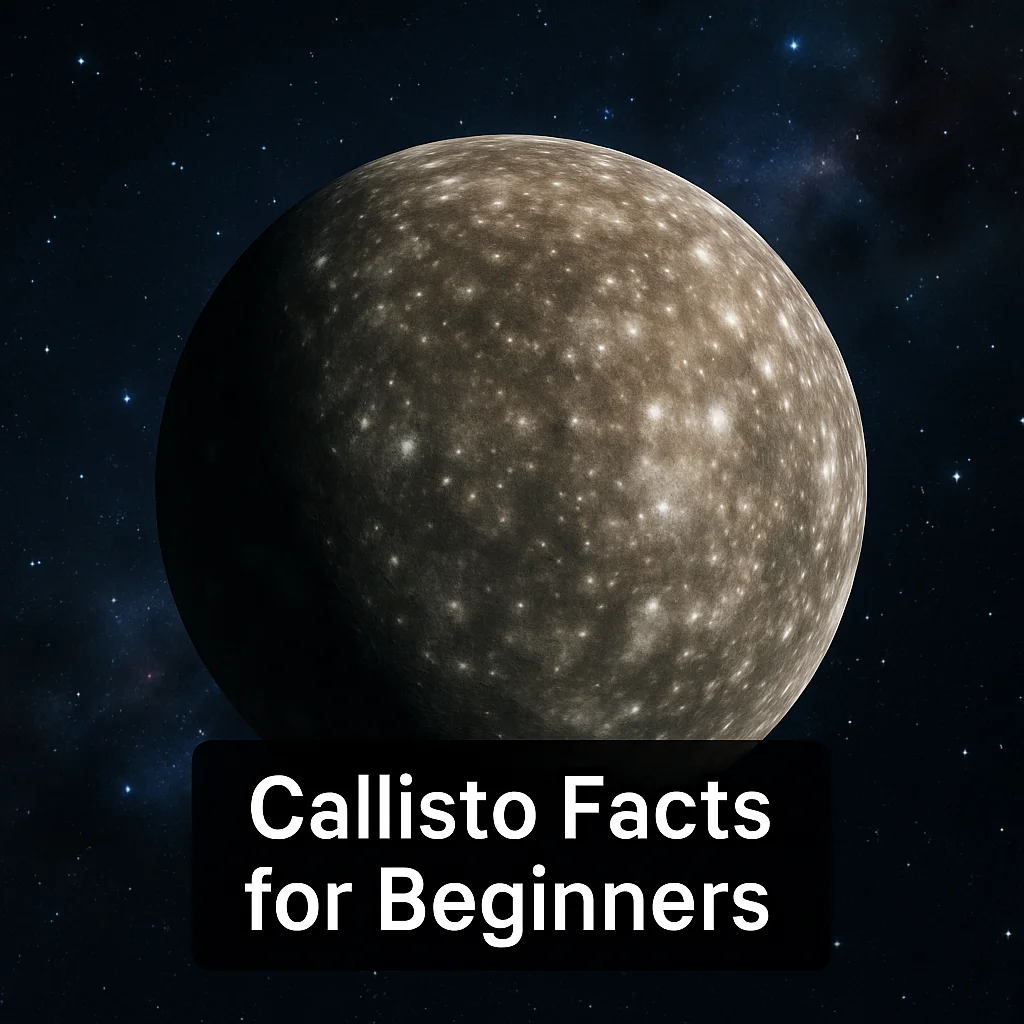
Unlike planets, moons orbit planets instead of the Sun. Callisto, like other moons, is classified based on its orbits rather than its physical characteristics. As a celestial body, Callisto's features and environment are shaped significantly by its proximity to Jupiter.
In this article, you'll learn about Callisto's location, its impressive size, and the intriguing features of its surface and composition. We will also explore its orbit around Jupiter and how scientists have gathered information about this fascinating moon.
📍 Where It Is and How Far Away
Callisto resides in the outer part of our Solar System, orbiting Jupiter, which is the fifth planet from the Sun. As one of the Galilean satellites, it is the farthest from Jupiter compared to its sister moons—Io, Europa, and Ganymede. If you were to travel from Earth to Callisto, you'd be making a journey of hundreds of millions of miles.
The distance from the Sun affects how much sunlight and heat Callisto receives. Positioned far from the Sun, Callisto gets less sunlight than planets located closer to the center of our Solar System, resulting in colder temperatures across its surface.
Understanding distances in space can be a challenge. Earth's distance from the Sun is called one astronomical unit (AU), and Jupiter's orbit is about 5 AU from the Sun. Although this may sound close, each astronomical unit is approximately 93 million miles (150 million kilometers), making Jupiter’s domain a remote and cold region compared to Earth.
🧱 Size, Mass, and Gravity (Made Simple)
Callisto is nearly the size of the planet Mercury, with a diameter of about 4,820 kilometers (nearly 3,000 miles). Imagine a ball slightly bigger than our Moon and about the size of the state of Texas, and you'll have an idea of Callisto's dimensions.
The mass of Callisto is about a third of that of Earth's Moon but spread across a larger volume, making it less dense. If you stood on Callisto, you'd feel lighter than you would on Earth. Callisto's surface gravity is around 12% of Earth's, so a 100-pound person would weigh only 12 pounds there.
Because Callisto is mostly made up of rock and ice, it has a relatively low density. This mixture impacts the moon's gravitational pull, making it significantly weaker than Earth’s, contributing to its distinction as a less dense celestial body in our Solar System.
🌡️ Atmosphere and Weather
Callisto has a very thin atmosphere, composed mostly of carbon dioxide, and lacks the density to support weather systems like winds or storms. The thin atmosphere means there are no clouds, rain, or dynamic weather patterns as we experience on Earth.
The low density of the atmosphere is due to Callisto's weak gravitational pull, which cannot hold onto gases effectively. Consequently, the environment is extremely cold, with surface temperatures plummeting to around -218 degrees Fahrenheit (-139 degrees Celsius) in shaded areas.
Because it's so far from the Sun, and sunlight is sparse, Callisto is a world of long shadows and low temperatures, contributing to its persistence as a frozen landscape with little in the way of atmospheric drama.
🪨 Surface and Interior
Callisto's surface is one of the most cratered and ancient surfaces in the Solar System. It is dominated by impact craters and multi-ring structures formed by collisions with meteors and comets over billions of years. The surface largely dates back over four billion years, back to a time when the Solar System was a more volatile place.
The moon lacks large mountains or volcanoes, primarily because its icy crust can't support such structures. There are subtle ridges and troughs but not as prominently as found on other celestial bodies with more active geology.
Beneath the surface, Callisto is believed to have a rocky and icy crust over an ocean of liquid water, which is kept from freezing by heat produced from radioactive decay in the rocky core. This potential liquid water ocean makes Callisto a subject of interest when considering the potential for life beyond Earth.
🌀 Rotation, Orbit, and Seasons
Callisto takes about 16.7 Earth days to complete one orbit around Jupiter and the same amount of time to rotate once on its axis. This synchronous rotation means one side of Callisto always faces Jupiter, similar to how one side of the Moon always faces Earth.
Callisto's orbit is nearly circular, and its distance from Jupiter is about 1.2 million miles (1.9 million kilometers). It doesn't experience significant seasonal changes since its axis is not significantly tilted with respect to its orbit around Jupiter.
This regular orbit ensures Callisto remains a stable and consistent feature in Jupiter’s collection of moons, with predictably calm periods with respect to its positioning and temperature.
🧲 Magnetic Field and Radiation
Callisto does not have a significant magnetic field of its own, unlike some of its neighboring moons. However, it resides within Jupiter's vast magnetosphere, an area dominated by the planet's powerful magnetic field.
The lack of a magnetic field means Callisto does not hold on to a protective shield against space weather. But its distance from Jupiter places it outside the most intense radiation belts, granting protection from high-energy particles that are more prevalent closer to the massive planet.
This setting means that Callisto is less affected by Jupiter's radiation than other moons like Io or Europa, presenting fewer challenges for future spacecraft missions.
🌙 Moons, Rings, and Neighbors
Callisto does not have any moons or significant ring systems of its own. Its landscape is mainly shaped by its past impact events and its gravitational interactions with Jupiter.
Despite being farther from Jupiter, Callisto, like all of the Galilean moons, is influenced by Jupiter's massive gravitational pull. This contributes to minor geological activities, storing subtle interplay in its ice-rock composition.
The lack of moons or rings around Callisto allows scientists to study it largely without the complexities introduced by additional satellites or ring particles, offering a purer view of celestial body dynamics.
🔭 How We Know (Missions and Observations)
Most of what we know about Callisto comes from a combination of telescopic observations and spacecraft missions. Telescopes have allowed us to see the large surface features and measure orbital characteristics from Earth.
Notable space missions such as NASA's Galileo probe, which orbited Jupiter during the 1990s, provided valuable close-up data from Callisto. This mission sent back detailed images and scientific measurements of Callisto's surface and magnetic environment.
The data collected from these efforts include images, spectroscopy, and magnetic readings, all contributing to a more detailed understanding of this ancient moon and its place within the Jovian system.
❓ Common Questions and Misconceptions
Is Callisto a star? No, Callisto is a moon, not a star. Stars emit their own light, while moons shine by reflecting sunlight.
Can you stand on Callisto? Yes, Callisto has a solid surface, albeit icy and rugged, unlike gas planets where standing isn’t possible.
Is Callisto habitable? Currently, there is no evidence of life on Callisto, but its subsurface ocean offers potential for microbial life.
Why is Callisto so cratered? Callisto's lack of geological activity means old impact craters remain, preserving a record of ancient collisions.
Is Callisto hotter than Earth? No, Callisto is much colder due to its distance from the Sun and thin atmosphere.
Does Callisto have weather? Callisto has no dynamic weather due to its thin atmosphere and cold environment.
Does Callisto have a North and South Pole? Yes, like Earth, Callisto has poles, though they have different temperature patterns due to less sunlight.
Does Callisto have water? Callisto likely has a subsurface ocean under its icy crust, challenging to study but intriguing to scientists.
📌 Summary
- Callisto is a large moon of Jupiter, part of the Galilean satellites.
- It is located in the outer Solar System, orbiting the gas giant Jupiter.
- Callisto is about the size of Mercury, with weaker surface gravity than Earth.
- The atmosphere is very thin, mainly carbon dioxide, with no weather systems.
- Its surface is heavily cratered, ancient, and icy, with potential subsurface ocean.
- Callisto rotates in sync with its orbit, showing one face to Jupiter.
- There is no significant magnetic field, but it is within Jupiter's magnetosphere.
- Unlike the inner moons, Callisto has no rings or other moons to accompany it.
- Observations from telescopes and missions like Galileo inform our knowledge.
- Remarkably, Callisto might hide subsurface oceans, holding curiosity for life studies.