🪐 Europa’s Ocean: Why Scientists Are Excited
🌌 What It Is
Europa is one of Jupiter's moons and has fascinated scientists for many years. Unlike Earth's Moon, Europa is an ice-covered celestial body that is thought to harbor a vast ocean beneath its frozen surface. This ocean potentially holds more water than all of Earth's oceans combined.
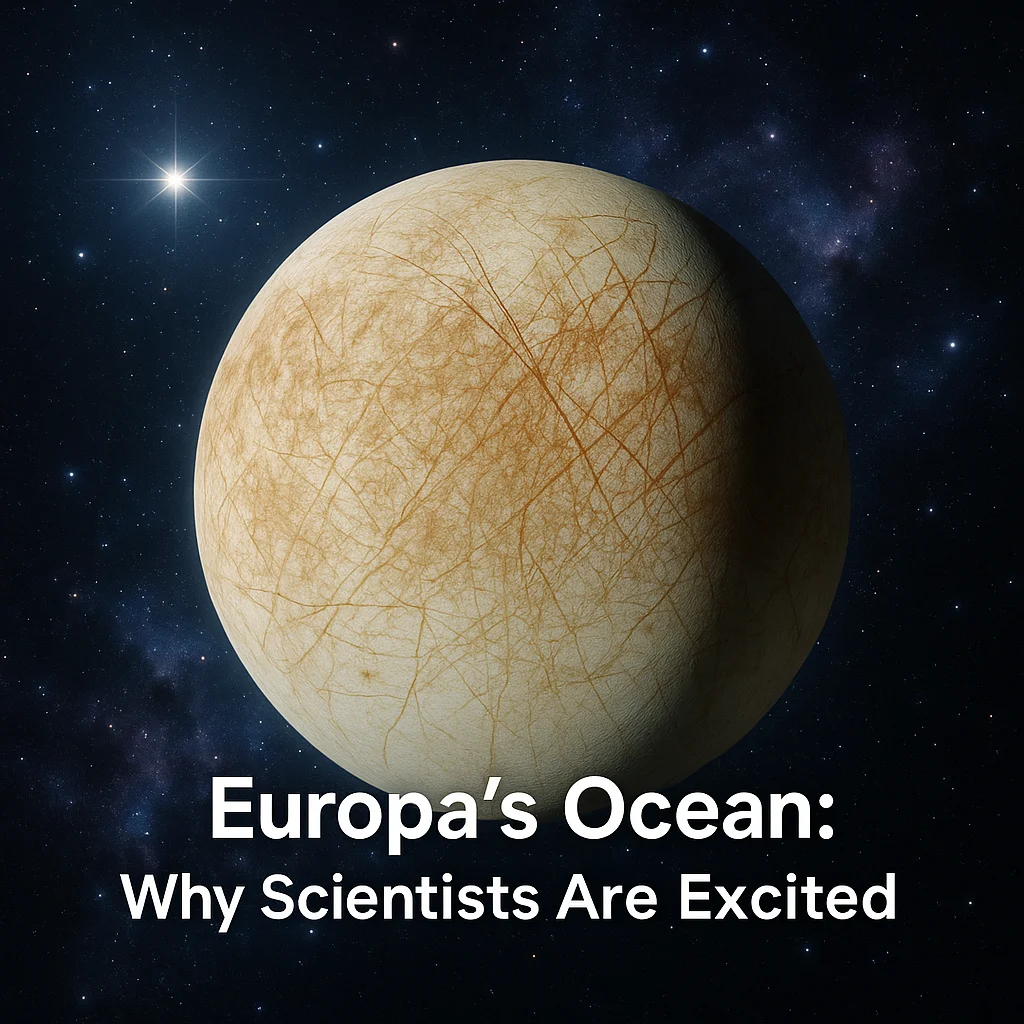
Europa is classified as one of the Galilean moons, named after Galileo Galilei, who first observed them in 1610. Alongside three other large moons—Io, Ganymede, and Callisto—Europa orbits Jupiter, the largest planet in our Solar System.
This article will explore Europa's location, physical characteristics, surface, and the potential for life in its ocean. We'll also look at how scientists have learned about this intriguing moon and tackle some common misconceptions.
📍 Where It Is and How Far Away
Europa resides within our Solar System as one of the moons orbiting Jupiter. To visualize its distance, consider that Jupiter is the fifth planet from the Sun, sitting beyond the asteroid belt that separates the inner rocky planets from the gas giants.
The average distance from Earth to Europa is about 484 million miles or roughly 5.2 astronomical units (AU), where one AU is the distance between Earth and the Sun. If you could travel at the speed of light, it would take over 35 minutes to reach Europa from Earth.
Europa's distance from the Sun significantly influences its surface conditions. Despite its icy exterior, it receives only a fractional amount of sunlight compared to Earth, resulting in extremely low temperatures on the surface, typically around -260 degrees Fahrenheit.
🧱 Size, Mass, and Gravity (Made Simple)
Europa is roughly the size of Earth's Moon, with a diameter of about 1,940 miles. It's slightly smaller in size but has a larger mass due to its denser composition, primarily from rock and water ice.
Gravity on Europa is much weaker than on Earth. If you weigh 100 pounds on Earth, you would weigh only about 13 pounds on Europa. This moon's lower gravity means you could jump higher and throw objects much farther than you could on Earth.
Despite its small size and weak gravity, Europa's ocean might exert pressure similar to Earth's deep ocean environments, creating a unique setting that fosters scientific interest.
🌡️ Atmosphere and Weather
Europa has a very thin atmosphere composed mainly of oxygen. However, this atmosphere is not breathable and is far sparser than the air we're used to on Earth. It lacks the pressure needed to support life as we know it.
Weather patterns as we understand them do not exist on Europa because its atmosphere is too thin to support them. There's essentially no wind or precipitation, just a thin veneer of oxygen produced by the interaction of sunlight with Europa's icy surface.
The modest atmosphere and lack of weather phenomena indicate that Europa's environment is dominated by its solid surface and the ocean underneath, which influences the atmospheric characteristics and potential weather patterns indirectly.
🪨 Surface and Interior
The surface of Europa is primarily water ice, crisscrossed by a complex network of streaks and cracks. These features are thought to result from the movement of its subsurface ocean, pushing and pulling the ice above.
Europa's lack of large craters suggests that the surface is relatively young and continuously reshaped by geological processes. Some scientists speculate that geysers might occasionally erupt, venting water vapor into space through cracks in the ice.
Beneath the icy exterior is a vast ocean, possibly salty like Earth's oceans. The ocean floors may be rocky, and heat from Europa's interior could foster hydrothermal vents, similar to those found in Earth's oceans, potentially creating environments where life might exist.
🌀 Rotation, Orbit, and Seasons
Europa has a synchronous rotation, meaning it takes the same amount of time to rotate on its axis as it does to orbit Jupiter, roughly 3.5 Earth days. This results in one side of Europa always facing Jupiter.
Orbiting Jupiter once every 85 hours, Europa takes about 12 years to complete one orbit around the Sun. The nearly circular orbit and lack of significant axial tilt mean that Europa does not experience seasons like Earth.
This constant exposure to one side of the moon facing Jupiter reveals dynamic tidal forces that stretch and compress Europa, possibly keeping its ocean in a liquid state beneath the icy shell.
🧲 Magnetic Field and Radiation
Europa doesn’t have its own magnetic field, but it resides within Jupiter’s powerful magnetic environment. This interaction creates a magnetic induction within Europa, hinting at a conductive, possibly salty ocean beneath its ice.
Jupiter's magnetic field also means that Europa is subject to high levels of radiation, which would be fatal to life forms exposed on or near the surface. This radiation exacerbates the challenges of exploring Europa.
Despite this, the magnetic field interactions and radiation data are invaluable to scientists studying Europa's ocean, as they provide indirect evidence for its existence and nature.
🌙 Moons, Rings, and Neighbors
Europa shares its orbit with several other Jovian moons, most notably its gravitational siblings, Io, Ganymede, and Callisto. These moons interact through gravitational forces, creating tidal effects that add to the intrigue of Europa's ocean.
Europa itself doesn’t have any moons or rings. The gravitational interplay with its neighbors contributes to the tidal heating that may keep Europa's ocean in a liquid state.
The lack of a ring system around Europa is consistent with its classification as a moon, where gravitational interactions focus more on the moon's interior dynamics rather than forming an external ring structure.
🔭 How We Know (Missions and Observations)
Europa has been studied extensively through telescopes and spacecraft. The Galileo spacecraft, which orbited Jupiter from 1995 to 2003, provided crucial data about Europa’s surface and the puzzle of its under-ice ocean.
Telescopes on Earth and in space have examined Europa's reflected light to analyze its surface composition. These observations buttress our understanding of the icy surface and the possibility of a salty ocean.
Future missions, such as NASA’s Europa Clipper, aim to probe Europa's mysteries further, with sophisticated instrumentation designed to detect signs of microbial life and explore the moon’s habitability.
❓ Common Questions and Misconceptions
Is Europa a star? No, Europa is a moon orbiting Jupiter, not a star. Stars emit light due to nuclear fusion, whereas moons like Europa reflect sunlight.
Can you stand on Europa? Yes, Europa has a solid icy surface, so standing on it is possible, though its low gravity might make walking a unique experience.
Is Europa habitable? While the surface is inhospitable due to cold and radiation, the subsurface ocean might host life, similar to Earth's deep oceans.
Why is Europa icy? Europa’s distance from the Sun keeps it cold enough for water to remain frozen at the surface.
Is Europa larger than Earth? No, Europa is much smaller; it’s about 90% the size of Earth's Moon.
Why is Europa interesting to astronomers? It might harbor conditions suitable for life beneath its ice-covered surface, making it a prime target for astrobiology.
📌 Summary
- Europa is an ice-covered moon orbiting Jupiter, one of the Galilean moons.
- Located 484 million miles from Earth, it takes over 35 minutes for light to reach it.
- Similar in size to Earth's Moon, Europa has weak gravity.
- A thin oxygen atmosphere exists, with no real weather patterns.
- The surface is icy, with potential for a salty ocean beneath.
- Rotates and orbits synchronously with Jupiter, allowing no seasons.
- No magnetic field, but within Jupiter’s, influencing its ocean.
- No rings or moons, neighbors include Io, Ganymede, and Callisto.
- Known from telescopic and mission data like Galileo, more to come from Europa Clipper.
- Intriguing for potential subsurface life due to ocean and tidal heating.