🪐 Ganymede Facts for Beginners
🌌 What It Is
Ganymede is one of Jupiter's moons and holds the title of the largest moon in our Solar System. It is even bigger than the planet Mercury! But unlike planets, moons like Ganymede orbit around larger bodies like Jupiter instead of directly orbiting the Sun.
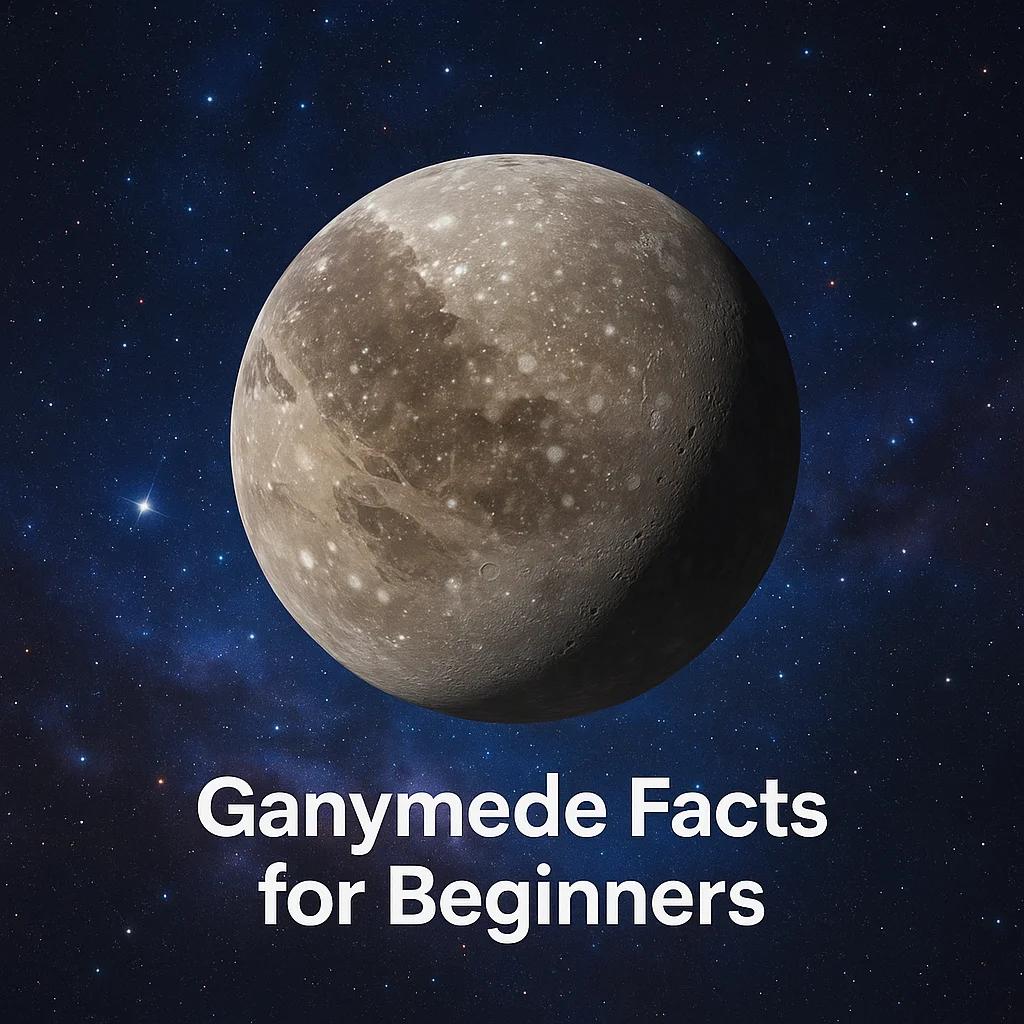
One of the interesting things about Ganymede is that it is classified among the Galilean moons, a group of four largest moons of Jupiter discovered by Galileo Galilei in 1610. The Galilean moons include Io, Europa, Ganymede, and Callisto.
In this article, we will explore Ganymede's features such as its size, orbit, surface conditions, and more. Let's embark on this cosmic journey to understand what makes Ganymede truly unique!
📍 Where It Is and How Far Away
Ganymede orbits Jupiter, the largest planet in our Solar System. Located in the outer parts of the Solar System, about 484 million miles from the Sun, it is roughly 5 times farther from the Sun than Earth is. This unit, the average Earth-Sun distance, is known as an astronomical unit (AU).
At this great distance, sunlight reaching Ganymede is much fainter, creating a colder environment compared to Earth's. The reduced sunlight affects not only the moon's temperature but also the potential for solar-powered missions in the region.
Ganymede completes an orbit around Jupiter every seven Earth days, creating a dynamic dance with the other Galilean moons as they exert gravitational influences on each other, an interesting phenomenon for astronomers.
🧱 Size, Mass, and Gravity (Made Simple)
Ganymede boasts a diameter of about 5,268 kilometers, which means it is larger than both the planet Mercury and our own Moon. Despite its size, its mass is less than Mercury's because it consists more of ice, which is lighter than rock.
The surface gravity on Ganymede is about 1/7th of Earth's gravity. This means if you weigh 70 kg on Earth, you would only weigh 10 kg on Ganymede. Walking there would feel like bouncing with ease, much like astronauts on the Moon.
Due to its lack of a solid surface as we know it, discussions on Ganymede's gravity are more theoretical than practical, akin to stepping onto a vast icy world with interesting geological features.
🌡️ Atmosphere and Weather
Ganymede has a very thin atmosphere, primarily composed of oxygen. However, it is too thin to support human life or to have any weather systems similar to Earth's. There are no clouds, winds, or storms found here due to this lack of a substantial atmosphere.
Temperatures on Ganymede are frigid, averaging around -160 degrees Celsius. This cold is primarily due to the moon's distance from the Sun and the thinness of its atmosphere, which cannot hold onto any heat.
The lack of weather on Ganymede is a direct result of its weak gravitational force and sparse atmosphere, leaving a permanently frozen surface in stark contrast to more dynamic planetary environments.
🪨 Surface and Interior
The surface of Ganymede is a fascinating mix of water-ice and various geological features like craters, grooves, and ridges. The impact craters show that Ganymede has been bombarded by meteors over billions of years.
Scientists believe that beneath its icy crust, Ganymede hosts a salty ocean, which could contain more water than all Earth's oceans combined. This subsurface ocean is kept from freezing solid by heat produced from Ganymede's interior.
Ganymede's interior is layered, with a metallic core at the center surrounded by a rocky mantle and then an icy crust. This core is responsible for generating Ganymede's magnetic field, a rare feature for moons.
🌀 Rotation, Orbit, and Seasons
Ganymede has a synchronous rotation, meaning it always shows the same face to Jupiter, similar to how our Moon always shows the same face to Earth. A day on Ganymede, defined by a single rotation, is about 7 Earth days long.
Its orbit around Jupiter takes about 7 days as well, which means one rotation coincides with one orbit around Jupiter. Thus, there's no concept of seasons like on Earth.
The smooth synchronization of Ganymede's rotation and orbit offers a stable yet unique celestial rhythm that defines its periodic patterns and interactions with Jupiter.
🧲 Magnetic Field and Radiation
Ganymede is unique among moons in the Solar System for having its own magnetic field. This magnetic field creates auroras around the moon's poles, similar to Earth's Northern and Southern Lights.
However, being held within Jupiter's powerful magnetosphere, Ganymede is also subject to intense radiation, which poses significant challenges to any potential future missions there.
Understanding Ganymede's magnetic environment can help scientists learn about other bodies with magnetic fields and the dynamics of these fields within larger planetary systems.
🌙 Moons, Rings, and Neighbors
Ganymede itself is a moon and does not have any moons or rings of its own. However, it shares its celestial neighborhood with the other Galilean moons—Io, Europa, and Callisto—all of which have distinct properties and interactions with Jupiter.
The gravitational tug-of-war between these moons and with Jupiter creates a resonant relationship, meaning they regularly exert gravitational influences on each other, keeping their orbits stable.
These interactions make the Jupiter system a miniaturized version of the Solar System, offering astronomers a natural laboratory to study planetary dynamics in action.
🔭 How We Know (Missions and Observations)
Much of what we know about Ganymede has come from telescopic observations on Earth and missions like NASA's Galileo spacecraft, which spent several years observing Jupiter and its moons.
Telescopes provide vital data on Ganymede's orbit and basic features, while spacecraft can offer detailed images and measurements of the moon's surface, magnetic field, and internal structure.
The future looks promising with new missions planned to visit Jupiter and its moons, like the European Space Agency's Jupiter Icy Moons Explorer (JUICE), which will study Ganymede in detail.
❓ Common Questions and Misconceptions
Is Ganymede a star? No, Ganymede is a moon orbiting Jupiter and doesn't produce light like a star.
Can you stand on Ganymede? Technically yes, but it would be extremely cold and inhospitable for humans without protective gear.
Is Ganymede habitable? Currently, Ganymede's environment is too harsh for human life, though its subsurface ocean intrigues scientists looking for microbial life.
Why is Ganymede that color? Its surface appears to have varied tones due to a mix of rock and ice, with darker regions being rockier and lighter regions icier.
Does Ganymede have an atmosphere? It has a very thin atmosphere mostly of oxygen, but not enough to support life or weather.
Why is Ganymede larger than Mercury? While Ganymede is larger in size, its icy composition makes it less massive than rocky Mercury.
Does Ganymede have seasons? No, its axial tilt is negligible, leading to no significant seasonal changes.
Could there be life in Ganymede’s ocean? It's a possibility that intrigues scientists, but the harsh conditions make it unlikely for complex life forms.
Can spacecraft land on Ganymede? They can, in theory, but challenges include intense radiation and extreme cold.
What’s special about Ganymede’s magnetic field? It’s unique among moons, indicating a liquid metallic core generating this field, much like Earth’s core.
📌 Summary
- Ganymede is Jupiter's largest moon and the largest in the Solar System.
- It orbits Jupiter in the outer Solar System, much further from the Sun than Earth.
- Ganymede is larger than Mercury but has less mass due to its icy composition.
- The atmosphere is thin, mostly oxygen, leading to extremely cold surface temperatures.
- The surface features ice and rock; below might lie a huge ocean.
- Rotation and orbit are synchronized, with Ganymede's day lasting about 7 Earth days.
- It has a unique magnetic field, creating auroras in its atmosphere.
- Ganymede interacts with Jupiter and its neighboring moons, shaping their orbits.
- Our knowledge comes from missions like Galileo and telescope observations.
- A fascinating feature is its possible subsurface ocean, sparking questions about life.