🪐 The Galilean Moons Compared
🌌 What It Is
The Galilean moons are four large moons orbiting the planet Jupiter, known as Io, Europa, Ganymede, and Callisto. They are called Galilean because they were discovered by the astronomer Galileo Galilei in 1610. These moons were the first group of objects found to orbit another planet, marking a pivotal moment in astronomy.
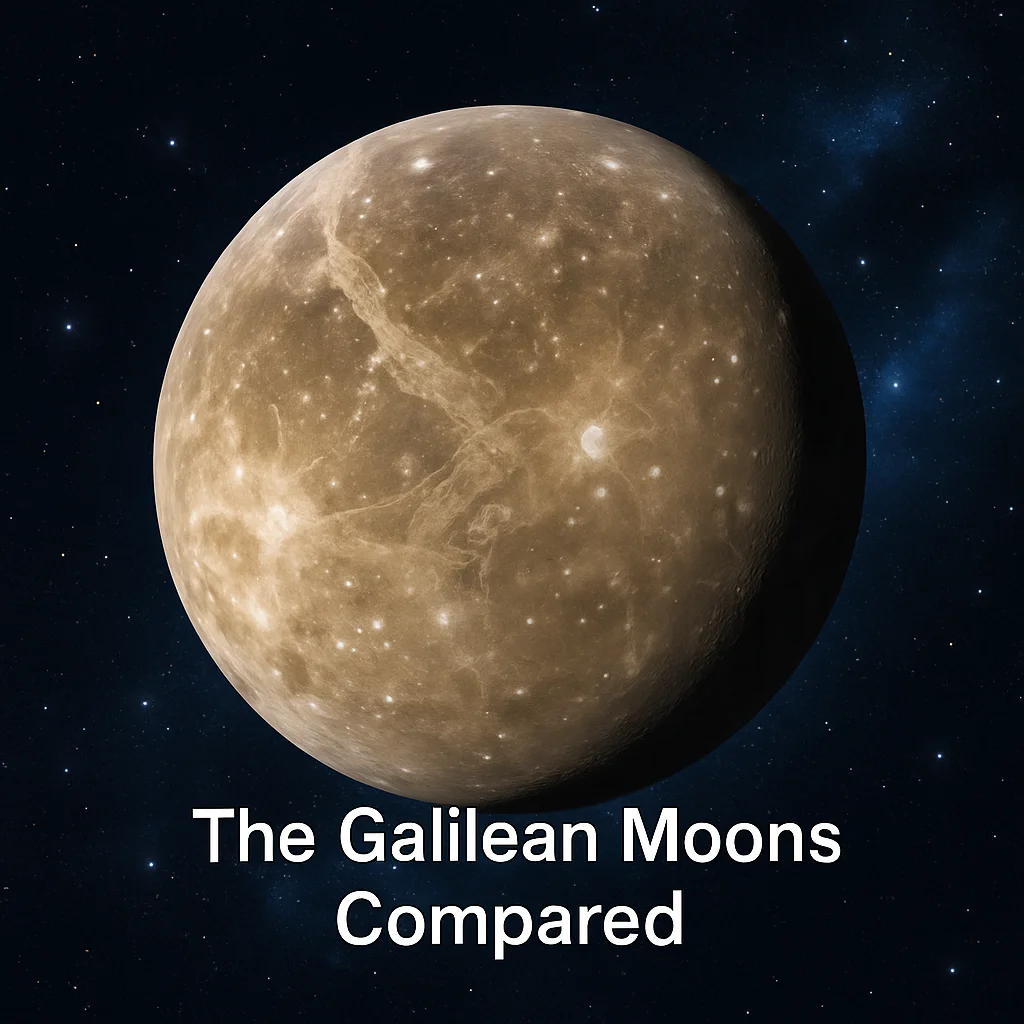
These moons are distinct from each other in many ways, including size, composition, and surface features. Understanding these differences helps astronomers learn more about the formation and evolution of the solar system. Throughout this article, we'll explore what makes each of these moons unique.
By examining the Galilean moons, readers will gain insights into planetary science, how objects interact in space, and the conditions that exist on other worlds far from Earth. Although these moons orbit the same planet, they are as diverse as the terrestrial planets in our solar system.
📍 Where It Is and How Far Away
The Galilean moons orbit Jupiter, the largest planet in our solar system. Jupiter is situated about 778 million kilometers (about 484 million miles) from the Sun. This distance is roughly 5.2 astronomical units (AU), where an AU is the average distance between Earth and the Sun.
Because Jupiter is so far from the Sun, its moons receive much less sunlight compared to any planet in the inner solar system. This affects their temperatures, making them extremely cold. Additionally, the positioning of these moons plays a crucial role in the gravitational dynamics between each moon and Jupiter.
Observations of these moons give us a fascinating look at a world within another world. Despite being so far, advanced telescopes and spacecraft missions have allowed astronomers to study these distant moons in remarkable detail.
🧱 Size, Mass, and Gravity (Made Simple)
A significant aspect of the Galilean moons is their size. Ganymede, the largest of them all, outstrips the smallest, Europa. Ganymede is even larger than the planet Mercury! In terms of mass, the moons also vary, with Ganymede again being the most massive. These moons have enough mass to be spherical due to their gravity.
The gravitational force on these moons differs significantly. Europa, with its smaller size and lower mass, has weaker gravity compared to Io, for instance. On Ganymede, the gravity is about 15% of Earth's. While you would weigh less on Ganymede, standing or walking would still feel familiar relative to the void of space or less massive celestial objects.
This gravitational range among the moons influences features such as their ability to hold onto thin atmospheres or how their surfaces and interiors behave, which we'll discuss further on.
🌡️ Atmosphere and Weather
The Galilean moons have intriguing atmospheric properties. Io, for instance, is home to volcanic plumes, which can inject materials into its thin atmosphere. This atmosphere, composed mainly of sulfur dioxide, is tenuous and patchy.
Europa, meanwhile, has an atmosphere composed mostly of oxygen, but it's so thin that it wouldn't offer any breathable air like Earth's atmosphere. Ganymede and Callisto have even thinner atmospheres, with traces of oxygen and other elements. These atmospheres represent just a whisper of air compared to Earth's.
There isn't weather on these moons as we know it on Earth; instead, their surfaces are mainly influenced by space weather and the radiation belts of Jupiter. The cold temperatures result from their distance from the Sun, coupled with minimal atmosphere to trap heat.
🪨 Surface and Interior
Each Galilean moon has a unique surface. Io is famously vibrant with sulfur and volcanic activity, making its surface highly dynamic and constantly changing. In contrast, Europa's surface is smooth and icy, with a cracked, frozen crust that suggests an ocean beneath.
Ganymede has a mix of water ice and rocky material, with clear evidence of tectonic activity. Its surface is a combination of dark, heavily cratered regions and lighter, grooved areas. Callisto's surface, filled with craters, is very old, providing a fossil record of the solar system's early period.
Regarding their interiors, scientists believe that under Europa's icy crust lies an ocean of liquid water—an area of great interest for the possibilities of life. Ganymede's interior may have a layer of water or slush as well, adding to the complexity and diversity of these moons' interiors.
🌀 Rotation, Orbit, and Seasons
The Galilean moons have synchronous rotation, meaning they always show the same face toward Jupiter, much like our Moon does with Earth. Their orbital periods range from about two days for Io to over sixteen days for Callisto, varying distances from Jupiter.
This synchronous rotation results from a gravitational interaction with Jupiter, bringing stability to their orbits. Because these moons orbit a gas giant, their seasonal variations are due not to axial tilt like Earth, but to their orbits and Jupiter's own seasonal changes.
Interestingly, scientists study how these orbits influence tidal forces on their surfaces and interiors. For instance, the gravitational stress caused by Io's close orbit to Jupiter results in significant volcanic activity.
🧲 Magnetic Field and Radiation
Notably, Ganymede is the only moon in the solar system known to have a magnetic field of its own. This magnetic field suggests there may be a liquid iron or iron-sulfide core within Ganymede. This field provides limited protection for the moon against Jupiter's magnetosphere.
All the Galilean moons, however, exist within the powerful magnetic field and radiation belts of Jupiter. This radiation environment poses challenges for spacecraft attempting to study these moons up close, requiring special design considerations to prevent damage.
Even Europa, renowned for its potential subsurface ocean, must contend with radiation; any future missions intending to explore Europa's surface will need to account for this significant environmental factor.
🌙 Moons, Rings, and Neighbors
The Galilean moons don't have smaller moons or rings of their own, but they are fascinating neighbors to each other around Jupiter. Their interactions include gravitational resonance, where their orbits influence each other, creating a dance of synchronous motion.
This gravitational interaction can produce tides affecting the internal heating of the moons, which is thought to be one reason for volcanic activity on Io and possible ocean maintenance on Europa. Their proximity to each other and massive Jupiter creates a complex system resembling a miniature planetary system.
The absence of rings around the moons emphasizes their role within Jupiter's vast magnetosphere and keeps our focus on their unique characteristics.
🔭 How We Know (Missions and Observations)
Our understanding of the Galilean moons comes from a combination of telescope observations and spacecraft missions. Ground-based telescopes provide insight into their orbits and basic surface features. Telescopic images show the moons' positions relative to Jupiter and each other.
The Galileo spacecraft, launched by NASA in 1989, was pivotal in expanding our knowledge of these moons. It delivered a wealth of information about their surfaces and provided tantalizing hints about subsurface oceans. More recent missions like Juno focus on Jupiter but offer occasional insights into the moons.
Future missions, such as the European Space Agency's JUICE (Jupiter Icy Moons Explorer) and NASA's planned Europa Clipper, aim to delve deeper, particularly into the possibilities of oceans beneath the icy surfaces, providing a potential future home for life.
❓ Common Questions and Misconceptions
Is Europa covered in ice? Yes, Europa is covered in a thick layer of ice with possible liquid water beneath.
Can you stand on Io? While Io has a rocky surface, extreme volcanism and lack of breathable atmosphere make it inhospitable.
Is Ganymede bigger than Mercury? Yes, Ganymede is larger than the planet Mercury, but less massive due to its icy composition.
Do the moons have seasons? Their seasons are minimal due to lack of axial tilt and are more influenced by their orbits and distance from Jupiter.
What's the temperature like? Extremely cold due to their distance from the Sun and tenuous atmospheres.
Will we find life there? Life as we know it is unlikely on the surface, but subsurface oceans like Europa's could hold potential.
Why are the moons so different? They formed and evolved in slightly different conditions, influenced by proximity to Jupiter and other factors.
Do the moons have magnetic fields? Only Ganymede has its own magnetic field, which is unique among moons.
📌 Summary
- The Galilean moons are four large satellites of Jupiter: Io, Europa, Ganymede, and Callisto.
- Located around 778 million kilometers from the Sun in Jupiter's orbit.
- Size varies greatly; Ganymede is the largest and more massive than some planets.
- Thin atmospheres composed of sulfur dioxide, oxygen; little to no weather like Earth.
- Surfaces range from volcanic and dynamic (Io) to icy and smooth (Europa).
- Synchronous rotation with Jupiter; no typical seasons due to axial tilt.
- Ganymede has a magnetic field; all moons affected by Jupiter's radiation.
- No rings or smaller moons orbiting them, but strong gravitational interactions between them.
- Explored by missions like Galileo with more on the way, expanding understanding.
- Ganymede's size over Mercury, potential oceans under Europa make them particularly fascinating.