🪐 Enceladus Facts for Beginners
🌌 What It Is
Enceladus is one of Saturn’s most intriguing moons. It is considered an icy moon, covered entirely by a thick layer of ice. Discovered in 1789 by astronomer William Herschel, Enceladus is named after a giant from Greek mythology.
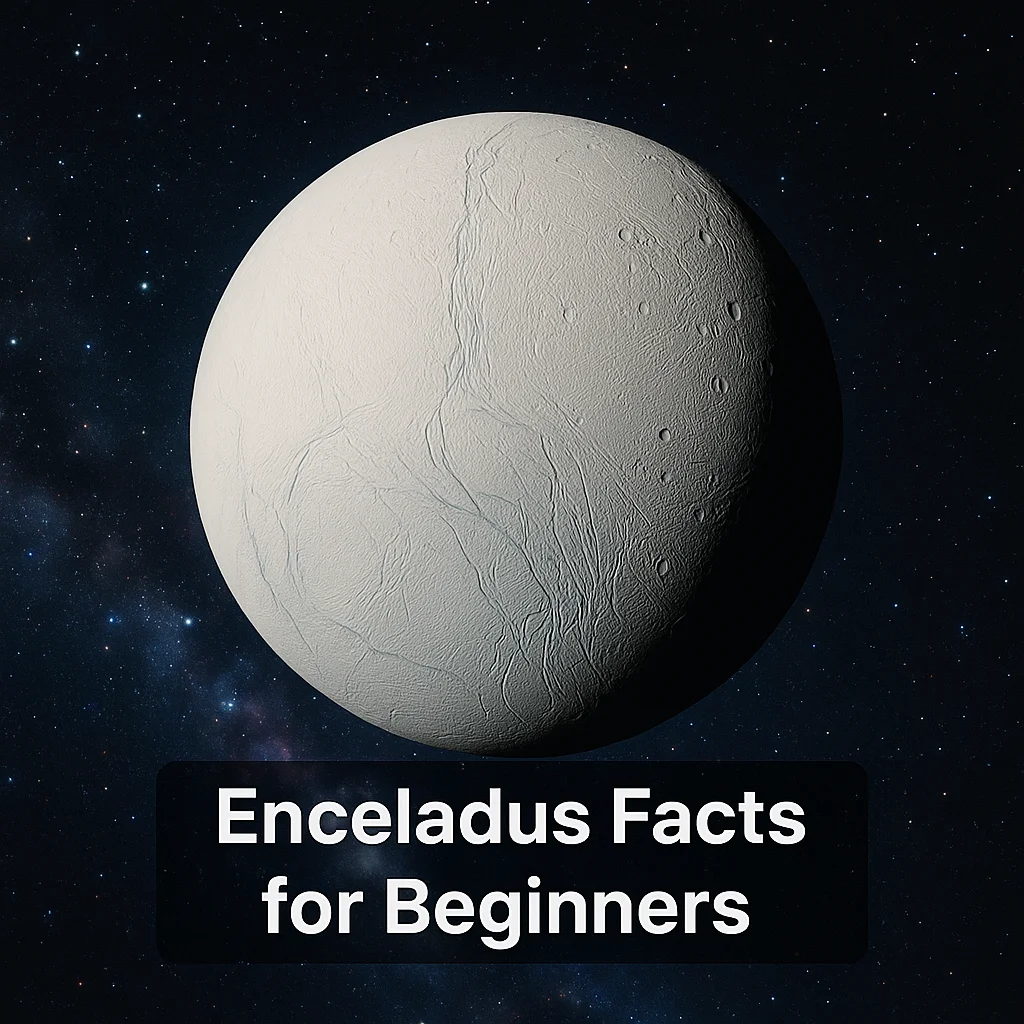
With its mysterious geysers and reflective surface, Enceladus has captured the interest of scientists and space enthusiasts alike. This icy world, smaller than Earth's moon, offers clues about potential extraterrestrial life and the dynamics of our solar system's celestial bodies.
In this article, we will explore various aspects of Enceladus, including its location, size, atmosphere, surface features, and the exciting missions that have expanded our understanding of this fascinating moon.
📍 Where It Is and How Far Away
Enceladus is situated in the outer part of our solar system, orbiting Saturn, which is the sixth planet from the Sun. As a satellite of Saturn, it is part of a vast family of over 80 moons, making Saturn a highly complex and dynamic planetary system.
To give you a sense of scale, Enceladus orbits its giant host Saturn at a distance that is much less than the distance between Earth and the Moon. The entire Saturn system, however, is about 1.2 billion kilometers (746 million miles) from Earth.
This great distance from the Sun means that Enceladus receives very little sunlight, leading to extremely cold temperatures on its surface, which are essential in maintaining its icy nature.
🧱 Size, Mass, and Gravity (Made Simple)
Enceladus is relatively small, with a diameter of approximately 500 kilometers (around 310 miles), making it about one-seventh the size of our Moon. Despite its small size, Enceladus has some powerful geological features, driven by its internal characteristics.
The surface gravity on Enceladus is weak due to its small size, which means you would weigh less standing on it than you do on Earth. This low gravity also affects the behavior of its geysers, allowing them to spray material far into space.
If you were to stand on Enceladus, you would find that the weak gravity and icy surface provide an alien experience quite different from walking on solid ground here on Earth.
🌡️ Atmosphere and Weather
Enceladus does not have a substantial atmosphere like Earth. However, it possesses a thin layer of gases, primarily composed of water vapor and other trace gases, emanating from its geysers.
Due to its thin atmosphere and the great distance from the Sun, Enceladus lacks the kind of weather patterns we are accustomed to on Earth. There are no clouds or storms, and the temperatures are consistently frigid.
The geysers play a significant role in the moon's atmosphere, regularly replenishing it with gas and creating a unique environment for study.
🪨 Surface and Interior
The surface of Enceladus is mostly ice, giving it a bright and reflective appearance, similar to fresh snow on a sunny day. This reflective property makes Enceladus one of the most brilliant objects in our solar system.
Signs of geological activity are evident, with the presence of geysers near its south pole that continuously eject plumes of water vapor and ice particles. These geysers are thought to be connected to subsurface oceans beneath the icy crust.
Inside Enceladus, scientists believe there is a layering system with a global ocean underneath the icy surface. This ocean may harbor conditions suitable for life, making Enceladus a prime location for studying possible habitability in the solar system.
🌀 Rotation, Orbit, and Seasons
Enceladus completes a rotation, or day, in about 1.37 Earth days, meaning its days are relatively short. Its orbit around Saturn, however, takes about 1.37 Earth days as well, due to its synchronous rotation. Therefore, the same side of Enceladus always faces Saturn.
Seasonal changes on Enceladus are minimal because its axis is not significantly tilted. As a result, the conditions remain consistent year-round, with little variation due to Saturn's own motion around the Sun.
The synchronous rotation means one hemisphere eternally faces Saturn, while the opposite side never sees it, a characteristic that also contributes to the unique distribution of surface features on the moon.
🧲 Magnetic Field and Radiation
Enceladus itself does not have a significant magnetic field. However, it orbits within Saturn's vast magnetosphere, which influences the particle environment surrounding the moon.
This interaction between Enceladus and the Saturnian magnetic field leads to the creation of auroras and other energetic phenomena near the moon's poles, driven by the charged particles within this magnetosphere.
For spacecraft visiting the region, understanding these magnetic interactions is crucial, as they affect both navigation and the collection of scientific data.
🌙 Moons, Rings, and Neighbors
Enceladus is part of a large family of moons orbiting Saturn, with several sister moons nearby, each with its own characteristics and geological history. These neighbors can influence Enceladus through gravitational interactions.
The particles ejected by Enceladus’s geysers contribute to Saturn's E ring, adding another fascinating aspect to its interaction with the ring system of Saturn. This link between Enceladus and the E ring points to a dynamic process of material exchange in the Saturnian system.
While Enceladus does not have any rings of its own, its contributions to the E ring bind it intrinsically to the complex and visually stunning ring system of Saturn.
🔭 How We Know (Missions and Observations)
Telescope observations and spacecraft missions have both played significant roles in shaping our understanding of Enceladus. Ground-based telescopes have provided initial observations, while detailed insight came from spacecraft.
Notably, NASA's Cassini spacecraft, which orbited Saturn from 2004 to 2017, conducted several flybys of Enceladus. It provided vital data on the moon’s surface, atmosphere, and geysers, as well as detecting evidence of a subsurface ocean.
The data collected by Cassini has inspired ongoing research and have laid the groundwork for potential future missions that could explore Enceladus even more closely in the quest to understand its potential habitability.
❓ Common Questions and Misconceptions
Enceladus is not a star but a moon, specifically one of Saturn's many moons. Despite its brightness, it does not emit its own light but reflects sunlight.
You cannot stand on Enceladus comfortably like you would on Earth, as it has a weak gravitational pull and a surface composed almost entirely of ice.
Enceladus is not habitable by humans due to its harsh conditions, thin atmosphere, and extremely low temperatures. However, its subsurface ocean holds potential for microbial life.
People might wonder why Enceladus is so bright. Its ice-covered surface reflects sunlight effectively, which accounts for its brilliance in the night sky.
Some may ask how Enceladus is related to Saturn’s rings. Material from its geysers contributes to the E ring, which is primarily made of ice particles and other debris.
Intrigue about Enceladus continues due to its geysers and subsurface ocean, which suggest it is an active and dynamic celestial body despite its small size.
📌 Summary
- Enceladus is an icy moon orbiting Saturn.
- It is located in the outer solar system, far from the Sun.
- The moon is small, with weak gravity, making it unique.
- Enceladus has a thin atmosphere composed mainly of water vapor.
- Its surface is covered in ice, with geysers venting material into space.
- It rotates in about 1.37 Earth days, with minimal seasonal changes.
- Enceladus interacts with Saturn’s magnetic field but has none of its own.
- Enceladus contributes material to Saturn’s E ring.
- The Cassini mission provided critical data on its geysers and subsurface ocean.
- A memorable fact: Enceladus shines bright due to its reflective ice surface.