🪐 Enceladus Geysers and Subsurface Ocean Explained
🌌 What It Is
Enceladus is one of the fascinating moons of Saturn, known for its spectacular geysers that spew water ice into space. It's classified as an icy moon due to its frozen exterior and intriguing geophysical features that suggest a subsurface ocean.
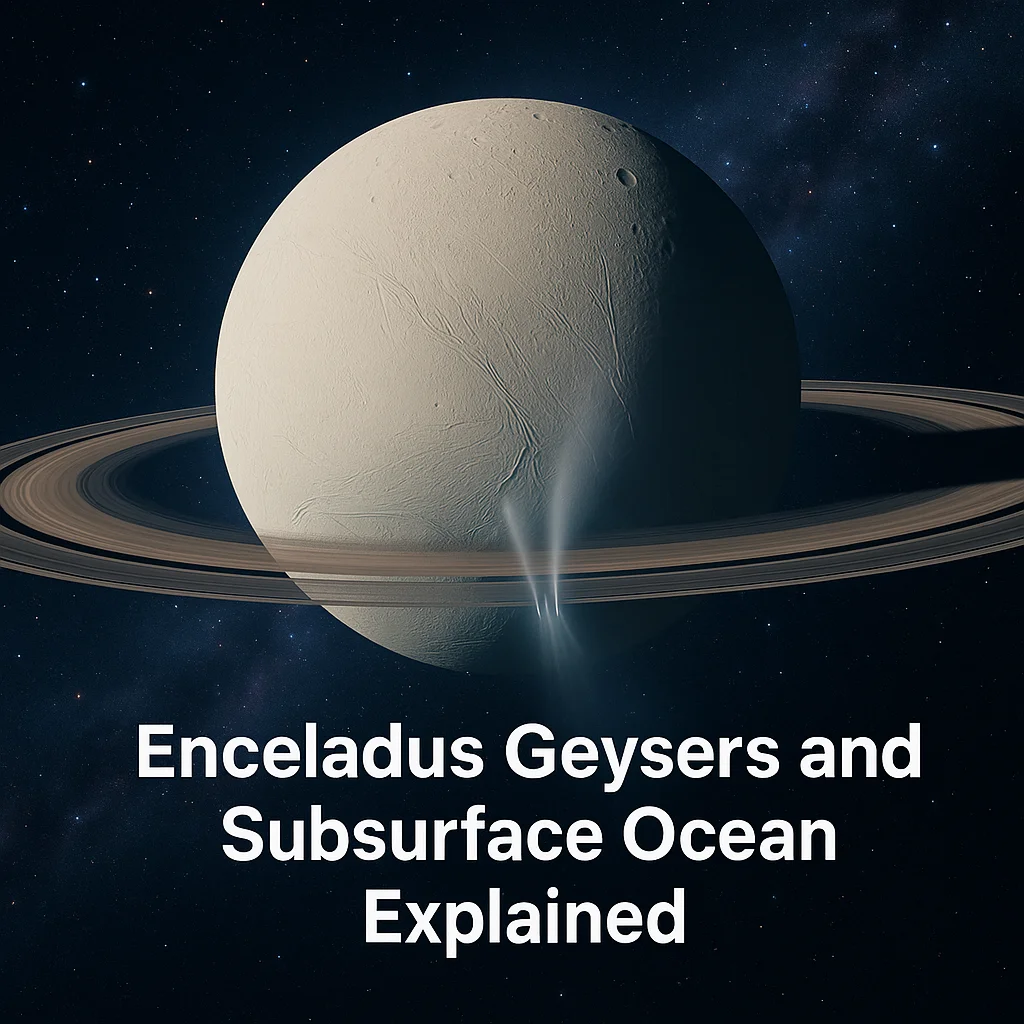
This moon has captured the attention of scientists and the public alike because it harbors conditions beneath its icy crust that could support life. In this article, you'll learn about the geysers of Enceladus, its mysterious ocean, and why it matters for our understanding of the solar system.
By exploring Enceladus, we hope to gain insight into the possibility of life elsewhere and the dynamic processes that occur beneath its surface. Throughout this journey, we will cover aspects of its location, size, gravity, atmosphere, and more, all in a simple and beginner-friendly format.
📍 Where It Is and How Far Away
Enceladus orbits around Saturn, which is the sixth planet from the Sun in our solar system. Saturn itself is a gas giant, known for its stunning ring system, with Enceladus being one of its many moons.
The distance from Earth to Saturn can vary between approximately 1 to 1.5 billion kilometers, depending on their positions in their respective orbits. This means that Enceladus is significantly far from Earth; it takes light over an hour to travel from Enceladus to us.
Because Enceladus orbits so far from the Sun, it receives minimal warmth, contributing to its icy environment. The distance means that sunlight is weak, creating a cold landscape with temperatures typically below the freezing point of water.
🧱 Size, Mass, and Gravity (Made Simple)
Enceladus is relatively small, with a diameter of about 500 kilometers, making it one of the smaller moons in the solar system. For comparison, it's roughly the size of the island of Great Britain.
Despite its size, Enceladus has a substantial mass for its volume due to its icy composition. However, its gravitational pull is weak compared to Earth. If you could stand on it, which you cannot, you would feel much lighter than you do on Earth.
The weak gravity affects how the material ejected from its geysers behaves, allowing icy particles to escape into space and contribute to one of Saturn's outer rings.
🌡️ Atmosphere and Weather
Enceladus does not have a traditional atmosphere like Earth. Instead, it has a thin wispy exosphere mainly composed of water vapor, emanating from the geysers at its south pole.
The geysers create a transient and localized atmosphere, contrasting with stable atmospheres around larger planets. These jets of water vapor and ice particles are propelled by internal heat sources below the icy crust.
Weather, as we know it on Earth, does not occur on Enceladus due to its thin atmosphere. Instead, surface conditions are dominated by temperature shifts due to its orbit and rotational axis tilt.
🪨 Surface and Interior
The surface of Enceladus is predominantly icy, presenting a reflective and bright appearance. The entire surface is visible as a bright, white icy sphere, making it one of the brightest objects in the solar system.
Underneath this icy surface lies a subsurface ocean believed to be formed and sustained by heat from gravitational interactions with Saturn and neighboring moons. These tidal forces keep parts of the ocean in a liquid state.
The interior of Enceladus is thought to consist of a rocky core surrounded by this global ocean, which is sealed off by the icy shell. This unique structure is what allows for the creation of the striking geysers observed.
🌀 Rotation, Orbit, and Seasons
Enceladus takes about 33 hours to make a full rotation on its axis, giving it a relatively quick day compared to Earth. It orbits Saturn every 1.37 Earth days, meaning it has a short year compared to our planet.
Due to its synchronous rotation, Enceladus always shows the same face to Saturn, similar to how our Moon always shows the same face to Earth. This locked rotation leads to unique thermal patterns on its surface.
Seasons on Enceladus are not pronounced due to its small axial tilt, meaning the surface experiences little variation between seasons as it orbits Saturn.
🧲 Magnetic Field and Radiation
Enceladus itself doesn't have a strong magnetic field like Earth, but it interacts with Saturn's powerful magnetic environment. This interaction causes intense radiation near Enceladus, which scientists are keen to study.
The geysers are also influenced by Saturn's magnetic field, creating a complex environment with charged particles that can be detected by spacecraft.
Understanding these interactions is crucial for planning missions to Enceladus, as they affect communication and energy requirements for spacecraft entering the environment.
🌙 Moons, Rings, and Neighbors
Enceladus is one of Saturn's most well-known moons, sharing its orbit with various other moons like Titan and Dione. Its gravitational interactions with these neighbors, along with Saturn, play a role in its geological activity.
The material from Enceladus' geysers feeds into Saturn's E ring, making it a distinct and dynamically interesting moon. This ring material consists of ice particles, which provide insight into the composition of Enceladus' underground ocean.
The study of its interaction with other moons helps scientists understand the moon's role within the Saturnian system and how it influences the structure of the rings and its siblings.
🔭 How We Know (Missions and Observations)
Most of our detailed knowledge about Enceladus comes from the Cassini spacecraft, which orbited Saturn and provided unprecedented data on its moons. Cassini flew by Enceladus multiple times, capturing images and gathering data on the moon's geysers and surface.
Telescopes from Earth also offer valuable insights by observing Enceladus' brightness changes and its contribution to Saturn's rings.
The combination of spacecraft data and telescopic observations has allowed scientists to hypothesize the existence of a subsurface ocean, understand surface composition, and appreciate the moon's dynamic environment.
❓ Common Questions and Misconceptions
Is Enceladus a planet? No, Enceladus is a moon, specifically one of Saturn's many natural satellites.
Can you stand on Enceladus? While Enceladus has a solid icy surface, it’s not suitable for human activity due to extreme cold and thin atmosphere.
Is Enceladus habitable? While Enceladus has water beneath its ice, making it interesting for the study of life, it's not habitable for humans as we know it.
Why does Enceladus have geysers? Geysers form due to heating from gravitational interactions that keep part of the subsurface ocean liquid, allowing for the ejection of water into space.
Why is Enceladus so bright? Enceladus' icy surface reflects sunlight efficiently, making the full disk of Enceladus appear extremely bright.
Can we see Enceladus from Earth? While it's too small to be seen with the naked eye, powerful telescopes can detect Enceladus as a bright point near Saturn.
Does Enceladus have an atmosphere? Not in the way Earth does; it has a thin exosphere mainly formed by water vapor from its geysers.
Is Enceladus a source for Saturn's rings? Yes, material from its geysers contributes to Saturn's E ring, spreading icy particles into space.
📌 Summary
- Enceladus is an icy moon of Saturn, known for watery geysers.
- It orbits Saturn far from the Sun, receiving minimal sunlight.
- At around 500 km wide, it's small with low gravity compared to Earth.
- No thick atmosphere; rather, a thin exosphere from its geysers.
- An icy surface hides a global ocean beneath, influencing its activity.
- Day lasts about 33 hours; year is around 1.37 Earth days, with little seasonal change.
- No intrinsic magnetic field but interacts with Saturn’s magnetosphere.
- Gravitational pull causes dynamic interactions with Saturn’s rings.
- Deep insights from Cassini spacecraft and telescopes.
- Memorable Fact: Enceladus is one of brightest objects due to its reflective icy surface.