🪐 Titan’s Lakes and Thick Atmosphere Explained
🌌 What It Is
Titan is the largest moon of Saturn, the sixth planet from the Sun in our Solar System. While it is not a planet itself, Titan is unique and holds a special place in the study of planetary science.
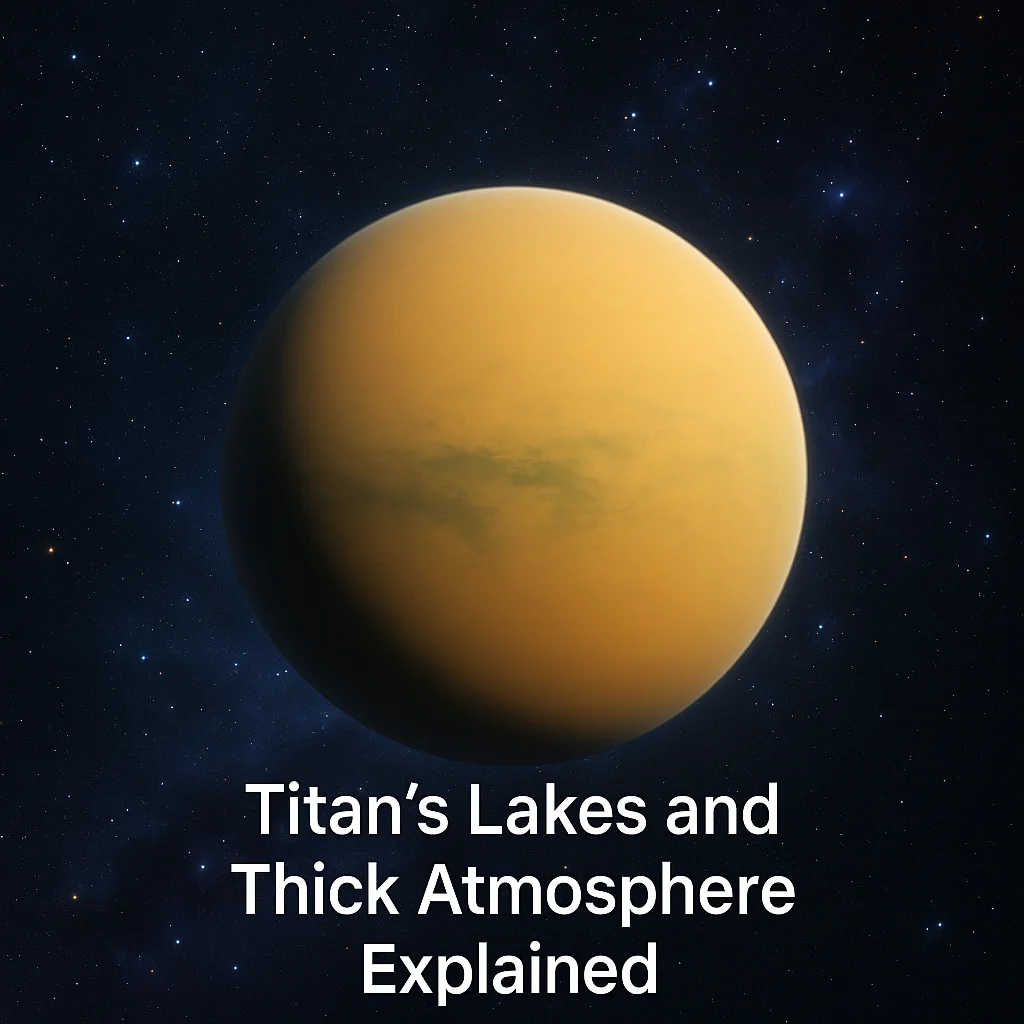
What makes Titan fascinating is its thick atmosphere and the presence of liquid lakes on its surface. Unlike any other moon, Titan's features resemble those found only on planets.
In this article, we will explore Titan's remarkable characteristics, including its location, size, atmosphere, surface, and more. Expect to learn about Titan’s environment and how scientists study this enigmatic moon.
📍 Where It Is and How Far Away
Titan is located around Saturn, the second-largest planet in the Solar System. Saturn is an outer planet made primarily of gases, which places Saturn itself about 1 billion miles from Earth, depending on their positions in orbit.
To put this distance in perspective, light from the Sun takes about 80 minutes to reach Saturn. This vast distance results in much less sunlight and much colder temperatures on Titan than what we experience on Earth.
The great distance from the Sun is one of the reasons for Titan's frigid conditions. With limited solar energy, temperatures are extremely low, impacting the chemical composition of the surface and atmosphere.
🧱 Size, Mass, and Gravity (Made Simple)
Titan is the second-largest moon in the Solar System, larger than the planet Mercury, although it holds less mass due to its lower density. Titan's diameter measures about 3,200 miles (or roughly 5,150 kilometers).
Despite its size, the gravitational pull on Titan is much weaker than on Earth. If you were to stand on Titan's surface, you would weigh about 14% of your weight on Earth, making movements feel lighter and steps longer.
Unlike the gas giants, Titan has a solid surface under its thick atmosphere, allowing for the concept of standing on it, unlike the gaseous skies of planets like Jupiter and Saturn.
🌡️ Atmosphere and Weather
The atmosphere of Titan is predominantly composed of nitrogen, much like Earth's, but it has significant amounts of methane and hydrogen as well. This thick atmosphere is one of Titan's defining features.
The presence of methane leads to complex weather patterns, including methane clouds and seasonal rains, which cycle much like water does on Earth. Titan experiences winds and periodic storms as a result.
Temperatures on Titan average around -290 degrees Fahrenheit (-179 degrees Celsius), sustained by its distance from the Sun and atmospheric chemistry that traps little heat.
🪨 Surface and Interior
Titan's surface is a fascinating mix of lakes, dunes, and icy plains, primarily shaped by methane and ethane precipitation and flowing liquids. The surface appears rugged and dynamic under its dense orange haze.
The interior of Titan is likely made up of a dense core of rock and ice, surrounded by layers of water ice, and possibly a subsurface ocean, suggested by gravitational data collected from spacecraft.
Similar to Earth, the surface features are shaped over time by both erosion and sedimentary processes, but instead of water, methane and ethane play crucial roles in this active landscape.
🌀 Rotation, Orbit, and Seasons
Titan takes about 16 Earth days to rotate on its axis, the same as its time to orbit Saturn, a characteristic known as synchronous rotation. Day and night lengths are equal on Titan.
Its orbit around Saturn leads to relatively weak seasons compared to Earth. However, the axial tilt of Saturn and Titan still allows for some seasonal changes, affecting atmospheric conditions.
Titan’s unusual rotation and orbit period mean the same side always faces Saturn, much like the Earth’s Moon, creating a predictable environment as it travels through space.
🧲 Magnetic Field and Radiation
Titan itself doesn't generate a significant magnetic field, but its thick atmosphere offers some protection from cosmic radiation and solar wind. The magnetic environment is mostly influenced by Saturn.
Auroras, caused by interactions with solar wind and Saturn’s magnetosphere, have been detected on Titan, illuminating the thick haze with light particles similar to Earth's northern lights.
This magnetic influence is crucial for understanding Titan’s atmosphere and any potential impact on spacecraft visiting the moon.
🌙 Moons, Rings, and Neighbors
Titan is one of Saturn’s 80-plus moons, making it a prominent member of a diverse celestial neighborhood. Titan’s gravitational influence helps maintain its orbit within Saturn’s extensive system of rings.
Its relationship with other moons through gravitational forces, known as resonance, can affect orbiting objects and even contribute to their geological activity.
Titan stands out due to its atmosphere and size, which drive curiosity and ongoing research into Saturn’s complex satellite system.
🔭 How We Know (Missions and Observations)
Titan has been the focus of many observation campaigns, both by spacecraft and telescopes. The Cassini-Huygens mission, a collaboration between NASA and ESA, provided most of the current data about Titan.
The Huygens probe made a historic descent to Titan’s surface in 2005, capturing images and data on atmospheric composition, surface conditions, and more.
Through these missions, scientists have employed radar and infrared imaging, vital for peering beneath Titan's thick atmospheric veil, showing liquid lakes and surface topology.
❓ Common Questions and Misconceptions
Is Titan a planet? No, Titan is a moon. It's large and planet-like, but it orbits Saturn, not the Sun.
Can you walk on Titan? Yes, but it would be challenging due to its low gravity and frigid temperatures.
Is Titan habitable? Not for humans. However, extreme conditions could potentially support microbial life in subsurface oceans.
Why does Titan look orange? Its thick atmosphere contains complex hydrocarbons, scattering sunlight to give an orange hue.
Are there real lakes on Titan? Yes, but they’re made of liquid methane and ethane rather than water.
Does it rain on Titan? Yes, although it rains methane, not water.
Is there volcanic activity on Titan? Possibly. Some regions indicate cryovolcanism, which involves icy rather than molten eruptions.
Why is it so cold? Titan is far from the Sun, resulting in limited solar energy and consistently low temperatures.
Can telescopes see Titan in detail? Earth-based telescopes see Titan as a blurry dot; detailed study requires spacecraft.
📌 Summary
- Titan is the largest moon of Saturn, exhibiting planet-like features.
- Located around the giant planet Saturn, it is over 1 billion miles from Earth.
- Titan is larger than Mercury but less massive, with weaker gravity.
- Its thick atmosphere is composed primarily of nitrogen and methane, driving exotic weather.
- The surface has lakes of methane and ethane, with an interior possibly containing a subsurface ocean.
- Titan orbits Saturn in synchronous rotation, experiencing mild seasonal changes.
- Influenced by Saturn’s magnetosphere, Titan doesn’t have a strong magnetic field of its own.
- It is one of more than 80 moons around Saturn, each contributing to a complex system.
- The Cassini-Huygens mission provided extensive data through radar and probe landings.
- Though remote and harsh, Titan remains a key interest for planetary scientists exploring life’s potential.