🪐 How Moons Get Their Atmospheres
🌌 What It Is
In the vast expanse of space, moons orbit various planets, primarily serving as their companions. These natural satellites can vary greatly in size, composition, and even potential for hosting atmospheres.
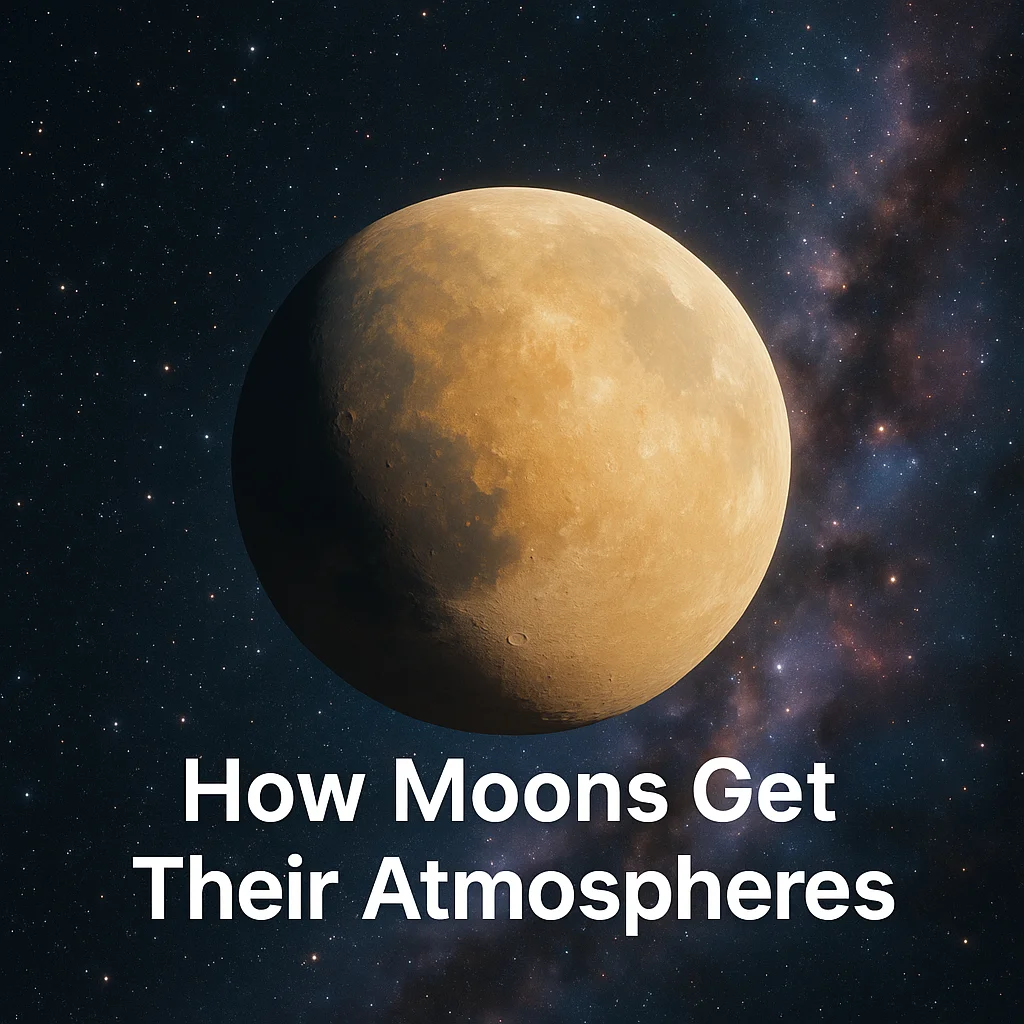
Understanding how moons acquire their atmospheres requires insight into the interplay between their physical characteristics and external environmental influences.
In this article, we'll explore the fascinating processes that can lead a moon to develop an atmosphere, the factors involved in this process, and what it reveals about the complexities of our Solar System.
📍 Where It Is and How Far Away
Moons can be found orbiting many of the planets within the Solar System, from the inner rocky worlds to the vast gas and ice giants. Each one is located at varying distances from the Sun, which directly impacts its thermal environment.
For instance, the moons of Jupiter are roughly 5 Astronomical Units (AU) away from the Sun, affecting their exposure to solar heat and radiation. One AU is the average distance from the Earth to the Sun, about 93 million miles.
The further a moon is from the Sun, the colder it generally becomes, which can influence factors like atmospheric retention and surface processes.
🧱 Size, Mass, and Gravity (Made Simple)
The size and mass of a moon are crucial in determining its gravitational pull. Moons with more mass have a stronger gravitational pull, which can help them retain an atmosphere, albeit often thin compared to Earth's.
Gravity, in simple terms, is what keeps us bound to the surface and affects how heavy we feel. However, many moons have much weaker gravity due to their smaller sizes, affecting their ability to hold onto gases.
If you were to stand on one of these moons, you would weigh much less than on Earth, which could make it challenging for them to keep atmospheres from escaping into space.
🌡️ Atmosphere and Weather
A moon's atmosphere, if present, can be composed of various gases, often determined by its chemical makeup and external influences, like solar wind or volcanic activity. Some moons have thin atmospheres mainly formed by particles sputtered from surfaces.
Weather on moons, where it occurs, is generally affected by factors like sunlight, rotation speed, and atmospheric composition. Large moons with atmospheres might experience cloud formations and wind patterns.
For example, Titan, Saturn's largest moon, has a thick atmosphere rich in nitrogen, with methane clouds and hydrocarbon lakes, driving complex weather systems within its chilly environment.
🪨 Surface and Interior
Moons can have diverse surfaces, ranging from rocky to icy terrains. Features such as craters, mountains, and even possible volcanic activity shape their landscapes, depending on their histories and compositions.
For icy moons, the surface might consist of frozen water or other volatiles. Some moons have internal heating mechanisms potentially driven by gravitational interactions, which could lead to subsurface oceans.
Understanding a moon's interior involves examining its layers, such as a core or mantle, which may hint at geological activity and potential for tectonics, influencing surface features over time.
🌀 Rotation, Orbit, and Seasons
The rotation period of a moon, often referred to as its "day," can differ significantly. Some moons, like our own Moon, are tidally locked to their planet, always showing the same face.
Orbits also vary, influencing the length of a moon's "year." These orbits, along with axial tilts, if present, can create seasons or result in stable or chaotic climates.
Tilt variation might mean that a moon experiences changing sun angles across its surface, causing seasonal temperature changes and affecting potential atmospheric dynamics.
🧲 Magnetic Field and Radiation
The presence of a magnetic field around a moon can offer insights into its internal dynamics and influence its ability to retain an atmosphere. Such fields can deflect radiation and charged particles.
Moons without magnetic fields may be more exposed to cosmic and solar radiation, affecting surface conditions and atmospheric composition by sputtering.
These interactions are vital for understanding space weather impacts on moons and conditions that spacecraft might encounter when exploring them.
🌙 Moons, Rings, and Neighbors
Many moons have intricate relationships with their planets, other nearby moons, or ring systems, which can impact their surfaces and atmospheres through gravitational interactions.
Notable moons like Io have intense volcanic activity partly due to gravitational tugs from Jupiter and neighboring moons, contributing sulfur compounds to its thin atmosphere.
While some moons have complex systems around them to study, others lack these features, offering simpler environments for examination.
🔭 How We Know (Missions and Observations)
Our understanding of moons and their atmospheres comes from telescopes and spacecraft, each offering unique insights. Telescopes capture visual and spectral data, revealing atmospheric composition and surface characteristics.
Space missions play a vital role in direct exploration. Notable missions like Galileo to Jupiter and Cassini-Huygens to Saturn have greatly expanded our knowledge of their moons.
These missions gather data from images, magnetic readings, and atmospheric samples, providing a clearer picture of the moons' nature and potential habitability.
❓ Common Questions and Misconceptions
Is every moon like our Moon? No, moons vary widely in size, composition, and activity.
Can you stand on all moons? Many have solid surfaces, but some are extremely icy or rocky, making standing difficult.
Are moons just big rocks? While some are heavily cratered, others have active geology or atmospheres.
Do moons have weather? Some, like Titan, experience active weather, but most have minimal or no weather.
Can moons have life? While moons like Europa and Titan intrigue scientists, definitive evidence of life elsewhere has yet to be found.
Is every moon close to its planet? Not always; distances vary, affecting gravitational influences and atmospheric conditions.
Why do some moons have atmospheres when others don't? Factors include size, distance from the Sun, and volcanic or chemical activity.
Can we visit moons with current technology? Yes, missions like those to our Moon and robotic explorations prove it's possible.
Do moons have auroras? Moons with magnetic fields might experience auroras, though they would differ from Earth's.
📌 Summary
- Moons are natural satellites of planets, varying in size and features.
- They orbit planets at different distances, which influences their thermal environment.
- The size and mass of a moon affect its gravity and ability to hold an atmosphere.
- Moons may have thin atmospheres with unique compositions, driven by sunlight and internal processes.
- Their surfaces can be rocky or icy, featuring craters, volcanism, or tectonic features.
- Moons have diverse rotation and orbital characteristics influencing their climate and stability.
- Some moons have magnetic fields; others face direct cosmic and solar radiation.
- Moons interact with planetary rings and gravitationally affect each other in complex ways.
- We learn about moons through telescopic observations and space missions.
- Titan is remarkable for its dense atmosphere and hydrocarbon lakes, offering insights into alien weather systems.