🪐 Ocean Worlds Explained (Europa, Enceladus, and More)
🌌 What It Is
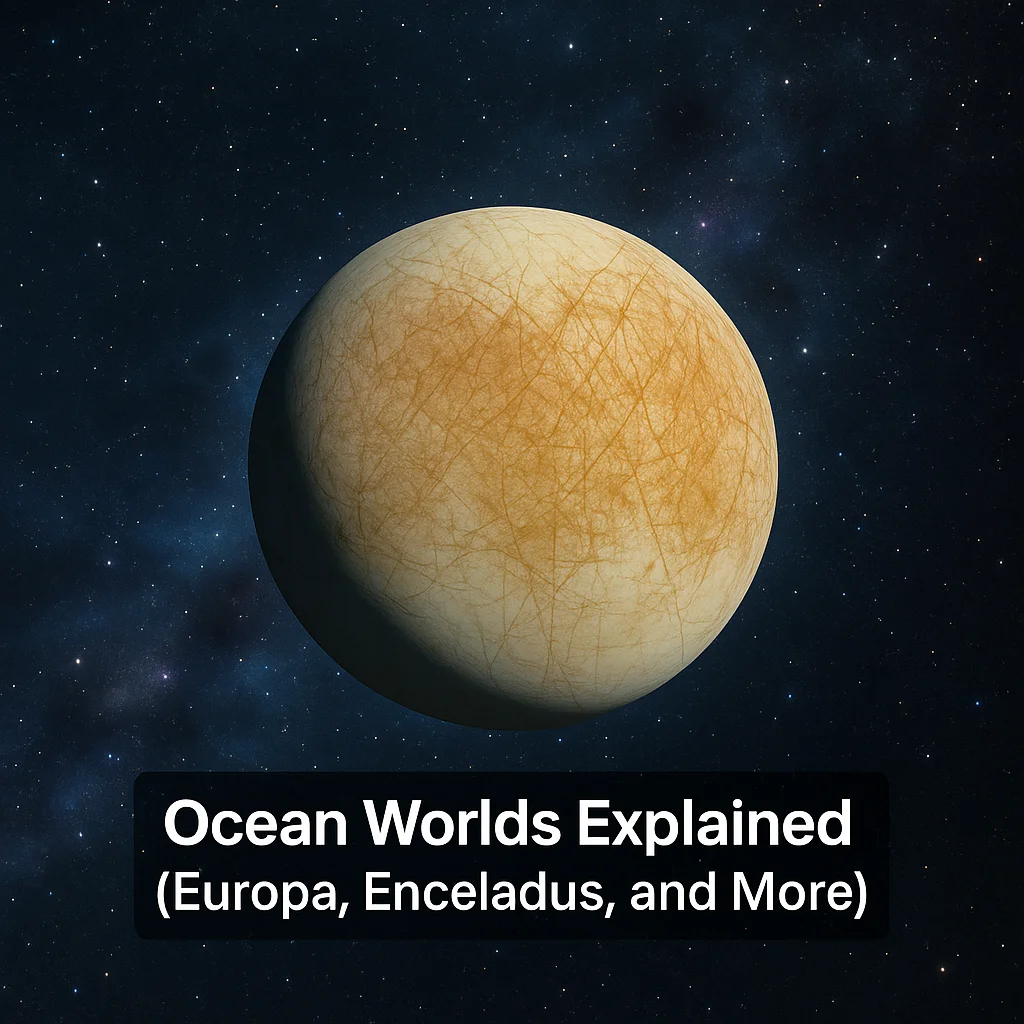
Ocean worlds are celestial bodies in our Solar System that possess significant amounts of liquid water beneath their surfaces. These fascinating moons and planets are thought to harbor subsurface oceans, making them intriguing targets in the search for extraterrestrial life. Some of the most renowned ocean worlds include Europa, one of Jupiter's moons, and Enceladus, a moon of Saturn.
The interest in ocean worlds stems from their potential to support life. Water is a key ingredient for life as we understand it on Earth, and the presence of liquid water on other planets or moons raises the possibility that they may harbor life forms, albeit of a very different nature.
In this article, we will explore the characteristics of these captivating celestial bodies, including their location, size, atmosphere, surface features, and more. By the end, you'll have a better grasp of why ocean worlds are considered one of the most promising sites in our Solar System for discovering signs of life.
📍 Where It Is and How Far Away
Ocean worlds like Europa and Enceladus are located far from Earth in the outer regions of our Solar System. Europa orbits Jupiter, the fifth planet from the Sun, while Enceladus circles Saturn, the sixth planet. Despite their distance, these moons continue to captivate scientists due to their unique features.
The distances to these ocean worlds can be daunting when translated into miles or kilometers, so astronomers use the term Astronomical Unit (AU), which is the mean distance from the Earth to the Sun, approximately 93 million miles. Europa is located about 5.2 AU from the Sun, translating to a significant journey for any spacecraft.
Europa and Enceladus receive far less sunlight than Earth, affecting their surface temperatures. These bodies are incredibly cold by earthly standards, but geothermal activity might keep water beneath their icy shells in a liquid state, making them especially interesting to scientists who study potentially habitable environments beyond Earth.
🧱 Size, Mass, and Gravity (Made Simple)
In terms of size, Europa is slightly smaller than Earth's moon, with a diameter of about 1,900 miles. Enceladus is even smaller, with a diameter of roughly 310 miles. The sizes of these moons play a critical role in their low gravity; Europa's gravity is just 13% of Earth's, while Enceladus has roughly 1% of Earth's gravity.
This low gravity means that if you stood on Europa, you'd weigh significantly less than on Earth. For example, a person weighing 100 pounds on Earth would feel like they weighed only 13 pounds on Europa. This reduced gravity not only has implications for potential human exploration but also affects the shape and stability of the oceans beneath their surfaces.
For celestial bodies without a solid surface, such as gas giants, "standing" is a tricky concept, but these moons have solid surfaces covered in ice. Their relatively small mass affects their ability to hold onto an atmosphere, which we'll explore next.
🌡️ Atmosphere and Weather
Europa and Enceladus have very thin atmospheres compared to Earth. Europa's atmosphere is primarily composed of oxygen, although it is far too thin to breathe. Enceladus has an atmosphere that contains water vapor, along with traces of nitrogen and carbon dioxide.
Unlike Earth, these moons do not experience weather in the traditional sense. There's no rain, no wind, and no seasonal changes. Instead, their weather patterns are driven by geological activity beneath their icy crusts, occasionally resulting in geysers or plumes that may spray water vapor and ice particles into space.
The lack of a thick atmosphere means there is little to no surface weather phenomena, such as storms or pressure systems, that we commonly associate with planetary atmospheres on Earth. This provides unique environments for scientific study and the possibility of life as it may exist elsewhere.
🪨 Surface and Interior
The surfaces of Europa and Enceladus are primarily composed of water ice, which creates a bright, reflective appearance with the whole moon's surface visible in images. Surface features include cracks and ridges formed by the gravitational interactions with their respective planets, coupled with subsurface forces.
It's believed that beneath their icy shells lie vast oceans of liquid water, kept from freezing by geothermal heat. On Europa, the ocean is suspected to be in contact with the moon's rocky mantle, which could provide the chemical energy necessary for life.
Enceladus, on the other hand, shows geyser-like plumes at its south pole, confirming the presence of liquid water and possibly hydrothermal activity. These subsurface oceans and interactions between water and rock may provide the raw materials essential for the development of life.
🌀 Rotation, Orbit, and Seasons
Europa and Enceladus both exhibit synchronous rotation, meaning they keep the same face towards their parent planet, much like our Moon does towards Earth. Europa completes one orbit around Jupiter in roughly 3.5 Earth days, while Enceladus orbits Saturn in about 1.4 Earth days.
These moons have negligible axial tilt, which means they do not experience varied seasons like Earth does. However, their elliptical orbits contribute to tidal heating, which plays a crucial role in maintaining their subsurface oceans in a liquid state.
Their rapid orbits and lack of significant seasonal changes create a stable environment beneath their shells, emphasizing the importance of gravitational forces in shaping their current state and potential habitability.
🧲 Magnetic Field and Radiation
Europa is immersed in Jupiter's strong magnetic field, which induces a slight magnetic field in Europa, a hint at the conductive saltwater ocean beneath its icy shell. This interaction creates a safe environment shielded from some of the harsh space radiation.
Enceladus lacks a magnetic field of its own but is bathed in Saturn's magnetic environment. The geysers and plumes eject water vapor and ice, contributing to Saturn's E-ring and creating a more neutral and safe environment for hypothetical microbes.
These dynamic interactions offer crucial insights into both moons' interiors, enhancing our understanding of their geological activity and potential habitability in the context of ocean worlds.
🌙 Moons, Rings, and Neighbors
Europa is one of the four largest moons of Jupiter and interacts gravitationally with its sibling moons, Io and Ganymede, in orbital resonance. This gravitational dance influences its geological activity and, by extension, its subsurface ocean.
While Enceladus is one of Saturn's smaller moons, its environmental impact is monumental. The water plumes near its south pole contribute material directly to Saturn's E-ring, setting the stage for complex tidal forces and geological phenomena.
The presence of nearby moons and ring systems adds layers of complexity to these ocean worlds, highlighting the intricate relationships and gravitational influences that can help maintain liquid oceans in such cold environments.
🔭 How We Know (Missions and Observations)
The understanding of Europa and Enceladus comes from both Earth-based telescopes and spacecraft. The Galileo mission provided key insights into Europa during its visit to Jupiter, while the Cassini mission offered invaluable information about Enceladus during its time at Saturn.
Spacecraft equipped with cameras, spectrometers, and magnetometers have measured light spectra, assessed gravitational fields, and captured data on magnetic interactions. These observations reveal much about the moon's interior structures and surface compositions.
Future missions like NASA’s Europa Clipper are set to further explore these worlds, enhancing our understanding of their potential habitability and the complexities beneath their icy surfaces. These missions aim to investigate the chemical composition of plumes and ice and will continue to unveil the mysteries of these fascinating moons.
❓ Common Questions and Misconceptions
Is Europa a star? No, Europa is a moon orbiting Jupiter.
Can you stand on Enceladus? Yes, but it's incredibly cold and would require specialized gear.
Is there life on these moons? Scientists have found no direct evidence of life, but the environments may support it.
Why are they so smooth in images? The icy surface reflects sunlight well, making them appear bright.
Is Enceladus composed entirely of ice? No, it has a rocky core beneath its icy shell.
Do these moons have seasons? Minimal to no seasons due to their low axial tilt.
Are they completely solid? No, they likely have subsurface oceans.
Do they have atmospheres like Earth? Their atmospheres are extremely thin, not supportive of human life.
Why search for microbes? Microbes are resilient life forms that could thrive in extreme environments similar to early Earth.
Are these worlds visible to the naked eye? Not from Earth; they require telescopic observation.
📌 Summary
- Ocean worlds like Europa and Enceladus harbor subsurface oceans.
- Located in the outer Solar System, orbiting Jupiter and Saturn.
- Small with low gravity; Europa similar in size to Earth's moon.
- Thin atmospheres; Europa's has oxygen, Enceladus shows plumes.
- Ice-covered surfaces with possible geothermal heat below.
- Synchronous rotation; short orbits influence internal heating.
- Subtle magnetic interactions; shielded environments.
- Influence and are influenced by their planet's rings and sibling moons.
- Knowledge largely comes from missions like Galileo and Cassini.
- Potentially bodes well for life; key interest in astrobiology.