🪐 Why Some Moons Are Captured Objects
🌌 What It Is
Captured moons are fascinating celestial bodies that intrigue astronomers and space enthusiasts alike. These moons differ from others due to their unique origin story: they are not formed from the same material surrounding their planet, but instead, they are believed to be objects that were gravitationally snared by a planet as they drifted through space.
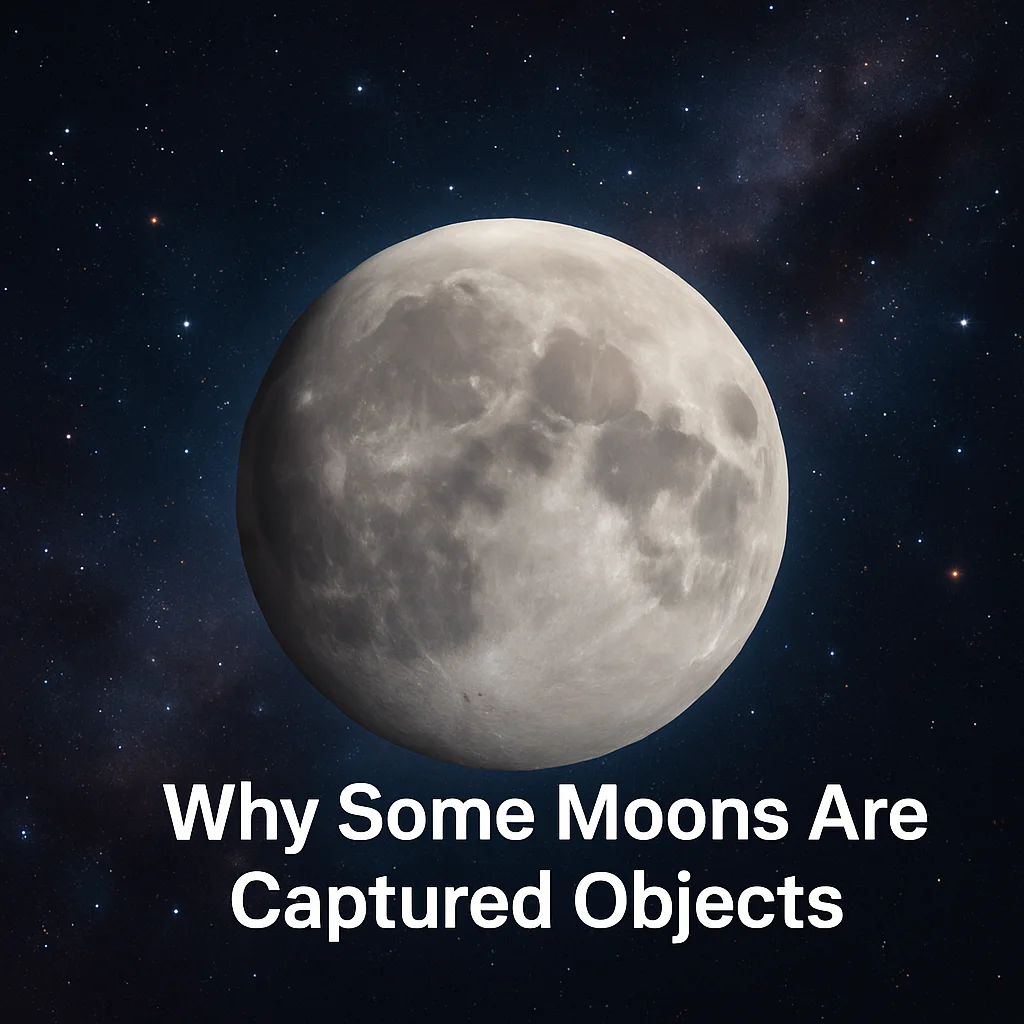
Unlike moons that form from the debris around a planet, captured objects can vary greatly in composition and appearance. Understanding these captured moons helps scientists learn more about gravitational influences and the history of our Solar System.
In this article, we will explore the concept of captured moons, where they can be found, their physical characteristics, and the factors that contribute to their capture by a planet's gravity.
📍 Where It Is and How Far Away
Captured moons are located within our Solar System, orbiting various planets like Jupiter, Saturn, and Neptune. They include well-known moons like Triton, which orbits Neptune. Triton is thought to have once been a part of the Kuiper Belt, a region of icy bodies beyond Neptune.
These moons are several astronomical units (AU) away from Earth. One AU is the average distance between the Earth and the Sun, about 93 million miles. For example, Neptune, with its captured moon Triton, resides over 30 AU from the Sun, making it a distant realm.
Their distance from the Sun plays a critical role in their environment, affecting temperatures and sunlight exposure. Such factors influence whether a captured moon retains an atmosphere and sustains geological activity.
🧱 Size, Mass, and Gravity (Made Simple)
Captured moons vary significantly in size, from small asteroids to large bodies like Triton, which is about 2,700 kilometers in diameter. This diversity in size affects their mass and gravitational pull.
A moon's gravity allows it to influence its environment, like maintaining an orbital path around its planet or potentially affecting other nearby moons. Smaller captured moons might not have enough gravity to shape themselves into spheres, often appearing irregular in shape.
The gravity of a captured moon dictates how it interacts with other celestial bodies, playing a crucial role in its capture and whether it collides with orbits around the planet.
🌡️ Atmosphere and Weather
Whether a captured moon has an atmosphere depends largely on its size and ability to retain gases. Larger captured moons like Triton have thin atmospheres of nitrogen with traces of methane.
Weather patterns on captured moons can also be fascinating. Triton's thin atmosphere allows for some surface activity, evidenced by geysers that release plumes of nitrogen gas.
The weather and atmospheric conditions are greatly affected by the moon's distance from the Sun, resulting in much cooler temperatures and limited gaseous retention compared to inner Solar System bodies.
🪨 Surface and Interior
The surface compositions of captured moons are diverse, often reflective of their origins before capture. Triton, for example, has a surface of frozen nitrogen, methane, and water ice.
Captured moons can have unique geographical features due to their history. Triton shows signs of past volcanic activity and its icy surface is marked by unusual ridges and valleys.
Much like Earth, some captured moons may possess differentiated interiors, with layers like a core, mantle, and crust, although such features might not be as well-defined as those on larger celestial bodies.
🌀 Rotation, Orbit, and Seasons
Captured moons often have orbits and rotations that differ from moons that formed in place. Triton, for instance, has a retrograde orbit, meaning it orbits Neptune in the opposite direction to the planet's rotation.
The capture process can result in irregular or elliptical orbits. These orbital characteristics can impact the length of a moon's day and the consistency of its seasons.
Many captured moons experience tidal interactions with their planets, which can gradually alter their orbits and rotation over time, potentially leading to even more unusual movement patterns.
🧲 Magnetic Field and Radiation
Magnetic fields in captured moons are often unpredictable due to their varied compositions and sizes. Large captured moons might exhibit significant magnetic features, while smaller ones do not.
Radiation from the host planet's magnetosphere can affect the surface of a captured moon. Triton, being close to Neptune, is influenced by its magnetic field, which can alter its surface over time.
Understanding magnetic fields and radiation levels is crucial for planning spacecraft missions, as they help anticipate the electronic and material challenges spacecraft might encounter.
🌙 Moons, Rings, and Neighbors
Captured moons are often accompanied by other natural satellites and, in some cases, ring systems of their parent planet. Triton, for example, is not alone in orbiting Neptune, sharing its path with over a dozen others, though none are as massive.
The gravitational dance among neighboring moons can lead to interesting phenomena, such as tidal heating or orbital resonance, which can affect their geological activity.
In instances where a captured moon is the only large moon or part of a sparse system, scientists study why it might have been captured without forming additional satellites.
🔭 How We Know (Missions and Observations)
Our understanding of captured moons comes from a combination of telescopic observations and spacecraft missions. Telescopes allow us to observe surface features and orbital patterns from afar.
Spacecraft missions provide detailed data on captured moons that telescopes cannot, such as measurements of the surface composition and atmospheric properties. The Voyager 2 mission, for instance, gave us a close look at Triton's surface and provided invaluable data.
Images, spectra, and gravitational readings from these missions help scientists piece together the history and behavior of captured moons, offering insights into their past and future.
❓ Common Questions and Misconceptions
Is a captured moon still a real moon? Yes, a captured moon functions just like any other moon, orbiting its planet due to gravitational forces.
Can a captured moon have life? While it's unlikely due to harsh conditions, the possibility isn't entirely ruled out, especially under subsurface ice layers.
Are captured moons always irregularly shaped? Not necessarily. Size and composition determine shape more than origin alone. Larger moons can become spherical through gravity.
Would a captured moon look visibly different? Not always. Being captured doesn't mean it looks distinct without detailed observation.
Is Triton the only captured moon? No, several other moons in the Solar System are believed to be captured, especially around giant planets.
Can a small planet capture a moon? It's less likely, as larger planets exert the necessary gravitational influence for capture.
📌 Summary
- Captured moons are celestial bodies snared by a planet's gravity.
- They orbit planets like Jupiter, Saturn, and Neptune, far from the Sun.
- Sizes vary greatly, affecting shape, mass, and gravitational interactions.
- Atmospheres might form on larger moons, influencing weather patterns.
- Surface features can include volcanoes, ridges, and ice due to varied origins.
- They often have unusual orbital properties, like retrograde motion in Triton's case.
- Magnetic fields and radiation can impact their surfaces and potential for life.
- They can exist with or without additional moons or ring systems nearby.
- Our knowledge comes from telescopes and missions, like those to Triton.
- Captured moons, like Triton, challenge our understanding of planetary systems.