🪐 Best Time to See Saturn (General Tips)
🌌 What It Is
Saturn is one of the most fascinating planets in our Solar System. Known for its spectacular ring system, Saturn is a gas giant like Jupiter, Uranus, and Neptune. These planets are much larger than the terrestrial planets and primarily composed of gases and ices.
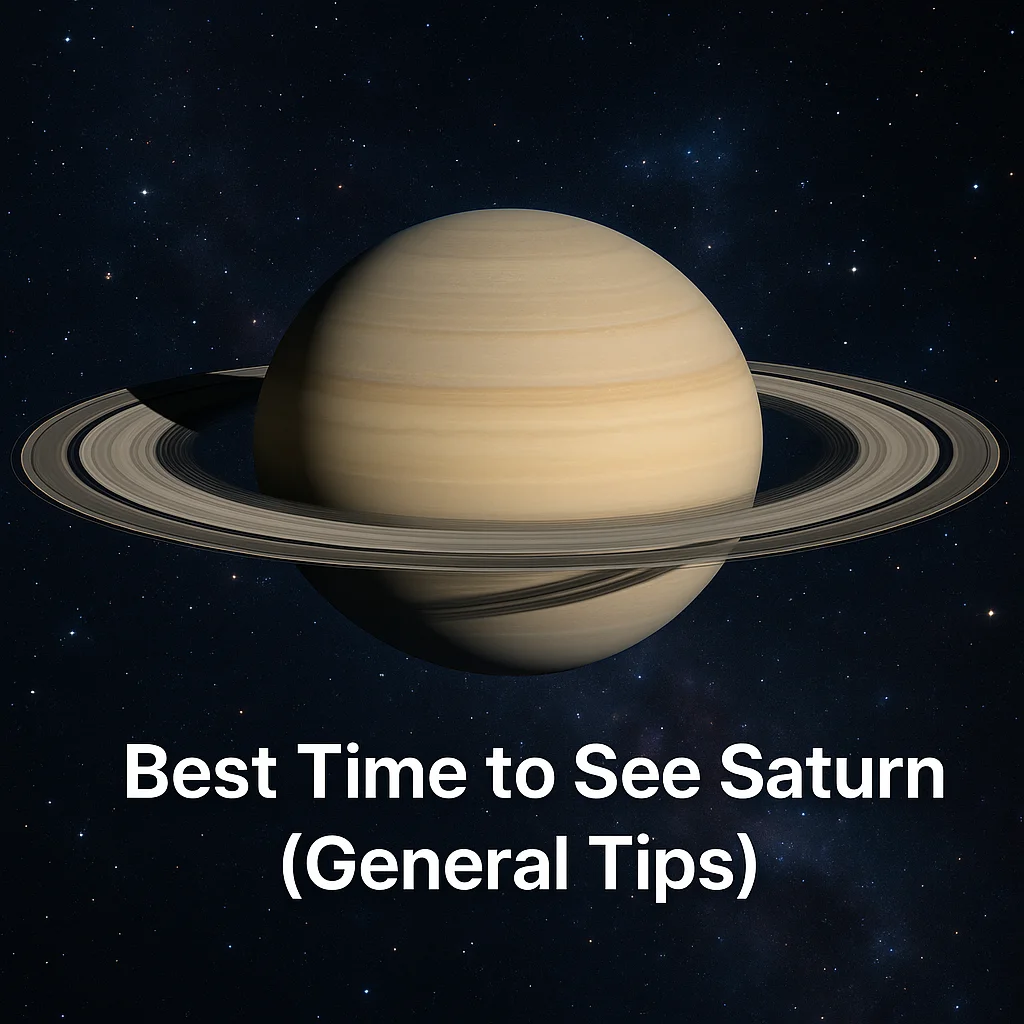
As the sixth planet from the Sun, Saturn is classified as an outer planet. It is far from the warmth of our central star, which influences many of its features. In this article, you will learn about Saturn's position, size, atmosphere, and more.
Through understanding its characteristics and position relative to Earth, you'll discover when and how to observe this majestic planet in the night sky.
📍 Where It Is and How Far Away
Saturn is located in the outer reaches of the Solar System, orbiting the Sun at an average distance of about 9.5 astronomical units (AU). An astronomical unit is the average distance from the Earth to the Sun, around 93 million miles. This means Saturn is about 884 million miles away from the Sun.
Because of its vast distance from the Sun, Saturn receives much less sunlight than Earth does, leading to significantly colder temperatures. Its position in the Solar System also means that it takes longer to complete a single orbit around the Sun.
Due to its orbit, Saturn's visibility from Earth changes over time. The best opportunity to see Saturn is during opposition, when the planet is directly opposite the Sun in the sky from Earth's perspective. During opposition, it is also closest to Earth, providing stunning views through a telescope.
🧱 Size, Mass, and Gravity (Made Simple)
Saturn is the second largest planet in the Solar System, dwarfed only by Jupiter. Its diameter is roughly nine times that of Earth. However, despite its enormous size, Saturn is composed mostly of hydrogen and helium, giving it a lower density compared to Earth.
If you could place Saturn in a gigantic bathtub, it would float! This is because its average density is less than that of water. Although it lacks a solid surface, the immense mass of the planet still provides a strong gravitational pull.
While standing on Saturn is impossible due to its gaseous composition, the "surface" gravity would feel similar to Earth because of its vast size compensating for its low density.
🌡️ Atmosphere and Weather
Saturn's atmosphere is primarily hydrogen and helium, with traces of methane, ammonia, and other gases. These elements create a colorful but thick atmosphere, with layer upon layer of clouds swirling in intricate patterns.
Strong winds and storms are a hallmark of Saturn's weather, with some wind speeds reaching up to 1,100 mph. The planet's rapid rotation—completing a day in about 10.7 hours—contributes to this extreme weather by creating intense banding patterns across its atmosphere.
The weather on Saturn is also influenced by internal heating beyond just solar energy. This internal heat helps drive the ferocious storms and contributes to the overall active nature of the planet's climate.
🪨 Surface and Interior
As a gas giant, Saturn doesn't have a solid surface like Earth's. Instead, it transitions into denser fluid and gaseous layers as you move closer to the core. Scientists describe Saturn as having a series of layers, starting with its outer atmosphere and extending to a dense core.
The core is believed to be composed of heavier elements, such as rock and metal, surrounded by layers of metallic hydrogen and helium. These layers create a gradual transition rather than an abrupt surface boundary.
Because of this lack of a solid surface, exploring Saturn's interior relies heavily on indirect observations, such as studying its gravitational and magnetic fields, as well as atmospheric probes.
🌀 Rotation, Orbit, and Seasons
Saturn's rapid rotation leads to a short day of only about 10.7 hours. This quick spin flattens the planet slightly at the poles, causing its distinct oblate shape.
When it comes to its orbit, Saturn takes about 29.5 Earth years to complete one trip around the Sun. This lengthy orbit and slight axial tilt mean that Saturn experiences extended seasons, each lasting over seven years.
The axial tilt of Saturn is similar to Earth's, which results in seasonal changes, impacting the angle at which sunlight strikes the planet and its rings.
🧲 Magnetic Field and Radiation
Saturn possesses a significant magnetic field, generated by the movement of conductive materials within its interior. This magnetic field is weaker than Jupiter's but still capable of producing auroras, similar to the Northern and Southern Lights on Earth.
The planet's magnetic field also traps charged particles, forming radiation belts similar to Earth's Van Allen belts. This harsh environment poses challenges to spacecraft operating in close proximity.
The interaction between Saturn's magnetic field and solar wind also generates space weather phenomena, influencing the planet's auroras and affecting any potential atmosphere of its moons.
🌙 Moons, Rings, and Neighbors
Saturn is possibly best known for its spectacular ring system, which can be seen in its full glory when the entire planet and rings are perfectly centered in view through telescopes. The rings are composed of countless small particles of ice and rock, each orbiting the planet.
In addition to its rings, Saturn is accompanied by at least 82 moons, with Titan being the most famous. Titan is larger than the planet Mercury and has a thick atmosphere rich in nitrogen, similar to Earth's.
These moons and the rings are in constant dynamic interaction. Their gravitational forces create resonances and gaps within the rings and influence the orbits of other moons.
🔭 How We Know (Missions and Observations)
Much of what we know about Saturn comes from both ground-based telescopes and space missions. Telescopes provide initial images and basic data, while spacecraft like the Cassini-Huygens mission offer in-depth analysis.
The Cassini spacecraft orbited Saturn for over a decade, capturing detailed images and conducting scientific experiments. It provided remarkable insights into Saturn's atmosphere, magnetic field, rings, and moons.
Through these missions, scientists collect data in forms such as images, spectral readings, and magnetic measurements, helping to build a comprehensive understanding of this complex planet.
❓ Common Questions and Misconceptions
Is Saturn a star? No, Saturn is a planet, and unlike a star, it does not produce its own light. It reflects sunlight.
Can you stand on Saturn? Saturn is composed mostly of gas and lacks a solid surface, so standing on it is not possible.
Is Saturn habitable? Saturn's environment is extremely hostile, with no solid surface and extreme pressures, making it uninhabitable.
Why does Saturn have rings? The rings are made of ice and rock particles, which are likely remnants of comets, asteroids, or shattered moons.
Are the rings solid? No, they are composed of countless small particles, ranging in size from tiny grains to large boulders.
What color is Saturn? Saturn has a pale yellow hue, with slight banding and ring shadows adding subtle colors.
📌 Summary
- Saturn is a gas giant, known for its iconic rings.
- It is the sixth planet from the Sun and far from Earth.
- Despite its size, it has a low density; would float on water.
- Atmosphere primarily hydrogen and helium with fierce storms.
- No solid surface; interior made of layers leading to a dense core.
- Rotates rapidly with a day of about 10.7 hours, a year lasts 29.5 Earth years.
- Has a significant magnetic field and radiation belts.
- Boasts a ring system and many moons, including Titan.
- Studied through telescopes and missions like Cassini.
- Known for its grand rings and the complexity of its dynamic system.