🪐 Why Planets Don’t Twinkle Like Stars
🌌 What It Is
When we look up at the night sky, we often see stars twinkling brightly. But have you ever noticed that planets do not twinkle like stars? This phenomenon is rooted in the nature of these celestial objects and the way light travels through Earth’s atmosphere.
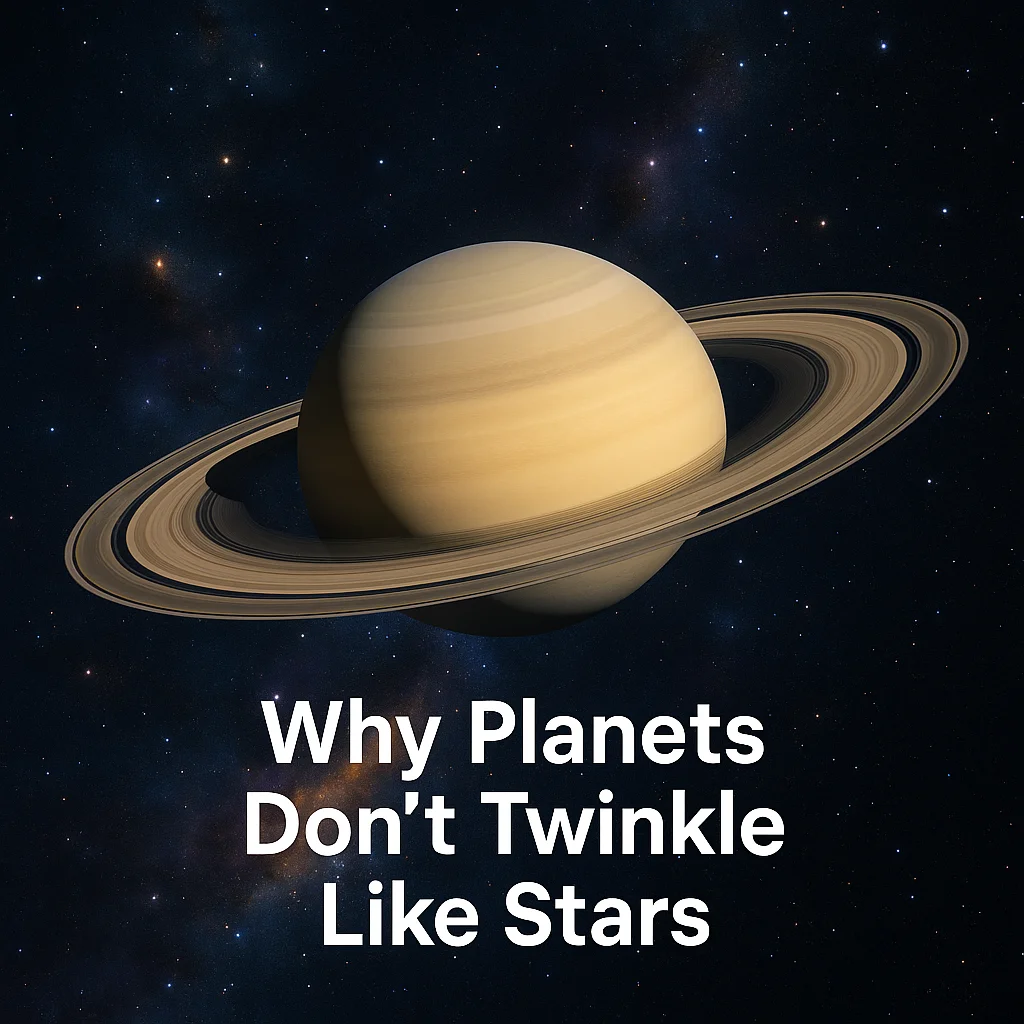
Planets are astronomical bodies that orbit a star, the most familiar of which are the eight planets in our Solar System. They can be classified based on their position and composition, such as the rocky inner planets like Earth and Mars, or the gas and ice giants like Jupiter and Neptune.
In this article, we'll explore why planets appear to shine steadily compared to the twinkling stars and provide insights into their characteristics, behaviors, and mysteries.
📍 Where It Is and How Far Away
Planets reside in the Solar System, which is a small part of our galaxy, the Milky Way. The distances between the planets and the Sun vary greatly. For example, Mercury is just about 36 million miles away from the Sun, while Neptune is a distant 2.8 billion miles.
To comprehend these vast distances, astronomers use astronomical units (AU), where 1 AU is the average distance from the Earth to the Sun, approximately 93 million miles. Thus, Mercury is about 0.39 AU away, whereas Neptune is 30.07 AU from the Sun.
These distances influence the temperature and light each planet receives. Closer planets receive more sunlight, leading to warmer conditions than those situated farther away, where it is colder and dimmer.
🧱 Size, Mass, and Gravity (Made Simple)
Planets come in varied sizes and masses, influencing how much they weigh and the gravity on their surfaces. For instance, Jupiter, the largest planet, is about 11 times the diameter of Earth and has over 300 times its mass.
Gravity is the force that attracts objects toward one another. On Earth, it keeps us grounded. Jupiter's strong gravitational pull would make you feel much heavier if you could stand there, hypothetically, since it doesn't have a solid surface.
In contrast, Mars is about half the size of Earth with less gravity, so you'd feel lighter there. The surface gravity of a planet affects how high you could jump and the atmosphere's structure.
🌡️ Atmosphere and Weather
The atmosphere envelops a planet, composed of gases that vary from planet to planet. For example, Earth's atmosphere is rich in nitrogen and oxygen, while Venus has a thick carbon dioxide layer with clouds of sulfuric acid.
Weather patterns, such as clouds and winds, result from the planet's rotation and solar heating. On Jupiter, storms can last for centuries, while Mars experiences dust storms that envelop the entire planet.
The atmospheric thickness and composition influence surface temperatures. Venus is the hottest planet, despite being further from the Sun than Mercury, due to its thick atmosphere that traps heat like a blanket.
🪨 Surface and Interior
Planets have diverse surfaces and internal structures. Rocky planets, like Mars, display craters, volcanoes, and canyons shaped by past volcanic activity and impacts. On Venus, volcanic plains dominate its landscape.
Gas giants, such as Jupiter and Saturn, do not have solid surfaces; they consist of thick gaseous layers leading into liquid interiors with a possible rocky core deep inside. Their structures are defined by the various gas layers exerting pressure as one moves inward.
Understanding a planet’s interior involves studying its seismic activity (if available) and magnetic field, providing insights without directly observing the core.
🌀 Rotation, Orbit, and Seasons
Planets rotate on their axes and orbit the Sun, governing the length of a day and a year. Earth, with a 24-hour rotation and a 365-day orbit, sets a standard that differs for each planet. For instance, Jupiter rotates in just 10 hours, leading to short days.
A planet's tilt affects its seasons. Earth's axis is tilted, giving us various seasons. Uranus has a unique tilt of over 90 degrees, causing extreme seasonal variations as each pole points toward and away from the Sun over its 84-year orbit.
These variations in rotation and orbit create diverse seasonal patterns, influencing planetary climates significantly.
🧲 Magnetic Field and Radiation
A magnetic field surrounds many planets, formed by spinning liquid cores that generate electric currents. Earth's magnetic field offers protection against solar and cosmic radiation, displaying auroras at high latitudes.
Jupiter possesses a powerful magnetic field, shielding it and its moons from high radiation levels, affecting spacecraft navigating its vicinity. The planet’s strong magnetic interactions are caused by its fast rotation and metallic hydrogen interior layer.
The presence and strength of a magnetic field are crucial for understanding a planet's ability to support life and influence nearby space weather.
🌙 Moons, Rings, and Neighbors
Planets can have moons and rings, dynamically interacting through gravitational forces. Jupiter has the most known moons in the Solar System, with vibrant volcanic activity seen on its moon Io, due to tidal forces.
Saturn is famous for its spectacular ring system that consists of ice particles, rocks, and dust, forming intricate patterns. The gravitational effect shapes moons and rings by maintaining their orbital paths.
Some planets, like Mercury and Venus, have no moons, underscoring the diversity of celestial bodies and gravitational conditions experienced across the Solar System.
🔭 How We Know (Missions and Observations)
Our understanding of planets comes from telescopic observations and spacecraft missions that provide detailed data. Telescopes can reveal a planet's light and spectral data, informing us about its atmosphere and composition.
Spacecraft, such as the Voyager and Cassini missions, have visited planets, sending back images and data about their surfaces, atmospheres, and magnetic fields. These missions provide direct insights into their environments.
The blend of telescopic studies and direct spacecraft exploration allows scientists to form a comprehensive picture of planetary properties and processes.
❓ Common Questions and Misconceptions
Is a planet a star? No, planets reflect light, whereas stars produce their own.
Can you stand on a gas giant? No, gas giants lack a solid surface to stand on.
Is Earth the only habitable planet? Currently, Earth is the only planet known to support life.
Why doesn’t a planet twinkle? Planets have a steady light as their larger disc averages atmospheric effects, unlike star points.
Do all planets have moons? No, not all planets have moons; for example, Mercury and Venus have none.
Could life exist on Mars? Scientists study signs of past water and conditions to find potential microbial life.
📌 Summary
- Planets are celestial bodies that orbit stars, shining steadier compared to twinkling stars.
- They exist in our Solar System at varied distances from the Sun.
- Planetary sizes and gravitational forces vary widely, influencing weight and atmosphere.
- Atmospheres differ in composition, affecting weather and temperatures.
- Surface features and interiors include rocky terrains or gaseous layers.
- Rotational and orbital dynamics shape days, years, and seasons.
- Magnetic fields influence radiation protection and auroras.
- Moons and rings reveal gravitational interactions and diverse environments.
- Spacecraft and telescopes provide essential planetary data and images.
- Planets do not twinkle because of their larger apparent size and light distribution.