🪐 How Gas Giants Formed
🌌 What It Is
Gas giants are massive planets primarily composed of hydrogen and helium, much like the Sun. These majestic giants do not have a well-defined solid surface and are characterized by their immense size and mass, which influences the entire Solar System.
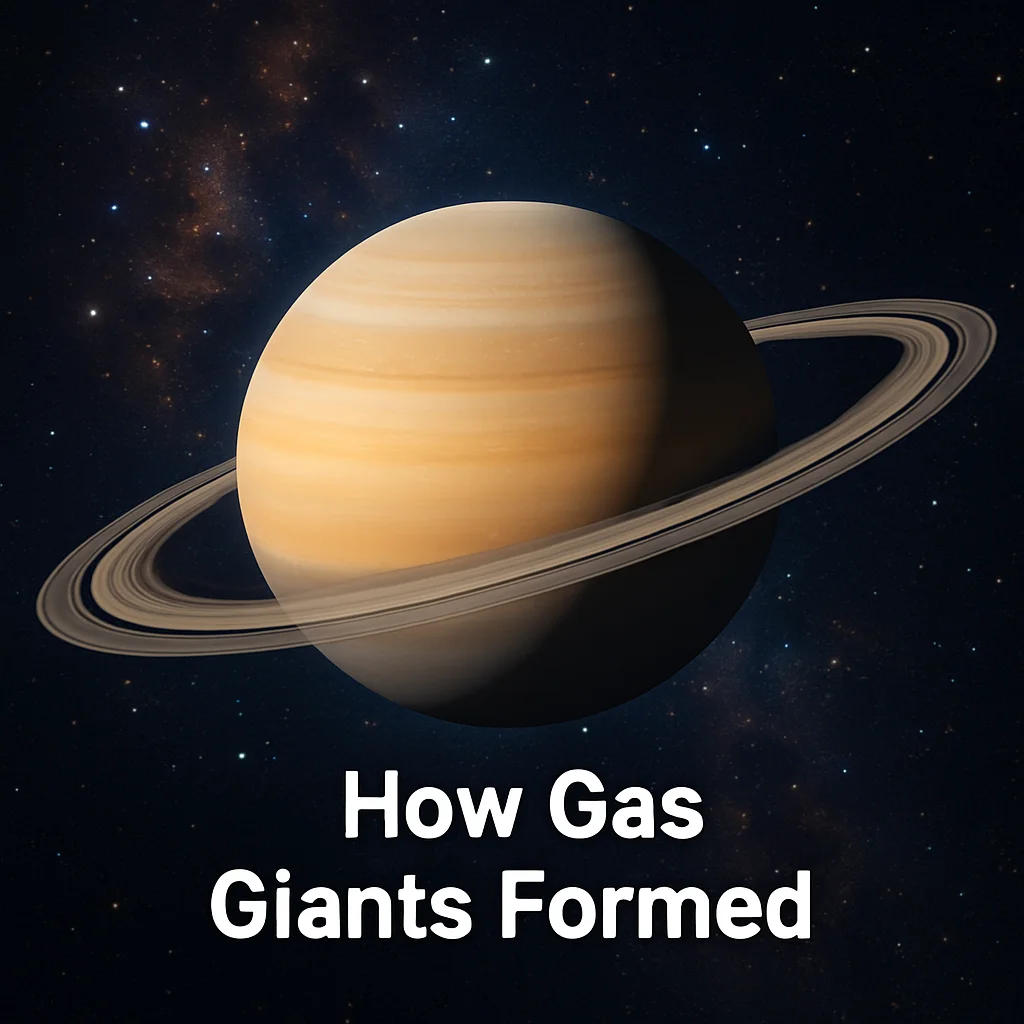
In our Solar System, the gas giants include Jupiter and Saturn, which are distinguished by their thick atmospheres and core elements that differ significantly from Earth-like rocky planets. Understanding how gas giants formed helps us appreciate the dynamic processes that shaped our cosmic neighborhood.
This article delves into the process of gas giant formation, exploring their classification, features, and roles within the vast expanse of space. By the end of this article, you'll have a beginner-friendly grasp of these enigmatic planetary giants.
📍 Where It Is and How Far Away
Jupiter and Saturn reside in the outer regions of our Solar System, past the asteroid belt. Unlike the rocky planets of the inner Solar System, these gas giants orbit at great distances from the Sun.
Jupiter, the largest planet in our Solar System, is about 5 astronomical units (AU) from the Sun. To put that into perspective, one AU is the average distance from Earth to the Sun, so Jupiter is five times farther away.
Because of their location, gas giants receive significantly less sunlight compared to Earth, which affects their temperatures and weather patterns. These distances mean they take longer to orbit the Sun, with Jupiter completing an orbit in 12 Earth years and Saturn in about 29 Earth years.
🧱 Size, Mass, and Gravity (Made Simple)
Gas giants, true to their name, are enormous by planetary standards. Jupiter, for instance, is so large that more than 1,300 Earths could fit inside it. Despite their size, most of their mass consists of gases.
The gravity on a gas giant like Jupiter is intense; it is more than double that of Earth’s surface gravity. However, because they lack a solid surface, standing on a gas giant would be impossible—one would simply sink into increasingly dense layers of gas.
Understanding the relationship between size, mass, and gravity helps us comprehend just how these planets dominate their orbits and influence their moons and surrounding space.
🌡️ Atmosphere and Weather
The atmospheres of gas giants are tumultuous and dynamic, characterized by thick clouds and ferocious storms. Jupiter's Great Red Spot is a massive storm system larger than Earth itself, showcasing the impressive weather patterns these planets can harbor.
The makeup of gas giants' atmospheres includes hydrogen, helium, and trace amounts of methane, ammonia, and water vapor. These components form vibrant cloud bands and cause fast winds and lasting storm systems.
Because they're so distant from the Sun, sunlight has less impact on their weather. Their rapid rotations also contribute to extreme jet streams that create distinctive banding patterns, observable even from telescopes on Earth.
🪨 Surface and Interior
Unlike terrestrial planets, gas giants don't have solid surfaces to speak of. They consist of outer layers of gas that become denser as you move inward, transitioning to a liquid state under immense pressure.
The interiors of these giants are fascinating, thought to include solid cores of rock and metal surrounded by layers of liquid metallic hydrogen. This unique structure results from the giant planet's gravitational forces compressing the materials beyond what we experience on Earth.
This understanding of the interior layers helps us visualize the complexity and scale of these magnificent celestial bodies.
🌀 Rotation, Orbit, and Seasons
Gas giants have rapid rotations; Jupiter, for example, completes a rotation in about 10 hours, which results in a bulging equatorial area due to centrifugal forces.
Despite their fast spinning, their orbits around the Sun are leisurely. Their lengthy orbits contribute to extended seasons, which differ significantly from those on Earth due to their large axial tilts.
Although they experience seasonal changes, the effect is less dramatic than on planets like Earth, due to their distance from the Sun and thicker atmospheres.
🧲 Magnetic Field and Radiation
The magnetic fields of gas giants are expansive and powerful, far exceeding Earth’s magnetic field. Jupiter’s magnetic field, for example, is the largest in the Solar System and generates intense radiation belts around the planet.
This strong magnetic field creates spectacular auroras at the planets' poles, similar to Earth’s northern and southern lights, but on a much grander scale.
The significant radiation environment poses challenges and considerations for spacecraft exploring these distant giants, necessitating robust protection against harsh space weather conditions.
🌙 Moons, Rings, and Neighbors
Gas giants are often characterized by their extensive moon systems and sometimes impressive ring systems. Jupiter, for instance, has over 75 known moons, with four large moons referred to as the Galilean moons: Io, Europa, Ganymede, and Callisto.
Saturn is famous for its awe-inspiring rings, which are the most extensive and complex in our Solar System. These rings consist of countless particles of ice and rock, creating a breathtaking spectacle.
Gravitational interactions between the gas giants and their moons lead to various phenomena, including tidal heating and orbital resonances, enriching the cosmic dance of these planets and their neighbors.
🔭 How We Know (Missions and Observations)
Much of our understanding of gas giants comes from spacecraft missions and telescopic observations. Pioneering missions like Voyager, Galileo, and the Juno spacecraft have provided invaluable data about Jupiter.
Similarly, the Cassini mission offered detailed insights into Saturn, its rings, and moons. These missions utilize various instruments to gather data on atmospheric composition, magnetic fields, and surface features, enhancing our knowledge of these remote worlds.
Telescopic observations complement spacecraft data, capturing images and spectra from Earth that allow scientists to monitor changes and dynamics in the gaseous atmospheres of these giant planets.
❓ Common Questions and Misconceptions
Is it a star? No, gas giants are not stars. They lack the mass needed to initiate nuclear fusion.
Can you stand on it? No, you'd sink into dense gas layers without a solid surface.
Is it habitable? Gas giants are not habitable due to extreme pressures and lack of a solid surface.
Why is it that color? The colors result from chemical compounds in their atmospheres reflecting sunlight.
Do gas giants have seasons? Yes, but they are less pronounced due to the thick atmosphere and distance from the Sun.
Why do they have so many moons? Their strong gravity allows them to capture numerous moons and other celestial debris.
📌 Summary
- Gas giants like Jupiter and Saturn are massive planets made primarily of gas.
- Located in the outer Solar System, these planets are far from the Sun.
- They are enormous in size with intense gravity and lack a solid surface.
- Their atmospheres are made of hydrogen and helium, with dynamic weather systems.
- Gas giants do not have a definite solid surface but have complex interiors.
- They spin quickly, have long orbits, and experience subtle seasonal changes.
- Strong magnetic fields lead to intense radiation belts and stunning auroras.
- Many moons and magnificent rings accompany these planets, influenced by gravity.
- Our knowledge stems from spacecraft missions and telescope observations.
- Jupiter, for instance, is known for its Great Red Spot, a storm larger than Earth.