🪐 Jupiter vs Saturn: Key Differences
🌌 What It Is
Jupiter and Saturn are two of the most fascinating planets in our Solar System. Both are classified as gas giants, meaning they are predominantly composed of hydrogen and helium and lack a solid surface. These planets are part of the outer planets group, which lies beyond the asteroid belt.
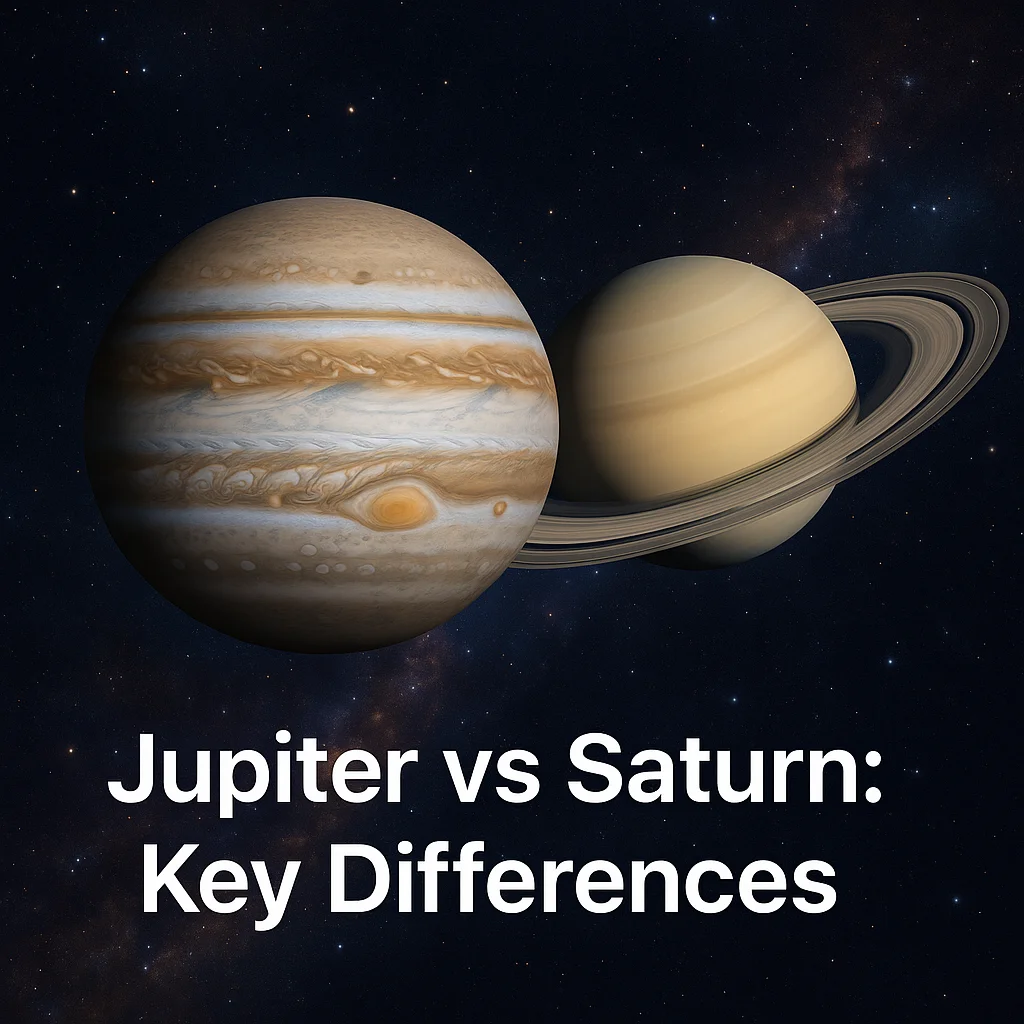
This article will help you understand the key differences between Jupiter and Saturn. From their immense sizes to the intriguing details of their atmospheres and moons, these celestial giants hold many secrets.
By exploring these differences, we can gain a deeper understanding of their individual characteristics and the role they play in the Solar System's structure. Whether you're a curious beginner or an aspiring astronomer, there's always something new to learn about these magnificent planets.
📍 Where It Is and How Far Away
Located beyond the asteroid belt, Jupiter is the fifth planet from the Sun, while Saturn is the sixth. Their positions in the Solar System are not just numbers; they affect how these planets interact with sunlight and their overall characteristics.
Jupiter is about 484 million miles from the Sun, whereas Saturn is approximately 886 million miles away. These distances are sometimes expressed in astronomical units (AU), with 1 AU being the average distance from Earth to the Sun. Jupiter sits at about 5.2 AU, while Saturn is located at around 9.5 AU.
The greater distance from the Sun means less sunlight reaches Saturn compared to Jupiter. This difference influences their temperatures, with Saturn being generally cooler than Jupiter. Despite this, both planets still receive enough sunlight to drive dynamic weather patterns, as we'll explore further.
🧱 Size, Mass, and Gravity (Made Simple)
Jupiter is the largest planet in our Solar System, often described as a colossal giant. It has a diameter of about 86,881 miles, making it more than 11 times wider than Earth. Saturn, while slightly smaller, is still enormous with a diameter of about 72,367 miles.
In terms of mass, Jupiter is more than 300 times the mass of Earth, while Saturn is around 95 times the mass of Earth. This incredible mass of Jupiter means it exerts a much stronger gravitational pull. However, because neither planet has a solid surface, you wouldn't be able to "stand" on them as you would on Earth.
The powerful gravity of these planets affects their moons and gives them the ability to retain thick atmospheres. Despite the stronger gravity, both planets have less surface gravity than Earth due to their gaseous nature and larger sizes.
🌡️ Atmosphere and Weather
The atmospheres of Jupiter and Saturn are primarily composed of hydrogen and helium. However, they also contain trace amounts of other gases, including methane, ammonia, and water vapor. These gases contribute to the cloud formations and weather patterns on both planets.
Jupiter's atmosphere is famously turbulent, with powerful storms such as the Great Red Spot—a gigantic storm several times the size of Earth that has raged for centuries. The planet's rapid rotation also generates strong jet streams that wrap around the planet.
Saturn, while having a similar atmospheric composition, is known for its extensive and intricate cloud layers. The planet's atmosphere experiences fast winds and storms, though they tend to be less intense than those on Jupiter. The beautiful ringed appearance of Saturn is a result of these atmospheric conditions and its unique structure.
🪨 Surface and Interior
As gas giants, neither Jupiter nor Saturn have a solid surface. Instead, their atmospheres gradually transition into liquid and then into a solid core. The term 'surface' in this context refers to the visible outer layer of the clouds.
Jupiter's interior is believed to consist of a dense core surrounded by a layer of liquid metallic hydrogen, followed by a thick layer of molecular hydrogen. Saturn has a similar internal structure, with a small, rocky core, a layer of liquid metallic hydrogen, and then molecular hydrogen.
The lack of a solid surface means that any exploration or "landing" on these planets would entail dealing with extreme pressures and temperatures deep within their gaseous atmospheres. Understanding these interiors helps us learn about planet formation and dynamics.
🌀 Rotation, Orbit, and Seasons
Jupiter is known for its rapid rotation, completing a full spin in just about 10 hours. This fast rotation gives the planet its oblate shape and contributes to the extreme weather conditions observed. Its orbit around the Sun, however, takes about 12 Earth years.
Saturn also rotates quickly, taking approximately 10.7 hours for one rotation. It takes around 29.5 Earth years for Saturn to complete one orbit around the Sun. The planet's axial tilt of about 27 degrees means it experiences more distinct seasons compared to Jupiter.
The rapid rotation and significant tilt of these planets affect their weather systems and the appearance of their cloud bands, providing a dynamic environment that is both beautiful and complex.
🧲 Magnetic Field and Radiation
Both Jupiter and Saturn have strong magnetic fields, but Jupiter's field is particularly powerful. It extends far out into space and creates intense radiation belts that pose challenges to spacecraft visiting the planet.
This magnetic field also generates spectacular auroras near the planet's poles, much like Earth's Northern and Southern Lights but on a much larger scale. Saturn's auroras are less intense but still offer a magnificent sight.
The magnetic environments of these planets are crucial for understanding how they interact with their surroundings and protect their moons from cosmic radiation. For spacecraft, navigating through these fields requires careful planning to avoid damage from radiation.
🌙 Moons, Rings, and Neighbors
Jupiter is home to at least 79 known moons, including the four large Galilean moons: Io, Europa, Ganymede, and Callisto. These moons vary widely in size and composition, offering a diverse range of environments for study.
Saturn is famous for its stunning rings composed of ice and rock particles. It also has over 80 known moons, the largest being Titan, which is larger than Mercury and has a dense atmosphere of its own.
The gravitational influence of these giants helps maintain their ring systems. The interactions with their many moons and rings provide insights into gravitational resonances and orbital dynamics.
🔭 How We Know (Missions and Observations)
Our understanding of Jupiter and Saturn comes from a combination of telescope observations and spacecraft missions. Ground-based and space telescopes offer valuable images and data on their atmospheres and rings.
Famous missions to these planets include NASA's Galileo and Juno missions to Jupiter, and the Cassini-Huygens mission to Saturn. These spacecraft have provided detailed images and crucial information about the planets' atmospheres, magnetic fields, and moons.
Data collected from these missions, such as gravity measurements and magnetic readings, allow scientists to build models of the planets' interiors and atmospheres, helping us piece together their histories and potential futures.
❓ Common Questions and Misconceptions
Is Jupiter a star? No, it's a planet. Although massive, it lacks the necessary nuclear reactions to be a star.
Can you stand on Jupiter or Saturn? No, both do not have solid surfaces like Earth.
Are they habitable? Neither planet supports life as we know it, but some of their moons, like Europa, may have conditions suitable for life.
Why does Jupiter have stripes? The stripes are cloud bands caused by the planet's fast rotation and heat rising from its interior.
Are Saturn's rings solid? No, they are made of countless small ice and rock particles.
Why is Saturn so light? Its low density means it could float in water, thanks to its gaseous composition.
Why are Jupiter's storms so long-lasting? The lack of a solid surface means less friction to slow down the storms.
Does Saturn have a solid core? Scientists think it has a small, rocky core deep within the planet.
📌 Summary
- What it is: Jupiter and Saturn are gas giants.
- Where it is: Both are located in the outer Solar System.
- Size/gravity takeaway: Jupiter is larger; both have massive gravitational pulls but low surface gravity.
- Atmosphere/weather: Both have thick, dynamic atmospheres with storms and cloud bands.
- Surface/interior: No solid surface; layered gases transitioning to a solid core.
- Orbit/rotation: Rapid rotation, long orbits; visible seasons on Saturn due to axial tilt.
- Magnetic/radiation: Strong magnetic fields create radiation belts and auroras.
- Moons/rings: Many moons, spectacular rings on Saturn; diverse orbital dynamics.
- How we know: Telescopic observations and missions like Galileo, Juno, and Cassini.
- One memorable fact: Saturn's rings could be young, possibly less than 100 million years old.