🪐 Saturn’s Storms and Weather Patterns
🌌 What It Is
Saturn is one of the most fascinating planets in our Solar System known for its stunning rings and dynamic weather patterns. It is classified as a gas giant, much like Jupiter, and is mostly composed of hydrogen and helium. As an outer planet, it resides far from the Sun, past the asteroid belt.
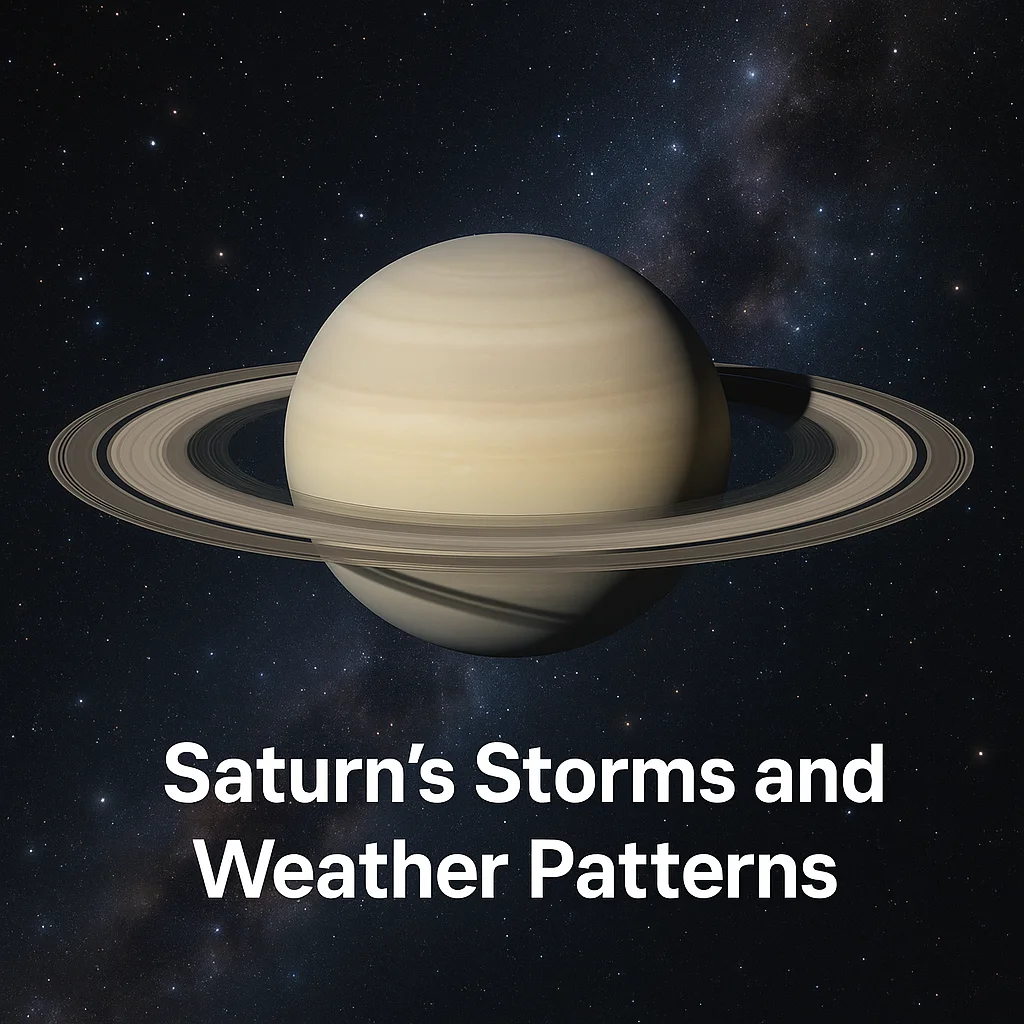
In this article, we will explore what makes Saturn so intriguing, especially focusing on its unique storms and weather systems. We will simplify complex concepts to help you understand how Saturn’s atmosphere and weather patterns are studied by scientists.
Our journey will cover Saturn’s distance from Earth, its enormous size, and the awe-inspiring storms that characterize its atmosphere. We will also look into its rotation, magnetic properties, and the remarkable rings and moons that orbit this gas giant.
📍 Where It Is and How Far Away
Saturn is located in the outer regions of our Solar System as the sixth planet from the Sun. When you look at the planets in order starting from the closest to the Sun, Saturn comes right after Jupiter, making it another distant world.
Distance in space can be challenging to grasp. For perspective, Saturn is about 1.4 billion kilometers (approximately 870 million miles) from the Sun. This vast distance means Saturn receives only a fraction of the solar energy that Earth does, contributing to its frigid temperatures.
The Sun appears much smaller from Saturn, affecting not just its climate but also the way we observe this planet. It takes sunlight over an hour to reach Saturn, a measure commonly referred to as light-hours.
🧱 Size, Mass, and Gravity (Made Simple)
In terms of size, Saturn is colossal, second only to Jupiter in our Solar System. The planet's diameter is about nine times that of Earth's, which means you could line up nine Earths across Saturn’s equator and still have space left.
Despite being so large, Saturn's mass is only about 95 times greater than that of Earth, which might seem surprising given its size. This is because Saturn is made mostly of gas, making it far less dense compared to terrestrial planets like Earth.
If you were to stand on Saturn – which you can’t really do as it's a gas giant with no solid surface – you’d feel weightless, as the gravity there is only slightly higher than it is on Earth due to its rapid rotation.
🌡️ Atmosphere and Weather
Saturn’s atmosphere is a thick concoction of hydrogen and helium, much like the Sun. It also contains traces of methane, ammonia, and other gases. These elements interact in fascinating ways to produce some of the most incredible weather patterns observed in our Solar System.
One of the most famous features of Saturn’s atmosphere is the Great White Spot, a massive storm that can be seen from Earth through telescopes. These storms are believed to be fueled by the rapid rotation of Saturn, which can lead to swirling bands of cloud formations.
Wind speeds on Saturn are extraordinarily fast, reaching up to 1,800 kilometers (1,100 miles) per hour near the equator. The planet’s rotation, combined with its low density, allows these swift winds to whip around the planet’s upper atmosphere, creating turbulent weather systems.
🪨 Surface and Interior
Unlike rocky planets such as Earth or Mars, Saturn doesn’t have a solid surface. When we refer to layers within saturn, we talk about different gas and liquid stages rather than a crust or mantle.
Beneath its cloud tops, Saturn has a layer of metallic hydrogen, created under intense pressure. This layer is crucial because it's believed to be responsible for Saturn's powerful magnetic field.
The core of Saturn is composed of heavier elements, possibly a mixture of rock and metal-like materials. This core is relatively small compared to its massive outer layers but plays a vital role in the dynamics of the planet.
🌀 Rotation, Orbit, and Seasons
Saturn’s day is quick, lasting only about 10.7 Earth hours. This rapid rotation is what helps to create its distinctive flattened shape; it is noticeably wider at the equator than pole-to-pole.
A year on Saturn, or one complete orbit around the Sun, takes about 29.5 Earth years. This lengthy orbital period also affects its seasonal changes, making each season over seven Earth years long.
Saturn’s axial tilt, similar to Earth’s, leads to noticeable seasonal changes. However, given the planet’s long orbit, these changes happen very slowly compared to the rapid seasonal cycles we experience on Earth.
🧲 Magnetic Field and Radiation
Magnetic fields are essential as they protect planets from solar and cosmic radiation. Saturn’s magnetic field, generated by complex processes in its interior, is about 578 times stronger than Earth’s.
This field is responsible for the auroras that appear near Saturn’s poles, similar to the Northern and Southern Lights seen on Earth. These displays occur when charged particles collide with the atmosphere, resulting in beautiful glowing patterns.
Saturn’s radiation belts are not as intense as Jupiter’s, but they are still significant. Spacecraft need to be built to withstand these conditions when visiting Saturn or navigating its vicinity.
🌙 Moons, Rings, and Neighbors
Saturn is renowned for its spectacular ring system, composed primarily of ice and rock particles. These rings vary in size from tiny grains to large chunks and form concentric bands around the planet.
The planet also has a wealth of moons, with Titan being the most notable. Titan is larger than the planet Mercury and has a thick atmosphere, oceans of liquid methane, and ethane, making it a subject of great interest for astronomers.
The gravitational interactions between Saturn and its moons influence its rings’ structure and stability. Moreover, some moons create gaps in the rings through these gravitational interactions, a phenomenon known as resonance.
🔭 How We Know (Missions and Observations)
Our understanding of Saturn comes from a combination of telescope observations and space missions. Ground-based telescopes give us images of Saturn’s magnificent rings and help track its weather patterns over time.
Spacecraft like Pioneer 11, Voyager 1 and 2, and, more recently, the Cassini-Huygens mission, have provided an abundance of information about this gas giant. Cassini orbited Saturn for over a decade, sending back invaluable data that continues to be analyzed by scientists.
These missions have provided various data types, including detailed images, gravitational measurements, and the composition of Saturn's atmosphere and rings. This wealth of information helps to piece together a clearer picture of how Saturn functions.
❓ Common Questions and Misconceptions
Is Saturn a star? No, Saturn is not a star; it does not produce its light but reflects sunlight.
Can you stand on Saturn? Saturn is a gas giant with no solid surface, so standing on it isn't possible.
Is Saturn habitable? Saturn itself isn't habitable; its extreme conditions and lack of a solid surface make it inhospitable to life as we know it.
Why is Saturn that color? Saturn's yellow and golden hues result from ammonia crystals and other chemical reactions in its upper atmosphere.
What causes Saturn’s rings? Saturn’s iconic rings are made from ice and rock particles, possibly remains of comets, asteroids, or shattered moons.
Why does Saturn have storms? The planet’s fast rotation and composition contribute to its stormy weather systems.
How fast are Saturn’s winds? Saturn’s winds can reach speeds of up to 1,800 kilometers (1,100 miles) per hour.
What are Saturn’s rings made of? They are composed primarily of ice particles with some rock and dust.
Is Titan livable? While Titan has a thick atmosphere, it is extremely cold, making it unlikely to support life as we know it.
Why does Saturn appear flat? Its rapid rotation causes the planet to have an oblate shape, being wider at the equator than the poles.
📌 Summary
- Saturn is a gas giant planet known for its stunning rings.
- It is the sixth planet from the Sun, situated in the outer Solar System.
- While massive in size, its composition makes it less dense than Earth.
- Saturn's atmosphere is primarily hydrogen and helium with spectacular storms.
- It has no solid surface, making "standing" there impossible.
- Saturn rotates swiftly, creating flattened poles and extended seasons.
- Its powerful magnetic field generates impressive auroras.
- Saturn hosts a beautiful ring system and many moons, including Titan.
- Space missions like Cassini have vastly expanded our knowledge of Saturn.
- Saturn’s rapid winds and distinct weather patterns make it a remarkable world to study.