🪐 Earth Facts for Beginners
🌌 What It Is
Earth is the third planet from the Sun and the only known celestial body to support life. It is classified as a terrestrial planet, meaning it has a solid rocky surface, unlike the gas giants that are composed mostly of gases.
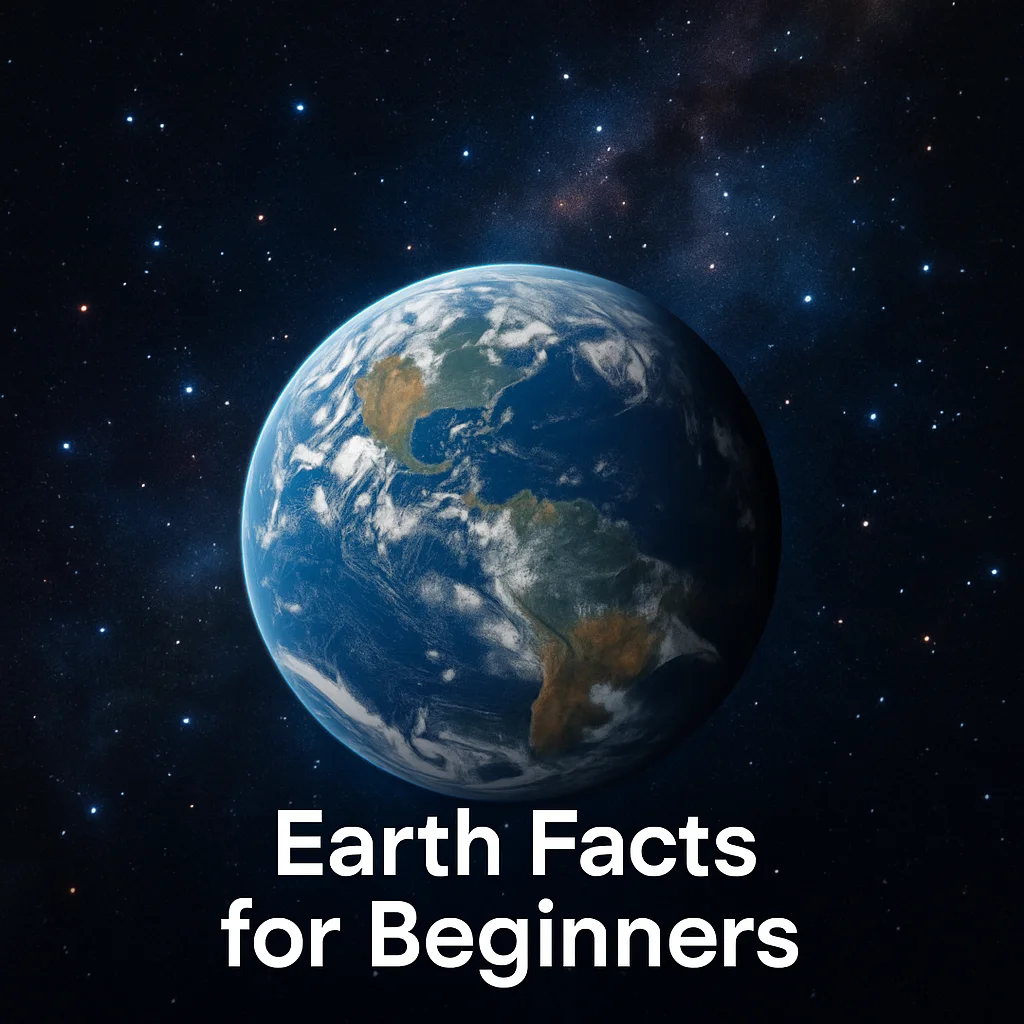
As an inner planet, Earth is closer to the Sun compared to the outer gas and ice giants of the Solar System. In this section, we will explore what makes Earth distinct in its characteristics and functions.
Readers will learn about Earth's position, size, atmosphere, surface, and the various phenomena that make it unique. By the end, you'll have a basic understanding of what makes Earth our home planet.
📍 Where It Is and How Far Away
Earth orbits the Sun in the Solar System. It is the third planet from the Sun, following Mercury and Venus. As a point of reference, Earth is located about 93 million miles from the Sun. This distance is referred to as 1 Astronomical Unit (AU), a unit used to express distances within the Solar System.
The exact positioning of Earth influences its climate and seasons. Because it lies in a zone where temperatures are stable enough to support liquid water, Earth is uniquely placed to sustain life. When compared, Earth is light-minutes away from the Sun. It takes roughly 8 minutes for sunlight to reach Earth.
This proximity to the Sun balances Earth's temperatures, contributing to a climate that supports a variety of ecosystems. In this section, we'll explore how its distance from the Sun plays a role in creating favorable conditions for life.
🧱 Size, Mass, and Gravity (Made Simple)
Earth has a diameter of about 7,917.5 miles, which might be difficult to visualize. Imagine the distance you would cover if you traveled from New York to Los Angeles three times. That's roughly the diameter of Earth.
In terms of mass, Earth is estimated to weigh around 5.972 × 10^24 kilograms. While this is a mind-boggling number, it's the mass that ensures a gravitational pull which allows us to walk and keeps our atmosphere intact.
Gravity on Earth means that objects fall toward the ground rather than floating into space. It is due to this gravity that creatures, buildings, and bodies of water remain anchored to the surface.
🌡️ Atmosphere and Weather
Earth's atmosphere is composed primarily of nitrogen (about 78%) and oxygen (about 21%), with trace amounts of other gases like argon and carbon dioxide. This gaseous blanket surrounds our planet, playing a crucial role in sustaining life by providing oxygen and regulating temperature.
The weather on Earth varies significantly from region to region due to differences in sunlight, water vapor, and air pressure. Sunlight drives weather patterns, creating winds, storms, and unique climate zones.
Notably, phenomena like hurricanes and tornadoes occur due to the interactions between warm and cold air masses. Earth's rotation also affects weather patterns, resulting in the characteristic patterns we observe, such as prevailing winds.
🪨 Surface and Interior
The Earth's surface is a complex system of land and water. About 70% is covered by oceans, while the rest is composed of continents and islands. The surface is constantly changing due to tectonic activity, erosion, and other natural processes.
The interior of Earth is divided into layers: the crust, mantle, and core. The crust is the outermost layer where we live. Beneath it lies the mantle, which is made of semi-solid rock that slowly moves, causing tectonic shifts.
At the center is the core, composed mostly of iron and nickel, divided into a solid inner core and a liquid outer core. The movements within these layers generate Earth's magnetic field, a vital feature we will explore further.
🌀 Rotation, Orbit, and Seasons
Earth completes one full rotation on its axis every 24 hours, which is why we experience day and night. This rotation gives us a sense of time and organizes human activity across time zones.
It takes Earth about 365.25 days to orbit the Sun, which is why we have a leap year every four years to synchronize our calendar. The tilt of Earth's axis (approximately 23.5 degrees) results in the seasons.
This tilt means that different parts of the Earth receive varying amounts of sunlight throughout the year, leading to seasonal changes. These changes in daylight and warmth dictate everything from plant growth to human cultural practices.
🧲 Magnetic Field and Radiation
Earth is equipped with a magnetic field generated by the movement of molten iron in its core. This invisible shield protects us from harmful solar radiation and cosmic rays, deflecting them away from the planet.
The interaction of charged particles from the Sun with Earth's magnetic field creates beautiful displays known as auroras, visible near the polar regions as shimmering lights.
Understanding Earth's magnetic field helps scientists prepare for space weather events that can affect satellites, power grids, and other technology here on Earth. It is a critical feature in making our planet hospitable.
🌙 Moons, Rings, and Neighbors
Earth has one natural satellite, the Moon, our nearest cosmic neighbor. The gravitational relationship between Earth and the Moon affects tides, stabilizes Earth's axial tilt, and may even have played a role in the evolution of life.
The Moon's surface is pockmarked with craters from astronomical impacts, similar to the processes that have shaped Earth. However, unlike the gas giants, Earth does not possess a ring system.
In the context of neighbors, Earth shares its orbital region with near-Earth objects such as asteroids and occasionally comets. These interactions provide a natural laboratory for studying planetary dynamics and evolution.
🔭 How We Know (Missions and Observations)
The knowledge we hold about Earth has been greatly advanced through telescopic observations and space missions. While telescopes provide remote observations of our planet and others, satellites and space probes offer detailed in situ data.
Famous missions such as the Apollo program have given us invaluable insight into Earth's natural satellite, the Moon. Similarly, satellite missions like NOAA's GOES series help us monitor Earth's weather and environmental changes.
These observations collect data in various forms, including images and spectra, which scientists analyze to draw conclusions about Earth's past, present, and future conditions. This scientific understanding also aids global efforts in monitoring environmental changes.
❓ Common Questions and Misconceptions
Is Earth a star? No, Earth is a planet. Stars like the Sun emit their own light, while Earth reflects the Sun's light.
Can you stand on Earth? Yes, Earth has a solid surface where we walk, unlike gas giants which do not.
Is Earth habitable? Absolutely. Earth supports a wide range of life due to its atmosphere, water, and suitable temperature range.
Does Earth have rings? No, Earth does not have a ring system like Saturn or other gas giants.
Why is Earth called the "Blue Planet"? Earth's surface is mostly covered by oceans, giving it a blue appearance from space.
Is Earth getting closer to the Sun? No, Earth's orbit is stable, although it fluctuates slightly over long timescales.
Does Earth have a shield against space radiation? Yes, Earth's magnetic field protects us from much of the harmful solar and cosmic radiation.
Is the Earth perfectly round? Earth is an oblate spheroid, slightly flattened at the poles and bulging at the equator.
📌 Summary
- Earth is the third planet from the Sun, a terrestrial planet.
- Located about 93 million miles from the Sun, in the habitable zone.
- Diameter of approximately 7,917.5 miles, with gravity keeping its atmosphere intact.
- The atmosphere is mainly nitrogen and oxygen, vital for life and weather systems.
- The surface features continents and oceans, shaped by plate tectonics and erosion.
- Rotation gives a 24-hour day; tilted axis results in seasons throughout its orbit.
- Earth's magnetic field shields against harmful radiation, creating auroras.
- One moon influences tides, stabilizes tilt; no rings presence.
- Knowledge from telescopes and missions; vital for environmental monitoring.
- Unique for supporting life, the "Blue Planet" stands out in our Solar System.