🪐 Earth’s Atmosphere Explained Simply
🌌 What It Is
The Earth's atmosphere is a thin layer of gases surrounding the planet. It acts as a protective shield, keeping harmful space radiation out while letting in just the right amount of sunlight to sustain life. It is also responsible for weather patterns and maintaining the climate.
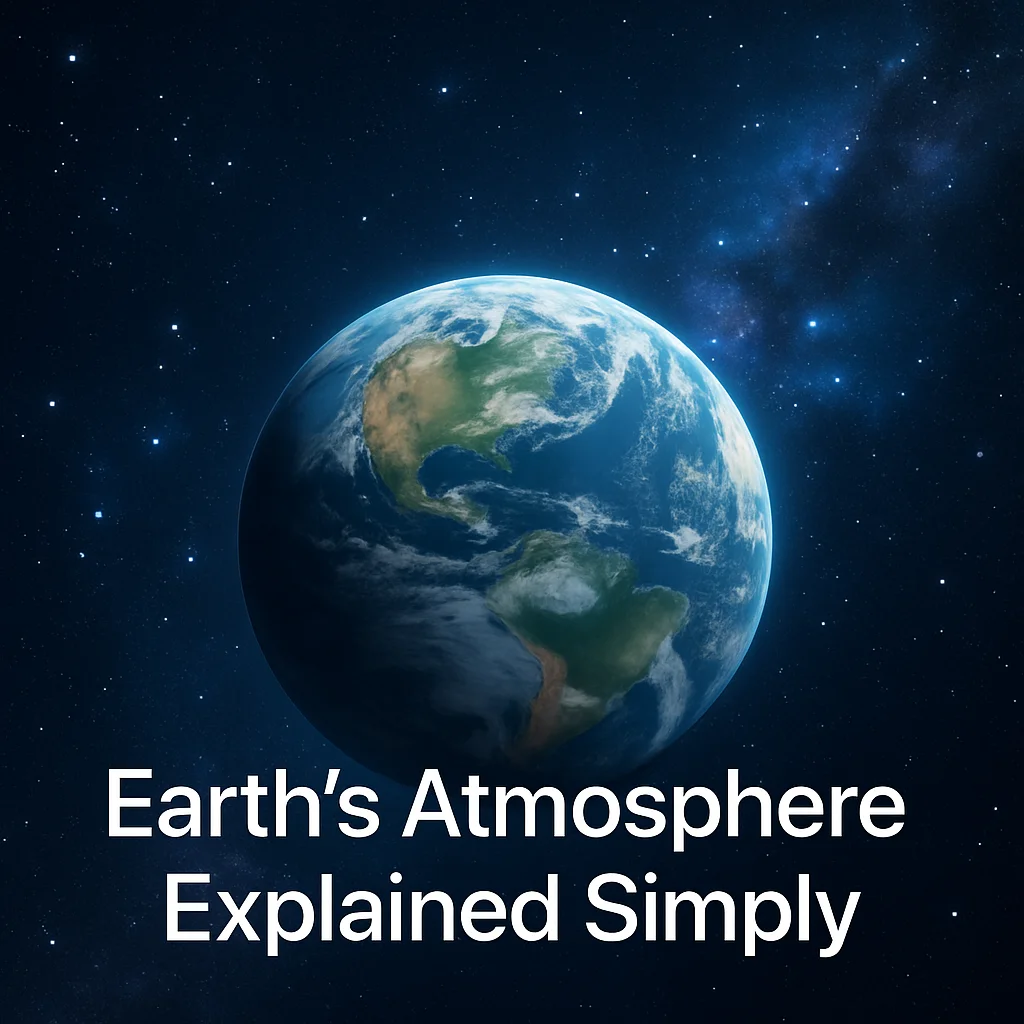
Earth is one of the inner planets of our Solar System, specifically classified as a terrestrial planet. This means it's mostly made of rock and metal, unlike the gas giants further out in the Solar System. The atmosphere is a key feature that makes Earth different from many other planets.
In this article, you'll learn about the atmosphere's structure, its role in Earth's weather, and how it affects everything from breathing to shielding the planet from the Sun's rays. You'll also gain insight into its composition and how it has evolved over time.
📍 Where It Is and How Far Away
Earth is located in the Solar System, which is a part of the Milky Way galaxy. Specifically, Earth is the third planet from the Sun, positioned at a comfortable distance that allows for liquid water. This distance is about 93 million miles, which seems vast, but it places Earth in what we call the "habitable zone," where temperatures can support life as we know it.
To simplify, this distance from the Sun is approximately one "astronomical unit" (AU). It's a handy way that astronomers use to measure space distances, where 1 AU is the average space length from Earth to the Sun. The light from the Sun takes about 8 minutes to reach the Earth.
This specific placement affects Earth's temperatures and seasons. Being in the middle of the solar lineup, our planet experiences moderate sunlight - not too hot and not too cold, a condition known as the "Goldilocks zone."
🧱 Size, Mass, and Gravity (Made Simple)
The Earth is relatively compact with a diameter of about 7,917 miles (12,742 kilometers), making it the largest of the terrestrial planets. Earth's mass is about 5.97 x 10^24 kg, providing enough gravitational pull to hold an atmosphere tightly bound to it.
Gravity is the force that gives weight to physical objects. On Earth, it gives us a sense of "down," meaning when we say something falls, it does because of Earth’s gravitational attraction. For instance, if you weigh 150 pounds here, it's due to Earth's gravity. On a planet with lesser gravity, you would weigh less, and on a planet with greater gravity, more.
If Earth were made of gas like the giant planets, it would not have a solid surface to stand on, and its gravity would differ. Earth's gravity helps keep everything from people to air close to the surface, crucial for sustaining life.
🌡️ Atmosphere and Weather
Earth’s atmosphere is primarily composed of nitrogen (about 78%) and oxygen (about 21%), with trace amounts of other gases such as carbon dioxide and argon. This mixture is essential for life, enabling respiration and protecting organisms from harmful solar radiation.
Weather on Earth is driven by the Sun’s energy. As sunlight warms Earth's surface, air gets hotter and rises, and cooler air rushes in to take its place, creating wind. Clouds form when moist air rises and cools, condensing into tiny droplets or ice crystals.
Earth's rotating axis and the uneven heating of its surface cause complex weather systems. These include storms, rain, and varied weather patterns, which are further influenced by Earth’s topography, such as mountains and oceans, as well as seasonal changes.
🪨 Surface and Interior
The surface of Earth is covered in landforms like mountains, valleys, and plains, created by geological processes such as tectonics and erosion. Unlike rocky planets with barren, cratered surfaces, Earth has active plate tectonics, which reshapes the surface over time.
Beneath the surface, Earth comprises several layers: the crust, mantle, and core. The crust is the outer layer where we live. Below it, the mantle is made of semi-solid rock that convicts slowly. At the center, the core is mainly iron and nickel, divided into a liquid outer core and a solid inner core, influencing Earth’s magnetic field.
These internal processes can lead to natural phenomena such as volcanic eruptions and earthquakes, as the tectonic plates shift and move over the more fluid mantle layer.
🌀 Rotation, Orbit, and Seasons
Earth rotates on its axis once approximately every 24 hours, which creates the cycle of day and night. This rotation speed is consistent enough to define "a day" in our timekeeping system.
It takes Earth about 365.25 days to complete an orbit around the Sun, defining what we call a year. Every four years, an extra day—February 29th—is added to keep our calendar in sync with this orbit, known as a leap year.
Earth's axial tilt of about 23.5 degrees is what causes the seasons. When the Northern Hemisphere tilts toward the Sun, it experiences summer while the Southern Hemisphere has winter, and vice versa.
🧲 Magnetic Field and Radiation
Earth generates a magnetic field that extends into space and protects the planet from the Sun's solar wind, a stream of charged particles. This field is what causes compass needles to point north and is crucial for navigation.
The interaction between Earth’s magnetic field and the solar wind creates phenomena like auroras, which are often visible near the polar regions. These are bright lights in the sky that many people associate with the "Northern Lights" or "Southern Lights".
The magnetic field also plays a role in protecting the atmosphere from being stripped away by solar wind, a fate different from some other planets without a magnetic shield.
🌙 Moons, Rings, and Neighbors
Earth has one natural satellite, the Moon. The gravitational interaction between Earth and the Moon causes ocean tides and influences the stability of Earth's axial tilt, which in turn affects the climate.
Unlike other planets like Saturn, Earth does not have rings. This lack of rings makes Earth unique among its close neighbors in the solar family.
The Moon is of great interest due to its influence on Earth and its potential as a site for future space exploration. The gravitational dance between the Earth and the Moon also offers rich opportunities for scientific study.
🔭 How We Know (Missions and Observations)
Earth has been observed from both telescopic and satellite perspectives. Satellites orbiting the Earth collect data about weather patterns, environmental changes, and global climate. These man-made "eyes in the sky" provide a wealth of information through instruments that measure everything from temperature to atmospheric composition.
Famous missions like NASA's Apollo program have allowed humans to view Earth from the Moon, providing new perspectives on our planet. Other missions investigate Earth's magnetic field, the Sun's energy input, and more, utilizing a blend of imagery, spectral, gravity, and magnetic data.
Telescopes placed in space, like the Hubble Space Telescope, offer insights into Earth's position in the broader structure of the cosmos, while ground-based observatories continue to improve our understanding of Earth's atmosphere and climate.
❓ Common Questions and Misconceptions
Is Earth a star? No, Earth is a planet. Stars, like the Sun, emit their own light, while Earth reflects light from the Sun.
Can you stand on its atmosphere? No, the atmosphere is not solid. It's made of gases you float through, not walk on.
Is Earth habitable for humans? Yes, Earth is the only planet we know of that supports human life, thanks to its atmosphere.
Is the sky really blue? The sky appears blue due to the way Earth's atmosphere scatters sunlight, especially shorter blue wavelengths.
Does gravity exist in space? Yes, gravity extends throughout space. The sensation of "weightlessness" in space is due to free-falling at the same rate as your spacecraft.
Why doesn't Earth have rings? Earth's gravitational dynamics and existing atmosphere don't support a stable ring system like those around gas giants.
📌 Summary
- Earth's atmosphere is a life-sustaining layer of gases.
- Located in the Solar System's habitable zone.
- Comparable in size and mass to other terrestrial planets.
- Made mainly of nitrogen and oxygen, crucial for life and protecting us from solar radiation.
- Surface features shaped by tectonics and erosion; interior heat drives geological activity.
- Day and night cycle every 24 hours; orbits the Sun annually, causing seasons.
- Magnetic field protects from solar wind and contributes to auroras.
- One Moon affecting tides; no rings.
- Knowledge from diverse missions and observations, space telescopes, and satellites.
- Unique among planets for supporting complex life forms.