🪐 Why Inner Planets Are Rocky
🌌 What It Is
The inner planets are a group of planets in our Solar System known for their rocky surfaces. These planets include Mercury, Venus, Earth, and Mars. Unlike the outer planets, which are gaseous or icy, the inner planets are also referred to as terrestrial planets.
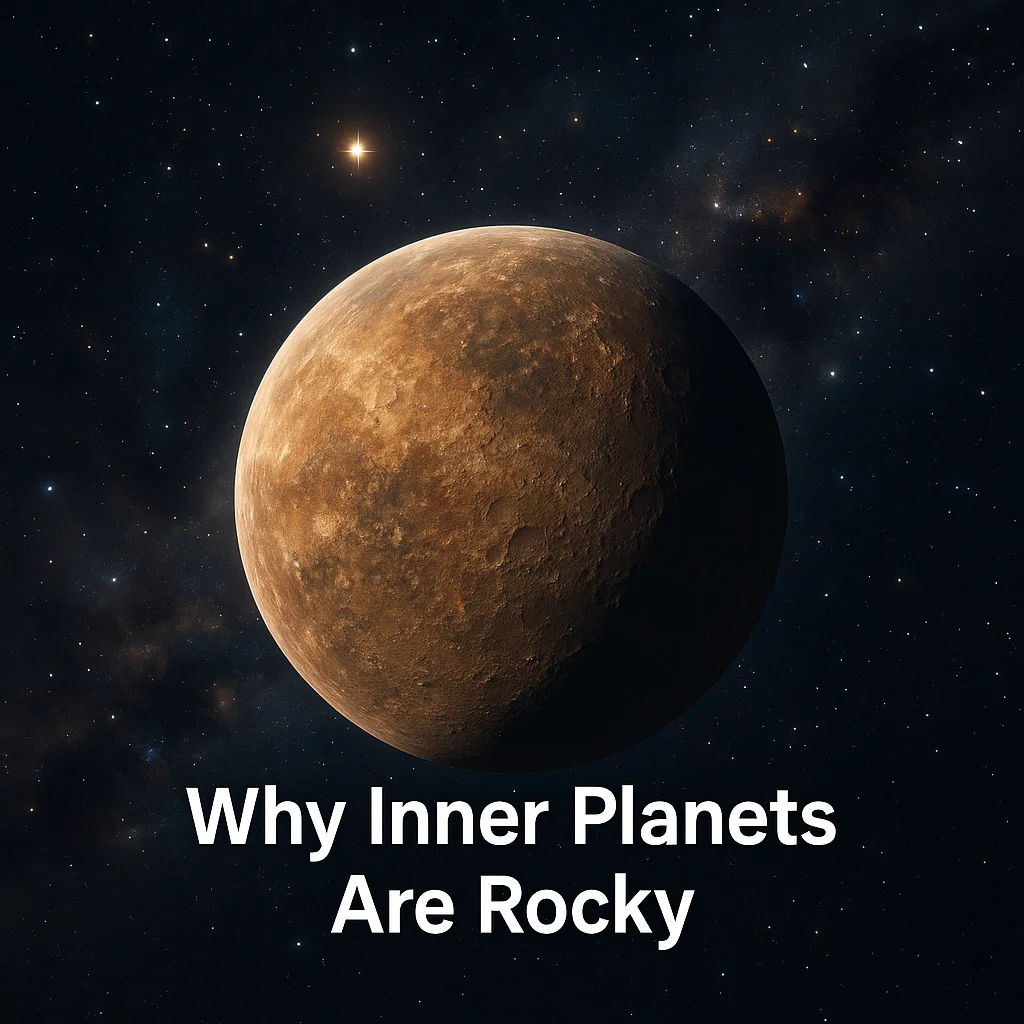
A planet is a celestial body that orbits a star like our Sun, is massive enough to be rounded by its gravity, and has cleared its orbit of other debris. The inner planets fulfill these criteria and are classified as terrestrial because of their solid, rocky surfaces.
In this article, you will learn why the inner planets have these rocky characteristics, how their positions affect them, their atmospheres, and various other aspects that make them unique in our cosmic neighborhood.
📍 Where It Is and How Far Away
The inner planets are located in the Solar System between the Sun and the asteroid belt. Mercury is the closest to the Sun, followed by Venus, Earth, and Mars. These planets are much closer to the Sun compared to the outer giants.
Distances in space can be vast, so astronomers use astronomical units (AU) to measure them; one AU is the average distance from Earth to the Sun. Mercury, for example, is about 0.39 AU from the Sun, while Mars is about 1.52 AU away. This proximity to the Sun means the inner planets receive more sunlight and generally have warmer climates compared to the outer planets.
The positions of these planets also determine their speed around the Sun. The closer a planet is to the Sun, the faster it moves in its orbit, resulting in shorter years compared to those of the outer planets.
🧱 Size, Mass, and Gravity (Made Simple)
The inner planets vary in size and mass, with Earth being the largest and heaviest. Mercury, the smallest, is about 38% the size of Earth. However, all inner planets have enough mass to create a strong surface gravity.
Gravity is what keeps you on the ground. On Earth, it is what makes things fall. Inner planets have a "surface" because their gravity is strong enough to hold solid materials together, forming crusts that you could stand on. For instance, if you weigh 100 pounds on Earth, you would weigh 38 pounds on Mars, owing to its lower gravity.
🌡️ Atmosphere and Weather
Each inner planet has a different type of atmosphere. Mercury barely has any atmosphere to speak of, while Venus has a thick, cloudy atmosphere composed mainly of carbon dioxide, leading to a runaway greenhouse effect and extreme temperatures.
Earth’s atmosphere is rich in nitrogen and oxygen, supporting life and moderating temperatures. Mars has a thin atmosphere, mostly carbon dioxide, resulting in colder temperatures and dust storms despite being similar to Earth in other ways.
Weather patterns on these planets vary widely, influenced by their atmospheric compositions, proximity to the Sun, and rotational patterns. For example, Venus has slow rotations but extreme greenhouse heating, while Mars experiences cold but windy conditions.
🪨 Surface and Interior
The surfaces of the inner planets are predominantly rocky and include various geological features such as craters, mountains, and valleys. For example, Mars features the largest volcano and canyon in the Solar System.
Beneath their surfaces, these planets have interiors made up mainly of metallic cores surrounded by rock. Earth’s magnetic field is generated by its liquid iron outer core, a feature that Mars, with its mostly dormant core, lacks.
The geology of these worlds is shaped by factors like volcanic activity, tectonic shifts, and erosion from wind or water. However, the level of activity varies; for instance, Earth is highly active geologically, whereas Mercury and Mars show signs of past activity.
🌀 Rotation, Orbit, and Seasons
The inner planets have relatively short orbital periods, thanks to their proximity to the Sun. For example, Mercury completes an orbit in about 88 Earth days.
Rotation periods vary significantly. Earth rotates once roughly every 24 hours, creating day and night cycles, whereas Venus has a retrograde rotation, meaning it spins the opposite direction of its orbit, taking about 243 Earth days for a single rotation.
Seasons on these planets are regulated by their axial tilts. Mars, with a tilt similar to Earth, experiences more Earth-like seasons, albeit longer because its year is nearly twice as long as ours.
🧲 Magnetic Field and Radiation
A magnetic field acts like a giant shield, protecting a planet from solar and cosmic radiation. Earth has a strong magnetic field, which gives rise to phenomena like the auroras.
Venus and Mars do not have global magnetic fields. This lack means their surfaces receive more radiation from the Sun, especially Mars, contributing to its harsh conditions.
Understanding a planet's magnetic field aids scientists in determining its interior dynamics and assessing the protection it offers to potential atmospheres or surface life.
🌙 Moons, Rings, and Neighbors
Among the inner planets, Earth and Mars have moons. Earth’s Moon is relatively large compared to its size, while Mars hosts two small, potato-shaped moons named Phobos and Deimos.
Unlike the outer planets, the inner planets do not have ring systems. This difference is primarily due to their smaller masses and closer proximity to the Sun, which affects their gravitational pull attributes differently than those of the gas giants.
The gravitational interactions between these planets and their moons contribute to phenomena such as tides on Earth, impacting marine life and human activities.
🔭 How We Know (Missions and Observations)
Our understanding of the inner planets comes from a combination of telescopic observations and space missions. Telescopes allow us to study their appearances, while space missions provide detailed information and close-up images.
Notable missions include NASA's MESSENGER, which orbited Mercury, and the Mars rovers like Curiosity. These missions collect data on surface compositions, atmospheric conditions, and more, enhancing our comprehension.
The information gathered helps scientists understand planetary formation, evolution, and the conditions that might support life, both on Earth and elsewhere.
❓ Common Questions and Misconceptions
Is Earth the only habitable planet? Currently, Earth is the only planet known to support life as we know it, but scientists are exploring Mars and other celestial bodies for signs of habitability.
Can people live on Mars? While Mars looks like it could support life, its harsh atmosphere and lack of liquid water on the surface make it inhospitable for humans without significant technological aid.
Are the inner planets moving closer to the Sun? The orbits of the planets are relatively stable over long periods, though minor changes can occur due to gravitational influences and other factors.
Why doesn’t Venus have a moon? It is a mystery why Venus does not have a moon, unlike Earth and Mars, and this topic remains an area for scientific inquiry.
Why is Mercury so heavily cratered? Mercury's surface is heavily cratered due to its exposure to more frequent impacts, a result of its proximity to the Sun and lack of a substantial atmosphere to burn up incoming objects.
Does Mars have water? Mars has polar ice caps and signs of ancient surface water, but liquid water in large quantities is not currently stable on its surface.
📌 Summary
- The inner planets are rocky and include Mercury, Venus, Earth, and Mars.
- They are located between the Sun and the asteroid belt.
- Earth is the largest, and Mercury is the smallest of the inner planets.
- Each has a distinct atmosphere that influences its weather.
- The surfaces are rocky, featuring mountains, craters, and valleys.
- These planets have shorter years but varied day lengths.
- Earth's magnetic field is active, while Venus and Mars lack global fields.
- Earth and Mars have moons, but none have rings.
- Missions and telescopes provide critical data on these planets.
- Understanding these planets helps answer questions about habitability and solar system history.