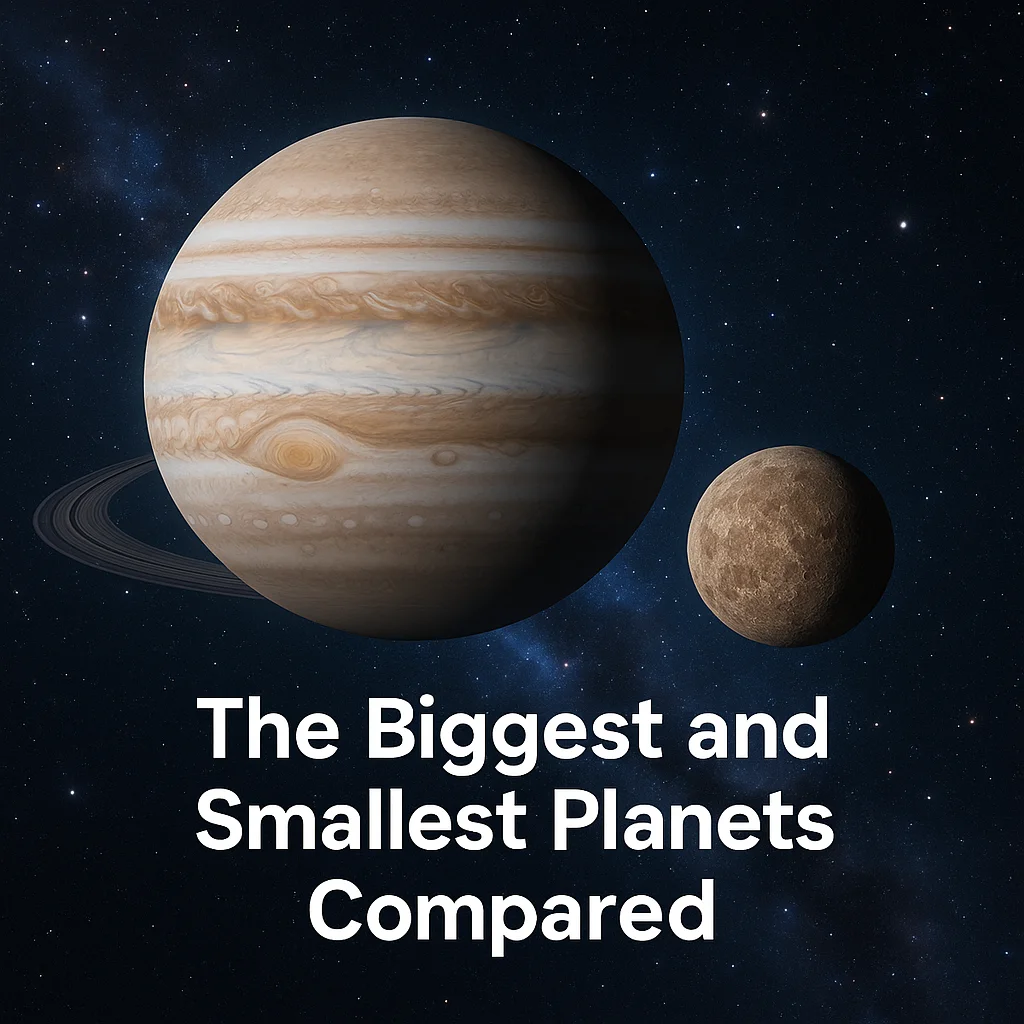
🪐 The Biggest and Smallest Planets Compared
🌌 What It Is
In our solar system, planets come in various sizes and compositions, creating a fascinating diversity. Planets are celestial bodies that orbit a star, in this case, our Sun, and are massive enough to be rounded by their own gravity.
The planets can be classified into inner and outer planets. The inner planets, like Earth, are rocky, while the outer planets are known for being gas or ice giants.
This article will guide you through understanding the largest and smallest planets in our solar system, helping you compare their size, mass, atmosphere, and more.
📍 Where It Is and How Far Away
The largest planet in our solar system is Jupiter, a gas giant located fifth from the Sun. It’s about 484 million miles away from the Sun, or over five times the distance from the Earth to the Sun. In astronomical terms, that's a little over 5 Astronomical Units (AU), where one AU represents the average distance between the Earth and the Sun.
In contrast, the smallest planet, Mercury, is the closest to the Sun, approximately 36 million miles away, or about 0.39 AU. Being so close to the Sun, Mercury receives a lot of sunlight and heat compared to Jupiter.
These vast distances mean that light from the Sun takes around 43 minutes to reach Jupiter, whereas it takes about 3 minutes to get to Mercury.
🧱 Size, Mass, and Gravity (Made Simple)
Jupiter is truly gigantic, with a diameter of about 86,881 miles. This is over 11 times the diameter of Earth! In terms of mass, Jupiter is about 318 times heavier than Earth, making it the most massive planet in our solar system.
Mercury, on the other hand, is much smaller, with a diameter of just 3,032 miles, slightly larger than the Moon, but much smaller than Earth. It’s the lightest planet, with a mass only about 5.5% that of Earth's.
Jupiter's enormous mass means it has a very strong gravitational pull. If you stood on a solid surface above the clouds (if that were possible), you would weigh more than twice as much as you do on Earth. Mercury's surface gravity is much weaker, so you’d weigh only about 38% of your Earth weight there.
🌡️ Atmosphere and Weather
Jupiter's atmosphere is mostly made of hydrogen and helium, swirling with strong winds and giant storms, like the Great Red Spot, a massive storm larger than Earth. These storms are fueled by the planet's rapid rotation and internal heat.
Mercury has a very thin atmosphere, mostly composed of oxygen, sodium, and hydrogen. This is because it's too small to hold a thick atmosphere, and its proximity to the Sun means any atmosphere easily escapes into space.
Temperatures on Mercury fluctuate drastically from day to night, ranging from extremely hot to very cold, because its thin atmosphere can't retain heat effectively.
🪨 Surface and Interior
Jupiter doesn't have a solid surface like rocky planets. Instead, it has layers of clouds and gradually transitions to a dense liquid interior of hydrogen and helium, towards a metallic core.
Mercury's surface is rocky, covered with craters from past impacts, similar to our Moon. The lack of significant atmosphere means surface processes are limited to these impacts and some tectonic activity in its past.
Mercury does have a large iron core relative to its size, which takes up a substantial part of its interior, contributing to its overall density.
🌀 Rotation, Orbit, and Seasons
Jupiter rotates very quickly, giving it a short day of just about 10 hours. It takes nearly 12 Earth years to complete one orbit around the Sun, making its year very long.
Mercury rotates slowly, with a day lasting about 59 Earth days. It orbits the Sun much faster, completing a year in just 88 Earth days. Because of its tilt, Mercury doesn’t have significant seasons.
Jupiter also has minimal seasonal changes because its axis is only slightly tilted relative to its orbit.
🧲 Magnetic Field and Radiation
Jupiter has a powerful magnetic field, the strongest among planets, generated by its metallic hydrogen interior. This field creates intense radiation belts and spectacular auroras around its poles.
Mercury has a weak magnetic field compared to Earth but is still significant for its size. It's thought to be generated by its large iron core.
These fields are crucial in protecting a planet’s atmosphere and affect how it interacts with solar wind and cosmic radiation.
🌙 Moons, Rings, and Neighbors
Jupiter boasts an impressive collection of moons, over 75, including the four largest, known as the Galilean moons: Io, Europa, Ganymede, and Callisto. It also has thin, faint rings.
Mercury has no moons or rings, likely because it’s too close to the Sun, whose gravity would make it difficult for moons to remain in stable orbits.
The presence or absence of moons significantly affects a planet's gravitational dynamics and natural satellite interactions.
🔭 How We Know (Missions and Observations)
Much of what we know about Jupiter comes from missions like Galileo and Juno, which have provided invaluable data about its structure, atmosphere, and magnetic fields.
Mercury has been closely studied by missions such as MESSENGER and the ongoing BepiColombo mission. These have helped map its surface and study its thin atmosphere and magnetic field.
Both planets have also been observed by various telescopes, providing detailed images and spectra to study their compositions and behaviors.
❓ Common Questions and Misconceptions
One common question is whether Jupiter is a failed star because of its size and composition. While it has similar elements to a star, it lacks the mass to initiate nuclear fusion.
People often wonder if you could stand on Jupiter. Due to its gaseous state, there is no solid surface to stand on.
Is Mercury habitable? Its extreme temperatures and lack of atmosphere make it impossible for life as we know it.
Does Jupiter's Great Red Spot make it dangerous? The spot is a storm, and while massive, it poses no threat to Earth.
People sometimes ask why Mercury is so small. Its small size results from its proximity to the Sun, which limits the material available for its formation.
Lastly, questions about Jupiter's color are common. The different colors result from its atmospheric composition and the chemistry of its clouds.
📌 Summary
- Jupiter is the largest planet, and Mercury is the smallest in our solar system.
- Jupiter is five times further from the Sun than Earth, while Mercury is closest to the Sun.
- Jupiter is 318 times the mass of Earth, while Mercury is slightly larger than the Moon.
- Jupiter has a thick atmosphere with storms; Mercury has a thin atmosphere.
- Jupiter has no solid surface, but Mercury's surface is rocky and cratered.
- Jupiter rotates in 10 hours; Mercury orbits the Sun in 88 days.
- Jupiter's magnetic field is very strong; Mercury's is weak but significant.
- Jupiter has over 75 moons; Mercury has none.
- Information comes from missions like Juno, MESSENGER, and telescopic observations.
- Jupiter's size makes it a failed star, but it's still a fascinating, complex planet.