🪐 Venus vs Mars: Two Very Different Worlds
🌌 What It Is
The Solar System is home to many fascinating worlds, each distinct in its characteristics and environment. In this exploration, we'll take a closer look at Venus and Mars, two terrestrial planets that occupy a unique place in both scientific study and popular culture.
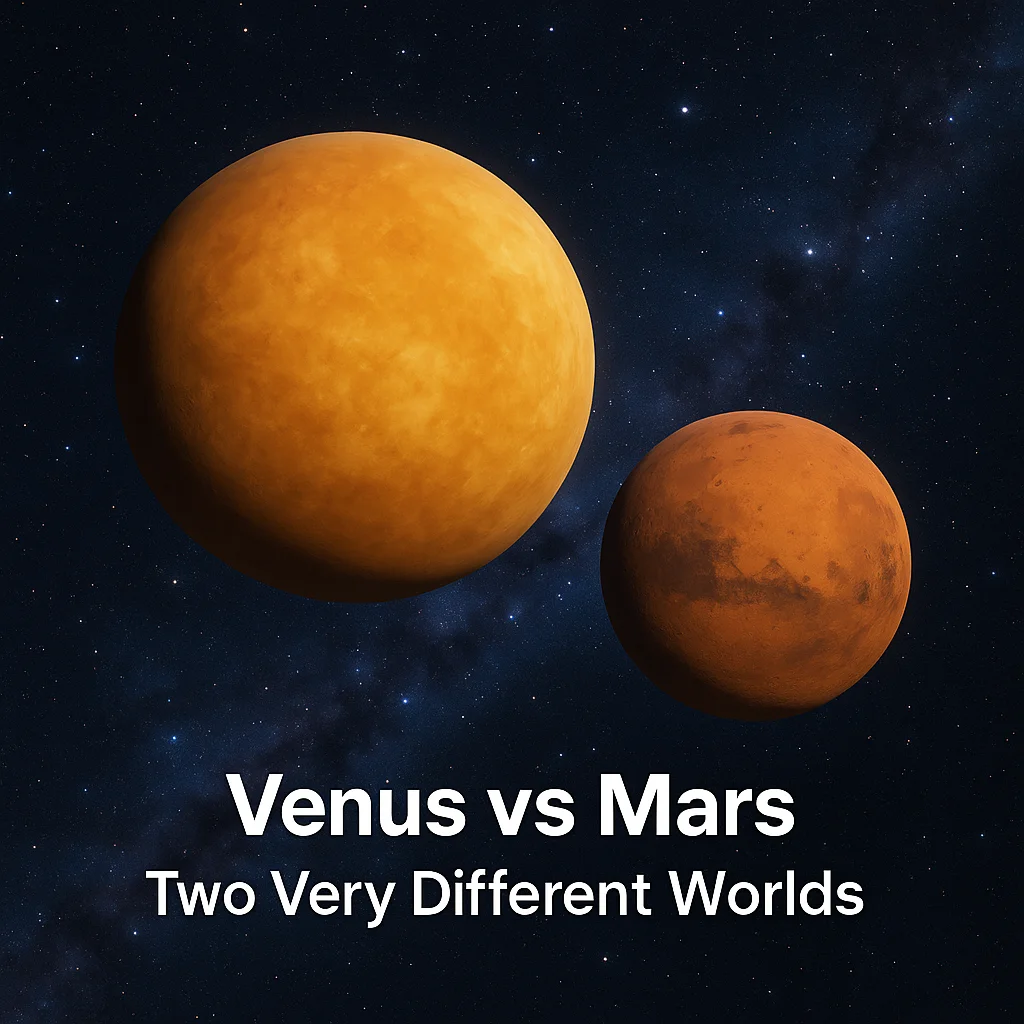
Venus and Mars are considered terrestrial planets, meaning they have solid, rocky surfaces. They are Earth's closest planetary neighbors in the Solar System and are often subjects of comparison due to their proximity and surface exploration potential.
Throughout this article, you will learn about the unique features and environments of Venus and Mars, their locations within the Solar System, and the scientific missions that have expanded our understanding of these two contrasting worlds.
📍 Where It Is and How Far Away
Venus is the second planet from the Sun, orbiting at an average distance of 67 million miles. Mars, on the other hand, is the fourth planet from the Sun, with an average orbit of 142 million miles. These distances mean that Venus is much closer to the Sun than Mars.
This difference in their positions has a significant effect on their climates. Venus receives a vast amount of sunlight, making it incredibly hot, whereas Mars, being further away, receives less sunlight, resulting in a much colder environment.
To put this in perspective, while a year on Venus lasts about 225 Earth days, a Martian year is about 687 Earth days long. This variation affects everything from atmospheric conditions to potential habitability.
🧱 Size, Mass, and Gravity (Made Simple)
Venus is often called Earth's "sister planet" because they are similar in size and composition, with Venus having a diameter of about 7,520 miles. Mars is smaller, with a diameter of about 4,220 miles, making it just over half the size of Earth.
Despite its size, Venus has a surface gravity similar to Earth's, allowing you to experience a familiar sense of weight if you could stand on it. Mars, being smaller and less massive, has a surface gravity about 38% of Earth's, meaning you would weigh significantly less there.
This difference in gravity would affect everything from the way a person walks to how water behaves on these planets and is a crucial factor in designing missions and equipment for interplanetary travel.
🌡️ Atmosphere and Weather
Venus has an incredibly thick atmosphere composed almost entirely of carbon dioxide, with clouds of sulfuric acid. This creates a strong greenhouse effect, trapping heat and causing surface temperatures to reach over 900 degrees Fahrenheit.
Mars boasts a much thinner atmosphere, mostly made up of carbon dioxide but with far lower atmospheric pressure than Earth or Venus. The weather on Mars is predominantly cold, with surface temperatures averaging around minus 80 degrees Fahrenheit.
These atmospheric conditions illustrate the diverse climates within our Solar System and the challenges they pose for any form of life or human exploration.
🪨 Surface and Interior
Surface conditions on Venus are extreme, with volcanic plains and a relatively young surface continually reshaped by tectonic activity and volcanic eruptions. Thick clouds and high atmospheric pressure limit the direct observation of its surface from space.
Mars, in contrast, features a barren landscape marked by large volcanoes, deep canyons, and possibly ancient river beds. The planet's surface has been shaped by past volcanic activity, meteorite impacts, and erosion.
The interiors of both planets remain subjects of study. Venus is believed to have a core, mantle, and crust similar to Earth's, while Mars lacks the active tectonic plates present on Earth.
🌀 Rotation, Orbit, and Seasons
An interesting characteristic of Venus is its retrograde rotation, meaning it spins in the opposite direction of most planets, with a day lasting about 243 Earth days. Mars rotates similar to Earth, completing a spin in just a little over 24 hours.
Both Venus and Mars have elliptical orbits, but Mars has a noticeable tilt, giving it distinct seasons akin to Earth. Venus, with its small axial tilt, does not have significant seasonal changes.
The concept of day and year length, and tilt, highlights the dynamic nature of planetary systems and how they govern the environment on each planet.
🧲 Magnetic Field and Radiation
Unlike Earth, Venus has no significant magnetic field, which impacts its ability to shield its surface from solar radiation. This exposure contributes to the planet's extreme surface conditions.
Mars has a very weak magnetic field, offering limited protection against solar and cosmic radiation. This lack of a strong magnetic field poses a challenge for potential habitability and human exploration.
Understanding magnetic fields helps scientists assess the capability of planets to support life and the technological demands for establishing a human presence.
🌙 Moons, Rings, and Neighbors
Unlike many other planets, Venus has no moons or rings, which is somewhat unusual among the terrestrial planets. This absence prompts questions about its history and possible past celestial events.
Mars is home to two small moons, Phobos and Deimos, which are irregularly shaped and thought to be captured asteroids. These moons contribute gravitational influences that affect Martian tides and provide additional targets for scientific study.
The interactions and histories of moons and rings give insight into the broader dynamics of our Solar System.
🔭 How We Know (Missions and Observations)
Telescope observations from Earth have given us initial insights into Venus and Mars, but spacecraft missions have dramatically expanded our understanding. For Venus, missions such as NASA's Mariner and ESA's Venus Express have provided detailed atmospheric data.
Mars has been explored by numerous missions including NASA's Viking landers, the Mars rovers, and orbiters like Mars Reconnaissance Orbiter, offering a wealth of information on its geology and atmosphere.
Data from these missions help scientists derive precise measurements of atmospheric composition, surface conditions, and magnetic fields, offering a comprehensive view of each planet.
❓ Common Questions and Misconceptions
Is Venus a star? No, it's a planet, although it is often visible as a bright object in the sky.
Can you stand on Venus or Mars? Mars, yes, if you have a spacesuit. Venus's surface is too hot and under too much pressure.
Is Venus habitable? Currently, no, due to its extreme surface conditions.
Why is Mars often called the "red planet"? Its reddish appearance comes from iron oxide, or rust, on its surface.
Are Venus and Mars visible from Earth? Yes, both can be seen with the naked eye under the right conditions.
Does Mars have liquid water? Not on its surface today, but there is evidence of past water flow.
📌 Summary
- Venus and Mars are terrestrial planets with rocky surfaces.
- Venus is the second planet from the Sun; Mars is the fourth.
- Venus's gravity is similar to Earth's; Mars's is weaker.
- Venus has a thick CO2 atmosphere; Mars's atmosphere is thin.
- Venus's surface is volcanic; Mars has canyons and volcanoes.
- Venus rotates slowly in retrograde; Mars has a day similar to Earth's.
- Venus has little magnetic field; Mars has a weak one.
- Venus has no moons; Mars has two small moons.
- Our knowledge comes from telescopic and spacecraft observations.
- Interesting fact: Venus's day is longer than its year!