🪐 Which Planet Has the Most Extreme Weather?
🌌 What It Is
Planets are fascinating celestial bodies that orbit stars, and in our Solar System, they orbit our sun. They vary widely in size, composition, and distance from the sun, leading to a range of environments and weather patterns. Among these, gas giants like Jupiter and Saturn are known for some of the most extreme weather conditions.
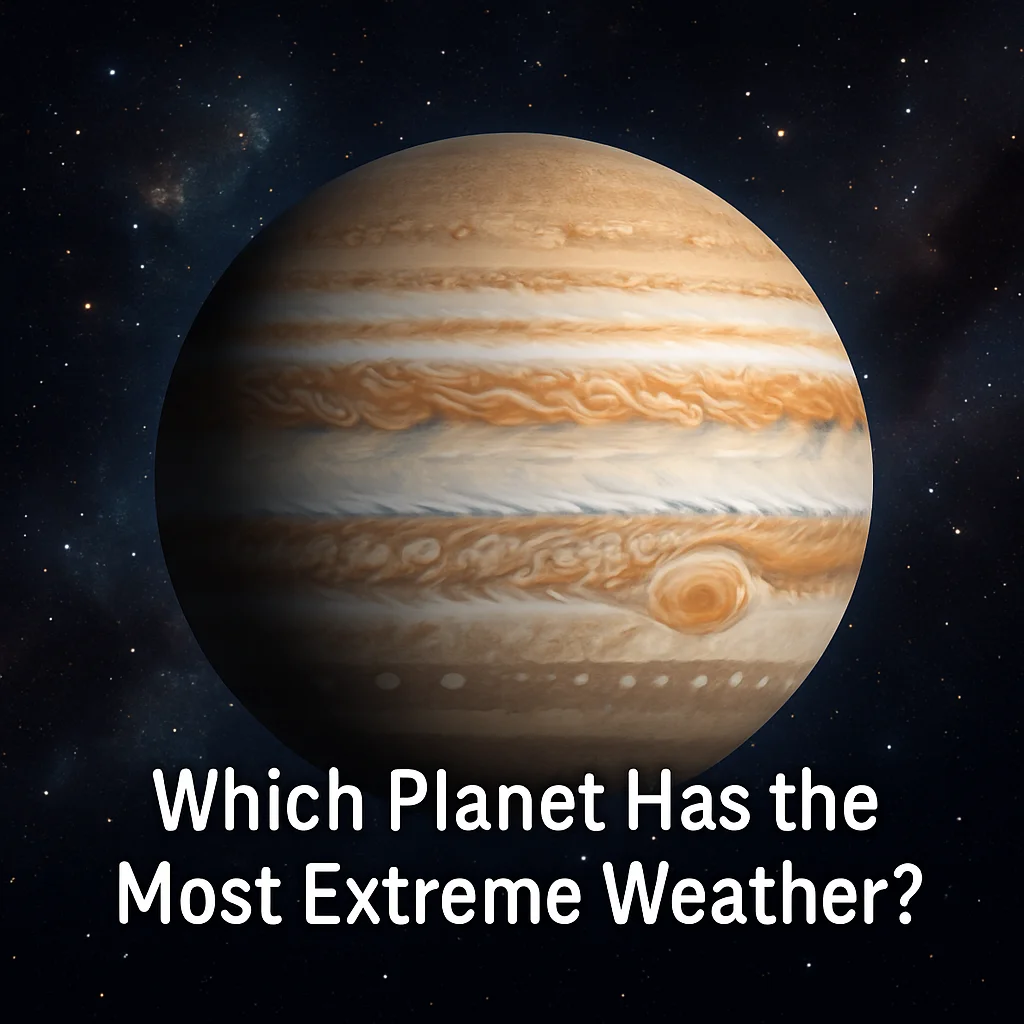
Jupiter, in particular, stands out with its colossal storms and powerful winds. As a gas giant, it lacks a solid surface and is primarily composed of hydrogen and helium. This classification helps scientists predict its atmospheric behavior, which you'll learn about in this article.
In this guide, we'll explore what makes Jupiter's weather so extraordinary. You'll learn about its atmosphere, storms, and other intriguing details that make it a planet of superlatives in our Solar System.
📍 Where It Is and How Far Away
Jupiter is the fifth planet from the Sun, situated between Mars and Saturn. It resides more than 5 astronomical units (AU) from the Sun, translating to over 400 million miles. To visualize this, consider that Earth is about 93 million miles from the Sun, or 1 AU. This distance from the Sun influences Jupiter's temperature and weather patterns significantly.
Being further away, Jupiter receives less sunlight than Earth, which affects its temperature. However, the planet generates more heat internally than it receives from the sun, playing a crucial role in its dynamic weather.
Jupiter can be observed from Earth through telescopes, where its full disk is visible. This complete view allows us to study its unique features, such as bands of clouds and the Great Red Spot, a gigantic storm persisting for hundreds of years.
🧱 Size, Mass, and Gravity (Made Simple)
Jupiter is the largest planet in our Solar System. It has a diameter of about 88,846 miles, which is more than 11 times that of Earth. In terms of mass, Jupiter is over 300 times that of Earth. This immense size means powerful gravity, which holds onto its thick atmosphere.
If you stood on a theoretical solid surface of Jupiter, you would feel much heavier than on Earth. This is because Jupiter's gravity is 2.5 times that of Earth's. However, since Jupiter is a gas giant, there's no solid ground to stand on, making this merely a thought experiment.
The vast size and mass of Jupiter influence its weather. It can support massive storms and banding in its atmosphere, resulting from its rapid rotation and the convection within its gaseous layers.
🌡️ Atmosphere and Weather
Jupiter's atmosphere is a colossal blanket of gas, primarily composed of hydrogen and helium, with traces of ammonia, methane, and water vapor. These gases create a colorful tapestry of cloud bands and storms, driven by complex chemical and physical interactions.
Clouds are a significant feature of Jupiter's atmosphere. They appear as bands of different colors, composed mostly of ammonia crystals. The Great Red Spot, a high-pressure storm big enough to swallow Earth, is one of Jupiter's most iconic features.
The planet's rotation, one of the fastest in the Solar System, causes powerful winds that reach speeds of up to 384 miles per hour. These winds stretch the cloud bands around the planet and contribute to the extreme weather patterns observed.
🪨 Surface and Interior
Unlike rocky planets, Jupiter is a gas giant without a clear surface. Its atmosphere gradually transitions into higher pressure and temperature zones, leading to a liquid metallic hydrogen interior. This lack of a solid surface influences how we understand its weather systems and landscapes.
Jupiter's core is hypothesized to be rocky and icy, surrounded by a thick layer of metallic hydrogen. Scientists believe this core is much larger than Earth's, contributing to the planet's intense magnetic field.
The planet's interior structure is largely unknown, but the gradual transition from gas to liquid challenges our typical perception of a "surface". Consequently, observations focus on atmospheric phenomena rather than surface features.
🌀 Rotation, Orbit, and Seasons
Jupiter completes one rotation approximately every 10 hours, the fastest rotation of any planet in our Solar System. This rapid spin contributes to its bulging appearance at the equator and abrupt weather changes.
Its orbit around the Sun takes about 12 Earth years. Despite this lengthy year, Jupiter experiences minimal changes in seasons due to its low axial tilt of approximately 3 degrees, compared to Earth's 23.5 degrees.
Jupiter's quick rotation and orbit create a unique dynamic in its cloud layers and storms, with patterns that differ vastly from the more familiar Earthly weather systems.
🧲 Magnetic Field and Radiation
Jupiter's magnetic field is the strongest of any planet in our Solar System. It stems from the swirling metallic hydrogen inside, generating intense magnetic forces that create radiation belts far stronger than Earth's Van Allen belts.
Auroras on Jupiter are dramatic and constant, a result of its powerful magnetic interactions with its moons and the solar wind. These auroras are much larger and more energetic than those on Earth, observable at both poles of the planet.
For spacecraft, navigating these radiation belts requires careful planning to avoid damage from high-energy particles. This intense radiation environment impacts the kind of equipment that can be used to study Jupiter.
🌙 Moons, Rings, and Neighbors
Jupiter is accompanied by more than 70 known moons, with the four Galilean moons — Io, Europa, Ganymede, and Callisto — being the largest and most studied. These moons influence and are influenced by Jupiter's magnetic field and form a mini solar system of their own.
The planet also has a faint ring system, primarily composed of dust particles from impacts on its moons. These rings are not as visible or as prominent as Saturn's but are an interesting feature of Jupiter's diverse system.
Gravitational interactions between Jupiter and its moons lead to tidal forces that can heat the moons' interiors, contributing to active volcanism on Io and potential subsurface oceans on Europa.
🔭 How We Know (Missions and Observations)
Our understanding of Jupiter comes from both telescopic observations and space missions. Telescopes on Earth and in orbit provide broad images, while spacecraft offer detailed data on Jupiter's atmosphere and magnetic field.
The Pioneer and Voyager missions provided the first close-up data, capturing images and measuring magnetic fields. Later, the Galileo spacecraft orbited Jupiter, delivering extensive insights into its moons and storms.
The Juno mission currently orbits Jupiter, focusing on its atmosphere, magnetic field, and interior structure. Juno's findings continue to refine our understanding of Jupiter's complex system.
❓ Common Questions and Misconceptions
Is Jupiter a star? No, it's a planet. While it's composed mostly of hydrogen and helium, it doesn't have enough mass to initiate the nuclear fusion required to become a star.
Can you stand on Jupiter? No. Jupiter is a gas giant without a solid surface, so there's nothing to stand on as we understand it.
Is Jupiter habitable? Currently, no. Its extreme weather, lack of solid surface, and high radiation levels make it an inhospitable environment for life as we know it.
Why is Jupiter that color? The planet's coloration arises from trace gases in its atmosphere and their interaction with sunlight, producing the reds, whites, and browns observed in its clouds.
Is the Great Red Spot shrinking? Yes, the Great Red Spot has been observed to be shrinking over the years, but it remains a prominent feature in Jupiter's atmosphere.
Does Jupiter affect our planet? Gravitationally, yes. Jupiter helps shield Earth from some potential comet impacts, its massive gravity attracting or deflecting these objects away from the inner solar system.
📌 Summary
- Jupiter is a gas giant, the largest planet in our Solar System.
- Located fifth from the Sun, about 5 AU away, it influences its environment with massive size.
- With a diameter over 11 times that of Earth, its gravity is immense despite having no solid surface.
- The atmosphere hosts extreme weather, including fast winds and the persistent Great Red Spot.
- Jupiter lacks a solid surface; its structure includes a potential rocky core surrounded by metallic hydrogen.
- With a rapid 10-hour rotation and a 12-year orbit around the Sun, its seasons are minimal.
- A strong magnetic field causes intense radiation and spectacular auroras.
- Jupiter has over 70 moons and a faint ring system, influencing its planetary environment.
- Explorations by spacecraft like Juno deepen our knowledge of its gas composition and magnetic field.
- Jupiter's colossal storms and dynamic weather remain one of the greatest mysteries in planetary science.