🪐 Planet Layers: Core, Mantle, Crust Explained
🌌 What It Is
Planets are fascinating celestial bodies that revolve around stars. In our Solar System, planets orbit the Sun. They are broadly classified into two categories: terrestrial planets, which are rocky, and gas giants, which are mostly made of gases and ices.
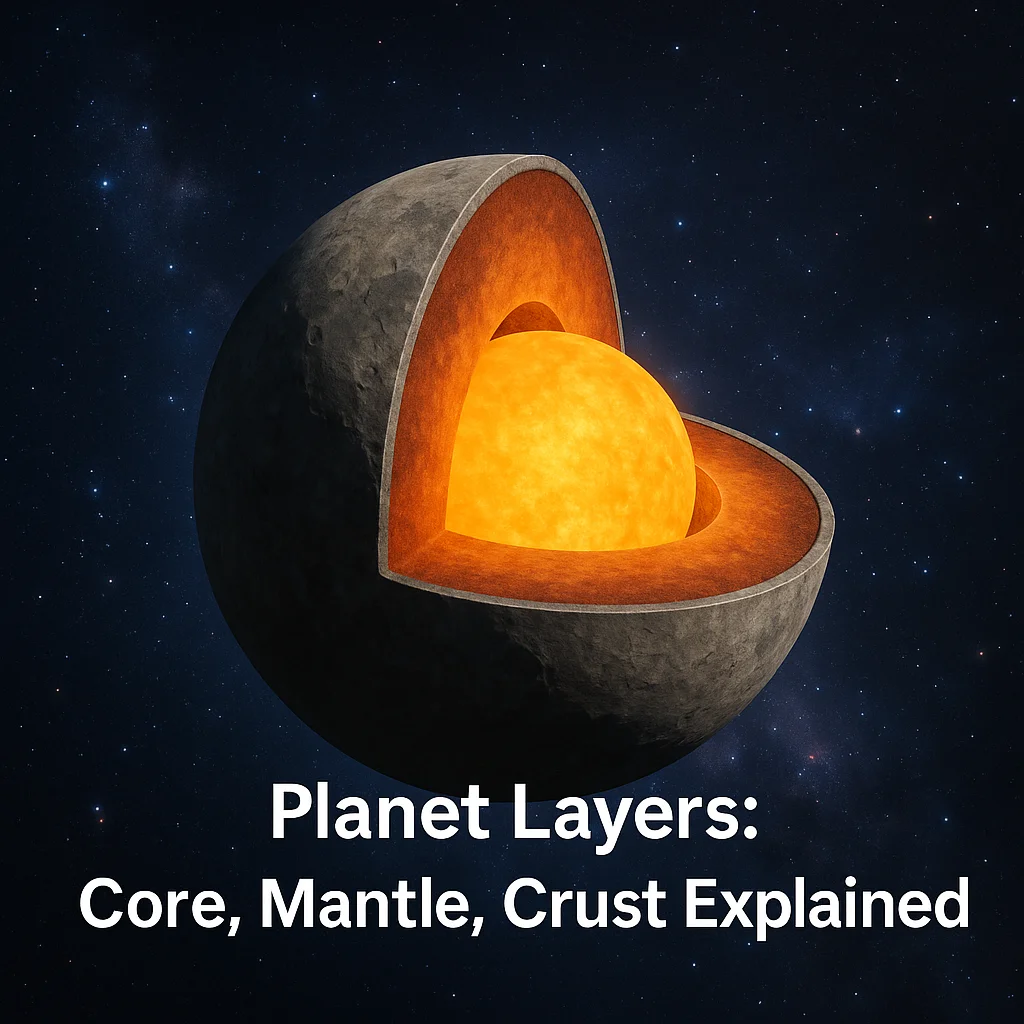
This article focuses on the surface and interior layers of planets, exploring the characteristics of the core, mantle, and crust. These layers define a planet's structure and give us clues about its formation and evolution.
By the end, you will understand the basic components that make up a planet's interior, and how these influence its overall properties and phenomena, such as volcanic activity and magnetic fields.
📍 Where It Is and How Far Away
The planets we discuss here are primarily those within our own Solar System. The Solar System resides in the Milky Way galaxy, tucked away in one of its spiral arms.
Distances in our Solar System can be enormous. For example, Earth is about 93 million miles from the Sun, a distance we call 1 Astronomical Unit (AU). Distances to other planets vary significantly; for instance, Neptune is about 30 AU from the Sun.
The position of a planet in relation to the Sun affects its temperature and the intensity of sunlight it receives. Inner planets like Mercury are hot due to their proximity to the Sun, while outer planets like Neptune are much colder.
🧱 Size, Mass, and Gravity (Made Simple)
Planets vary greatly in size and mass. Terrestrial planets like Earth and Mars are smaller and rockier, whereas gas giants like Jupiter and Saturn are much larger but composed mostly of gases.
Mass plays a significant role in gravity. Earth has a gravitational pull that gives objects a weight we are familiar with. On smaller planets like Mars, you would weigh about a third of your Earth weight.
Gas giants do not have a solid surface to stand on, but their immense mass creates strong gravitational forces. These forces can hold moons in orbit and even affect the paths of nearby objects.
🌡️ Atmosphere and Weather
The atmospheres of planets are composed of different gases. Earth's atmosphere is rich in nitrogen and oxygen, while Venus has a thick carbon dioxide atmosphere, creating a runaway greenhouse effect.
Weather patterns vary. For instance, Jupiter's storm systems like the Great Red Spot are caused by its fast rotation and thick atmosphere. Mars, with its thin atmosphere, experiences dust storms that can cover the entire planet.
Atmospheric compositions influence weather greatly. Planets closer to the Sun tend to be hotter, whereas those farther away like Uranus and Neptune experience frigid temperatures.
🪨 Surface and Interior
Terrestrial planets have solid surfaces with features such as mountains, valleys, and craters shaped by tectonic processes and meteorite impacts. Volcanic activity is also a significant factor in shaping surfaces, as seen on Earth and Venus.
Gas giants lack a defined surface; instead, their "surface" is the point where atmospheric pressure equals that at Earth's sea level. These planets have layered interiors, with a core, surrounding mantle, and dense atmospheric layers.
Understanding a planet's layers helps scientists infer its history and behavior. For instance, a molten core may give rise to a magnetic field, while tectonic activity suggests a dynamic mantle.
🌀 Rotation, Orbit, and Seasons
A planet's rotation defines its day, which can vary from a few hours to many Earth days. A planet's orbit around the Sun defines its year. Mercury orbits quickly, completing a year in just 88 Earth days, while Saturn takes about 29 Earth years.
Axial tilt affects seasons. Earth’s tilt results in four seasons, while Uranus, with its extreme tilt, experiences long seasons that last over 20 Earth years.
Some planets, like Venus, have a retrograde rotation, meaning they spin opposite to their orbit, leading to unique solar day lengths compared to Earth.
🧲 Magnetic Field and Radiation
Magnetic fields are generated by the movement of liquid metal within a planet's core. These fields protect planets from solar winds and cosmic radiation, forming protective spaces known as magnetospheres.
Earth's magnetic field leads to phenomena such as auroras, colorful lights seen near the poles. Jupiter’s powerful magnetic field traps radiation, creating intense radiation belts that spacecraft must navigate cautiously.
Understanding magnetic fields is crucial for planning spacecraft missions, as areas with high radiation can damage electronics and endanger missions.
🌙 Moons, Rings, and Neighbors
Moons vary widely among planets. Earth has one, while Jupiter and Saturn boast dozens, including large and diverse moons such as Ganymede and Titan.
Ring systems are most famously associated with Saturn, but Jupiter, Uranus, and Neptune also have rings. These are made of ice, rock, and dust particles, often remnants of moonlets or captured material.
Planetary interactions, such as gravitational forces from moons, can lead to interesting phenomena like tides and resonances that can significantly affect a planet's environment.
🔭 How We Know (Missions and Observations)
Knowledge of planets comes from both telescopic observations and spacecraft missions. Telescopes can observe planets from afar, gauging their size, color, and atmospheric composition using light spectra.
Spacecraft missions offer direct exploration. Missions like Voyager, Galileo, and the Mars rovers provide detailed data through images, gravity measurements, and atmospheric analyses.
This wealth of information allows scientists to piece together comprehensive pictures of planetary processes, from surface conditions to deep interior structures.
❓ Common Questions and Misconceptions
Is a planet a star? No, planets do not emit light like stars; they reflect sunlight.
Can you stand on Jupiter? No, Jupiter lacks a solid surface.
Is Mars habitable? While fascinating, Mars' thin atmosphere and radiation levels make it challenging for life as we know it.
Why does Neptune appear blue? Methane in its atmosphere absorbs red light, giving it a blue color.
Is Venus Earth’s twin? Venus is similar in size but has a very different atmosphere and surface conditions.
Can planets change their orbits? Over astronomical timescales, planetary orbits can shift slightly due to gravitational interactions or collisions.
Are all ring systems the same? No, rings differ in composition and size, reflecting the unique history of each planet.
Why don't we see Pluto? Pluto is a dwarf planet, smaller and farther away, requiring strong telescopes for observation.
📌 Summary
- Planets are diverse celestial bodies classified into terrestrial and gas giants.
- They orbit the Sun at varying distances, affecting their temperatures.
- Planetary size and mass influence gravitational forces and surface weight.
- Atmosphere composition affects weather, with diverse patterns from storms to calm.
- Terrestrial surfaces are shaped by geological activity; gas giants have unseen layers.
- Rotation and orbit determine a planet’s day and year, with tilt influencing seasons.
- Magnetic fields protect against radiation, affecting both planets and spacecraft.
- Moons and rings add complexity through gravitational interactions and material diversity.
- We learn from telescopes and missions, capturing a planet's multifaceted nature.
- One fascinating fact: Jupiter’s magnetic field is the strongest of any planet in the Solar System.