🪐 What Is a Planet? The Official Definition Explained
🌌 What It Is
The concept of a planet has fascinated humans for centuries. But what exactly makes an object a planet? According to the International Astronomical Union (IAU), a planet is a celestial body that orbits the Sun, has sufficient mass for its self-gravity to overcome rigid body forces so that it assumes a nearly round shape, and has cleared its neighboring region of planetesimals.
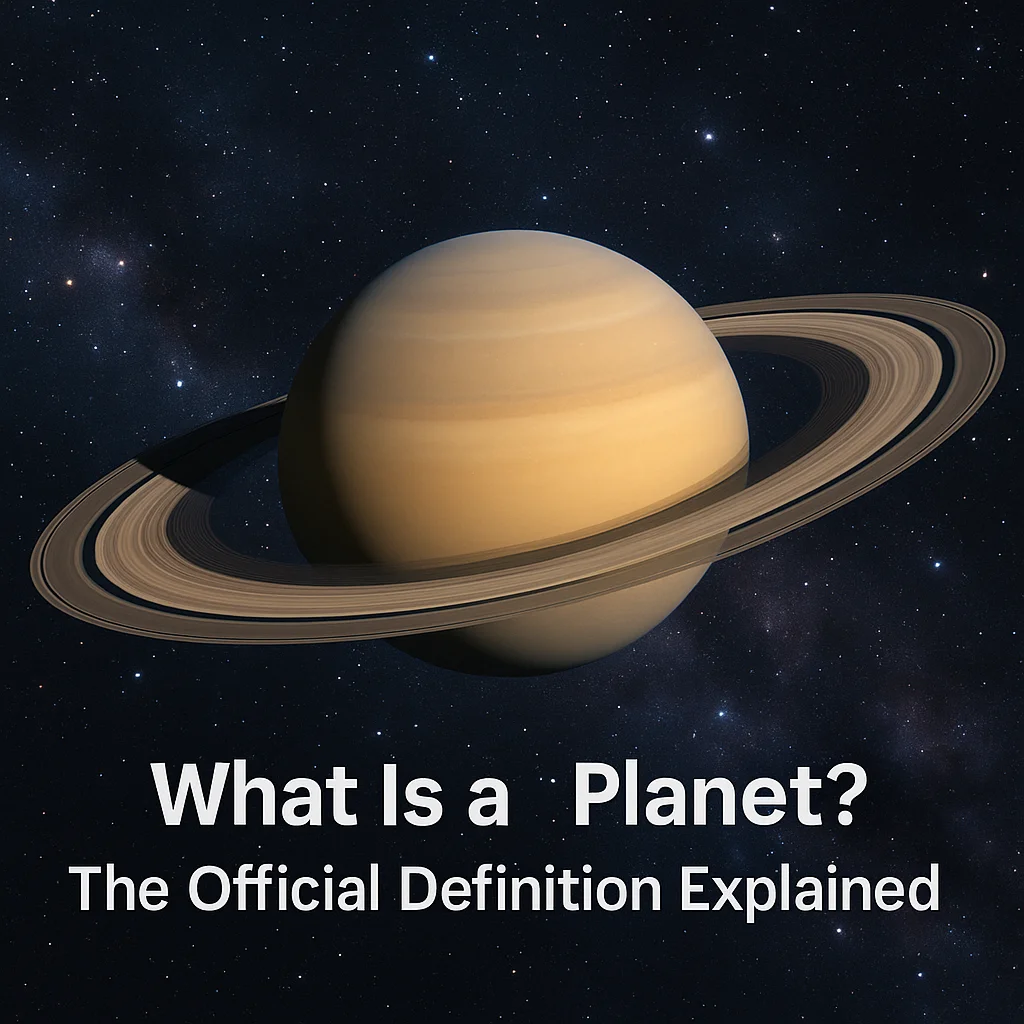
This definition came into official use in 2006 after the reclassification of Pluto, which highlights the refined criteria needed to distinguish planets from other celestial objects. In our Solar System, planets are divided into two categories: terrestrial planets, which are rocky, and gas giants or icy giants, which are composed mostly of gases or ices.
Throughout this article, you will learn more about what defines planets, their locations, physical characteristics, atmospheres, and more. Get ready to explore the fundamentals of planetary science!
📍 Where It Is and How Far Away
Planets are primarily located within the boundaries of our Solar System, which is centered around the Sun. In this system, the planets follow elliptical orbits at various distances. For context, an Astronomical Unit (AU) is the average distance from the Earth to the Sun, approximately 93 million miles or 150 million kilometers.
The inner planets, Mercury, Venus, Earth, and Mars, are closer to the Sun, while the outer planets, Jupiter, Saturn, Uranus, and Neptune, are much further away. This separation affects the amount of sunlight each planet receives and, subsequently, their surface temperatures and atmospheric conditions.
To put the distances into perspective, while Mars is about 1.5 AU from the Sun, Saturn is about 9.5 AU away, meaning sunlight and warmth diminish significantly as you move from the inner to the outer planets.
🧱 Size, Mass, and Gravity (Made Simple)
Planets vary significantly in size and mass. For instance, Jupiter is the largest and most massive planet in our Solar System, with a diameter of about 86,881 miles (139,822 kilometers). This sheer size contributes to its strong gravitational pull. In contrast, Mercury is the smallest planet, with a diameter of only 3,032 miles (4,880 kilometers).
Gravity on a planet's surface determines how heavy objects feel. On Earth, we are familiar with its gravity, which is why a person weighing 70 kg (around 154 lbs) would weigh only about 27 kg (approximately 60 lbs) on Mercury. On Jupiter, however, the same person would weigh around 165 kg (about 364 lbs) due to the planet's immense gravitational force.
Interestingly, gas giants such as Jupiter and Saturn don't have solid surfaces, so "standing" on them isn't possible in the traditional sense. Instead, one would sink through gaseous layers into regions of extreme pressures.
🌡️ Atmosphere and Weather
The atmosphere of a planet is a crucial aspect that affects its weather systems. Earth's atmosphere consists primarily of nitrogen and oxygen, which support life. Other planets have vastly different atmospheric compositions. For example, Venus has a thick, toxic atmosphere mainly composed of carbon dioxide, with clouds of sulfuric acid.
Weather patterns can be extreme, shaped by the planet's atmospheric composition and rotation. Jupiter is famous for its Great Red Spot, a massive storm larger than Earth, persistent for at least 400 years. The stormy and windy conditions in Jupiter's atmosphere result from its rapid rotation and heat from its interior.
The absence of an atmosphere, like on Mercury, means no conventional weather as we know it. This leads to drastic temperature changes between day and night, with scorching days and freezing nights.
🪨 Surface and Interior
Rocky planets like Earth have solid surfaces with features shaped by volcanic activity, erosion, and tectonic movements. Mars, for instance, has the largest volcano and canyon in the Solar System, suggesting a dynamic geological past.
Gas giants such as Jupiter do not have a true surface; instead, they consist of thick atmospheres transitioning gradually to dense cores of metallic hydrogen. The concept of layers in these planets helps scientists understand their formation and internal processes.
Layers of a planet may include a core, which is often metallic, surrounded by a mantle and a crust or outer envelope, which have varying compositions based on the planet type.
🌀 Rotation, Orbit, and Seasons
A planet's rotation on its axis defines the length of its day. Earth rotates once roughly every 24 hours, while Jupiter rotates much faster, completing a rotation in just about 10 hours. In contrast, Venus rotates very slowly, with its day longer than its year.
The orbit of a planet around the Sun defines its year length. For Earth, one complete orbit takes 365 days, but for Neptune, it takes about 165 Earth years due to its vast distance from the Sun. Some planets have axial tilts that cause seasons, like Earth and Mars, though the tilt angle and orbital duration govern their severity and duration.
Unusual characteristics like Venus’s retrograde rotation or Uranus's extreme axial tilt provide unique seasonal patterns, challenging scientists to understand their underlying causes.
🧲 Magnetic Field and Radiation
A planet's magnetic field is an invisible shield that protects its atmosphere from solar and cosmic radiation. Earth's magnetic field is generated by its rotating iron core, leading to phenomena such as the auroras, which occur when solar particles interact with the atmosphere.
Jupiter’s magnetic field is the strongest of any planet in the Solar System, extending far into space and creating intense radiation belts that can pose hazards to spacecraft. These fields can trap charged particles, affecting the space environment around the planet.
The influence of a magnetic field is essential for maintaining an atmosphere over geological time and protecting potential signs of life from harmful radiation.
🌙 Moons, Rings, and Neighbors
Planets often have moons or ring systems as a result of gravitational forces. Earth’s Moon affects ocean tides, while Jupiter has a remarkable 79 known moons, including the volcanically active Io and the ice-covered Europa, which may harbor oceans beneath its surface.
Saturn is well-known for its spectacular ring system, visible as concentric circles from afar with the entire planet and rings in frame. These rings are made of ice and rock particles, possibly remnants of comets, asteroids, or shattered moons.
Some planets, like Mercury and Venus, have no moons, which highlights the diversity in planetary features and raises questions about how moons form and evolve.
🔭 How We Know (Missions and Observations)
Our understanding of planets comes from telescope observations and space missions. Telescopes can capture images, measure spectra, and analyze the light to reveal physical characteristics. Spacecraft, like the Voyager probes, provide direct data on planetary atmospheres, magnetic fields, and other features.
Missions such as NASA’s Mars rovers explore the Martian surface, collecting rocks and soil. The Hubble Space Telescope captures stunning images of planets, showing full disks surrounded by dark space, contributing significantly to our knowledge.
The combination of remote sensing and in-situ measurements allows scientists to study planetary processes in detail, increasing our understanding of them.
❓ Common Questions and Misconceptions
Is it a star? No, planets do not generate their own light but reflect sunlight.
Can you stand on it? Not always. Gas giants don't have a solid surface.
Is it habitable? For now, only Earth is known to support life.
Why is it that color? A planet's color comes from its surface compounds and atmospheric gases.
Do all planets have moons? No, Mercury and Venus don't have moons.
Is it in our galaxy? Yes, the planets we discuss are in our Solar System, located in the Milky Way galaxy.
Are they round? Planets are mostly spherical due to gravity, with slight flattening at the poles.
Do they all orbit the same way? Most do, but Venus has a retrograde rotation.
Why is Pluto not a planet? It hasn't cleared its orbit of other objects, leading to its reclassification as a dwarf planet.
Can you see planets without a telescope? Yes, five planets can be visible to the naked eye from Earth under the right conditions.
📌 Summary
- Defines what makes a celestial body a planet
- Located in the Solar System, each in its unique orbit
- Varies greatly in size and gravity
- Atmosphere composition and weather patterns differ widely
- Rocky surfaces or gaseous layers depending on type
- Unique rotation speeds and orbital patterns creating seasons
- Magnetic fields contribute to atmospheric protection
- Moons and rings vary, impacting gravitational dynamics
- Knowledge gained from telescopic and space missions
- Each planet offers unique insights into our Solar System