🪐 What Makes an Atmosphere Stable?
🌌 What It Is
An atmosphere is a layer of gases surrounding a planet or a moon. It plays a crucial role in determining the weather and climate of celestial bodies and can protect the surface from radiation and space debris.
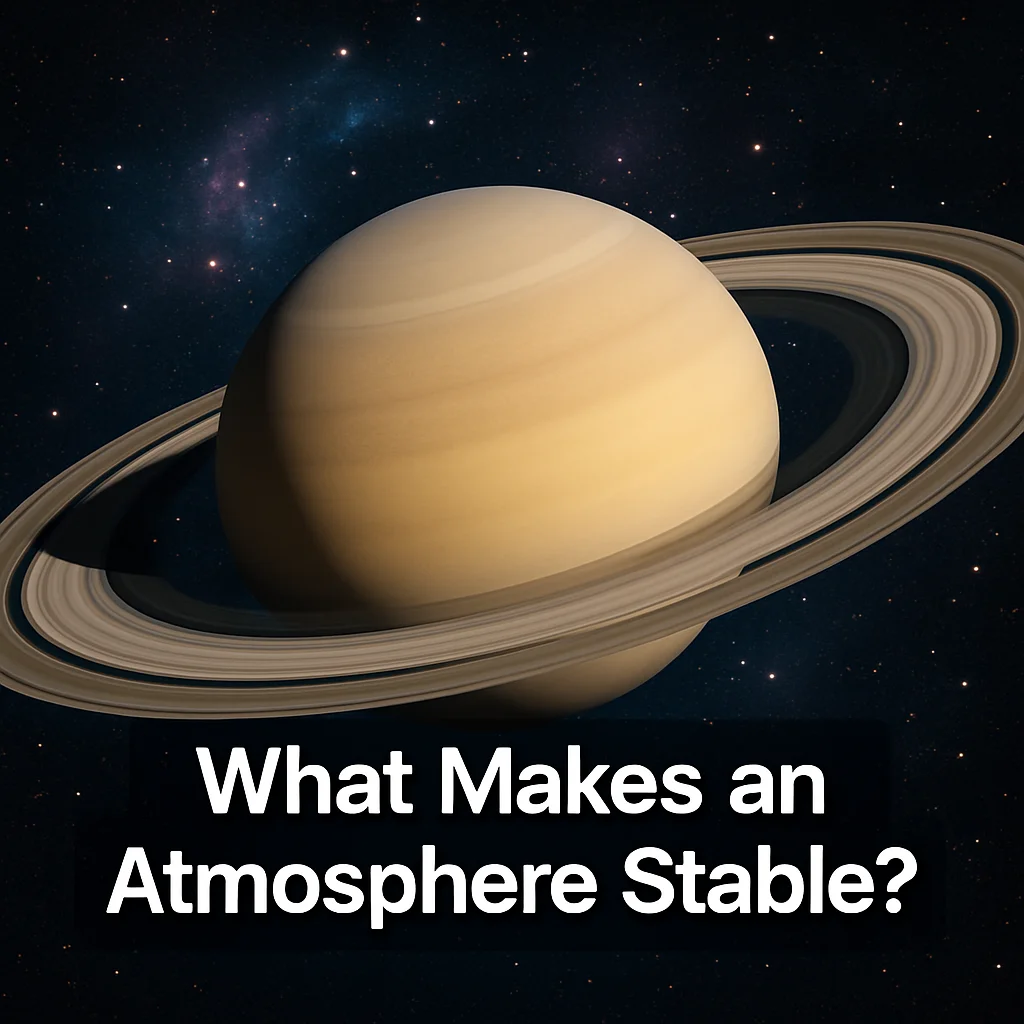
Planetary atmospheres vary widely across the Solar System. From the thick nitrogen-rich atmosphere of Earth to the sparse carbon dioxide-dominant envelope of Mars, each atmosphere has unique characteristics and dynamics.
In this exploration, we will uncover what makes a planet's atmosphere stable. We will learn about how pressure, temperature, and composition influence the behavior of an atmosphere, using examples from our Solar System to illustrate these concepts.
📍 Where It Is and How Far Away
Planetary atmospheres are found throughout the Solar System, from Mercury, which has no stable atmosphere, to the gas giants like Jupiter, whose atmospheres dominate their structures. The location of a planet in relation to the Sun greatly influences its atmospheric conditions.
For instance, Venus, Earth, and Mars reside in the inner region of the Solar System, where solar radiation affects their atmospheric composition and temperature. Their proximity to the Sun contributes to higher temperatures and increased atmospheric activity compared to the distant gas giants.
The distances of planets from each other and the Sun are vast. For example, Earth is about 93 million miles from the Sun—a distance known as one astronomical unit (AU). These distances play a role in determining the relative intensity of sunlight that reaches each planet, affecting atmospheric stability.
🧱 Size, Mass, and Gravity (Made Simple)
The size and mass of a planet significantly affect its atmospheric stability. Larger planets with more mass, like Jupiter and Saturn, possess stronger gravitational forces, which help them retain thick atmospheres made of light gases like hydrogen and helium.
Gravity on a planet's surface determines how tightly a planet can hold onto its atmosphere. Earth, with its moderate gravity, retains a stable atmosphere rich in nitrogen and oxygen. Meanwhile, smaller bodies like Mars have weaker gravity, leading to thinner atmospheres.
For gas giants, there is no solid surface to stand on; instead, their atmospheres transition into layers of dense gas and liquid as we move deeper. This lack of a definitive surface complicates the way we think about standing on these planets.
🌡️ Atmosphere and Weather
A planet's atmosphere is composed of various gases, which can include nitrogen, oxygen, carbon dioxide, and even methane. The specific mix depends on the planet's history and geological activity.
Weather patterns in these atmospheres are driven by factors such as solar energy, planetary rotation, and chemical composition. On Earth, the interaction of sunlight with the atmosphere leads to clouds, rain, and storms, while on Mars, the low pressure results in dust storms.
Temperature variations in a planet's atmosphere can be extreme, affected by its distance from the Sun and the planet's ability to conduct and retain heat. Saturn, for example, experiences cooler temperatures and distinct weather due to its great distance from the Sun.
🪨 Surface and Interior
For rocky planets like Earth and Mars, the interaction between the surface and atmosphere can affect atmospheric conditions. Surface features such as mountains and oceans play a role in shaping weather patterns.
For gas giants like Jupiter and Saturn, their "surfaces" are actually layers of clouds, with potential liquid layers further down. They have layered interiors composed of hydrogen, helium, and possibly rocky cores beneath.
The structure of a planet's interior can affect its magnetic field and atmospheric composition, influencing stability over time due to factors like volcanic activity, which may release gases into the atmosphere.
🌀 Rotation, Orbit, and Seasons
The rotation of a planet determines the length of its day. Earth rotates every 24 hours, defining our day-night cycle, while Jupiter's fast rotation results in a short 10-hour day, affecting its atmospheric dynamics.
A planet's orbit around the Sun defines its year. Earth takes roughly 365 days to orbit, while Neptune, much further from the Sun, takes 165 Earth years, impacting its exposure to solar energy and seasonal cycles.
The tilt of a planet's axis can create seasons, as seen on Earth. A planet with no tilt, like Mercury, lacks pronounced seasons, leading to minimal variation in surface conditions throughout its solar orbit.
🧲 Magnetic Field and Radiation
A magnetic field shields a planet's atmosphere from solar wind—a stream of charged particles emitted by the Sun. Earth's magnetic field causes auroras and protects us from harmful radiation.
Jupiter's strong magnetic field is a result of its rapid rotation and liquid metal hydrogen core. Its magnetic environment includes intense radiation belts that can affect spacecraft and possibly atmospheric stability.
The depth and strength of a magnetic field can vary; planets like Mars have weak fields, contributing to atmospheric loss over billions of years, showcasing the importance of magnetic protection.
🌙 Moons, Rings, and Neighbors
Many planets possess moons and ring systems that can influence atmospheric conditions. For example, Jupiter's moons, like Io with its volcanic activity, can interact with and modify Jupiter's magnetosphere and atmosphere.
Saturn's iconic rings are composed of ice and rock, affecting the distribution of sunlight to the planet and possibly contributing to complex atmospheric patterns.
Moons can cause tides and exert gravitational forces, which can affect atmospheric dynamics through interactions with the planet's gravitational field, creating complex systemic interactions within planetary atmospheres.
🔭 How We Know (Missions and Observations)
Our understanding of atmospheres relies on telescopes that observe planets from afar and spacecraft that venture into space to gather closer data. This approach provides a comprehensive view of atmospheric behavior.
Space missions such as the Voyager probes and the Hubble Space Telescope have offered insights into the atmospheres of distant planets, taking detailed images and spectra that reveal components like methane or water vapor.
Orbiters and landers have enhanced our understanding of planetary atmospheres, with missions such as the Mars rovers characterizing Martian weather and atmospheric composition directly from the surface.
❓ Common Questions and Misconceptions
Is it a star? No, planets are not stars; they reflect sunlight and don't emit their own light from nuclear fusion.
Can you stand on it? On rocky planets, yes, but on gas giants, there's no solid surface to stand upon.
Is it habitable? Habitable conditions depend on liquid water, atmosphere, and temperature—each planet is different.
Why is it that color? Atmospheric composition and sunlight reflection/color scattering determine a planet’s visible color.
Do all planets have atmospheres? Not all; Mercury has almost no atmosphere due to its proximity to the Sun and weak gravity.
Why do some planets have rings? Rings result from gravitational interactions and debris; not all planets can retain them.
📌 Summary
- The atmosphere is a layer of gases surrounding a planet.
- Located throughout the Solar System, impacting temperature and sunlight received.
- Planetary size and gravity influence atmospheric stability.
- Atmosphere composition varies across planets, affecting weather.
- Surface features shape weather; gas giants have complex interiors.
- Rotation and orbit affect day, year lengths and seasons.
- Magnetic fields protect atmospheres from solar wind.
- Moons and rings impact atmospheric conditions via gravity.
- We learn through telescopes and space missions.
- Atmosphere stability is key for understanding planetary environments.