🪐 Why Planets Have Different Colors
🌌 What It Is
Planets are celestial bodies that orbit a star and are massive enough to be rounded by their own gravity, but not massive enough to cause thermonuclear fusion. In our Solar System, the planets are divided into two categories: terrestrial and gas giants. Terrestrial planets, like Earth and Mars, are rocky, while gas giants, like Jupiter and Saturn, have thick atmospheres and are primarily composed of hydrogen and helium.
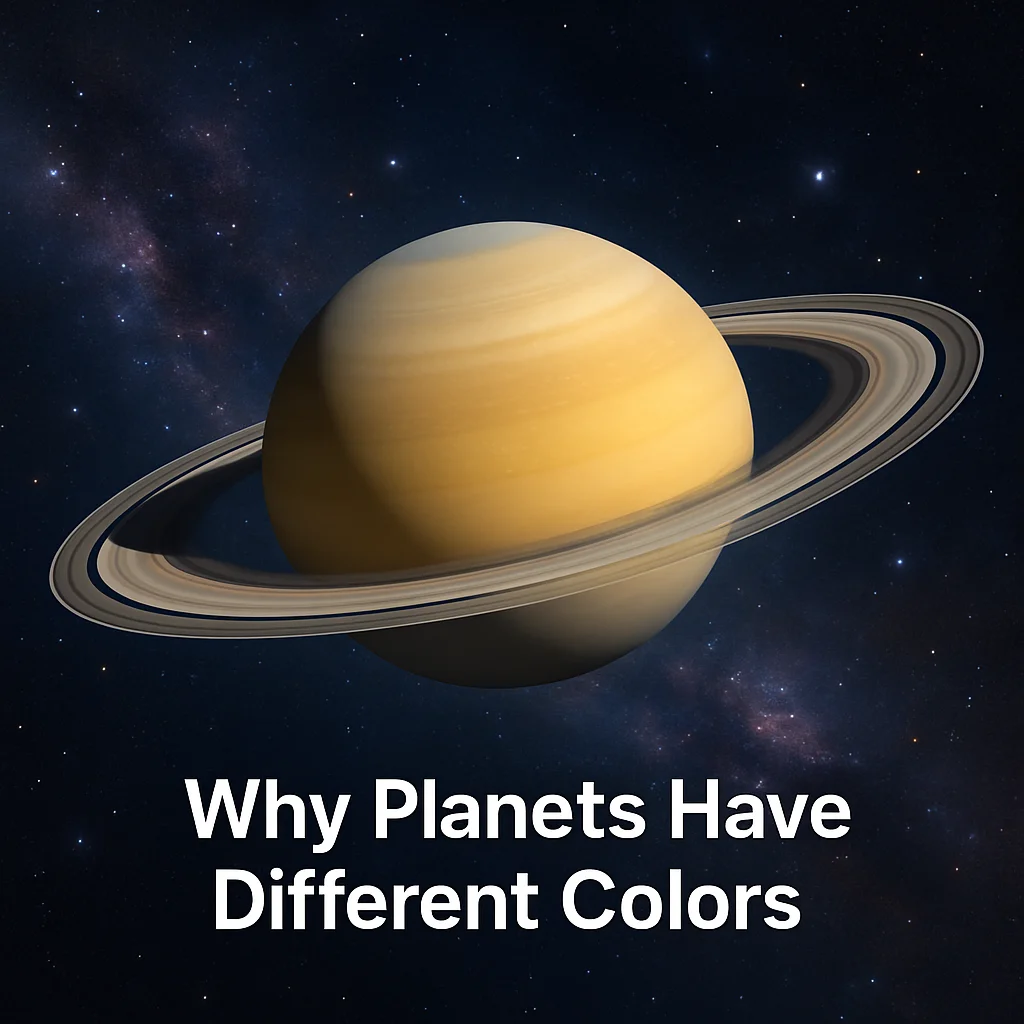
Each planet has its unique color, which can provide clues about its composition, atmosphere, and surface characteristics. The color we observe from Earth is the result of how the planet's surface and atmosphere reflect and absorb sunlight.
In this article, we will explore the reasons behind the varying colors of planets, considering factors such as solar distance, atmospheric composition, and surface materials. By understanding these factors, we can gain insights into the nature and history of these distant worlds.
📍 Where It Is and How Far Away
Planets in our Solar System orbit the Sun. Their distance from the Sun affects their temperatures and atmospheric compositions, which in turn influence their colors. The inner planets like Mercury and Venus are closer to the Sun and therefore experience more solar radiation than the outer planets like Neptune and Uranus.
The distance of a planet from Earth is typically described in astronomical units (AU). One AU is the average distance from Earth to the Sun, about 93 million miles. For example, Jupiter is about 5.2 AU from the Sun, making it a distant neighbor compared to Earth but much closer than Neptune, which is about 30.1 AU away.
These varying distances mean that the outer planets receive less sunlight and are generally colder. This impacts the chemicals in their atmospheres, which can freeze or evaporate, influencing the planet's color as seen from Earth.
🧱 Size, Mass, and Gravity (Made Simple)
Planets come in different sizes and masses. Jupiter, the largest planet in our Solar System, has a diameter of about 88,846 miles, while Mercury, the smallest, has a diameter of only about 3,032 miles. Mass and size contribute to a planet's gravity, which can affect the atmosphere and whether it retains certain gases.
The gravity on a planet's surface determines how heavy objects feel there. On Earth, gravity gives us weight. On Jupiter, gravity is much stronger due to its larger mass, meaning you would weigh more than twice your Earth weight. However, since Jupiter lacks a solid surface, standing there isn't possible.
For gas giants, their gravity can also influence the thick atmospheres they maintain. This capability to hold onto gases affects what light is absorbed or reflected, playing a major role in the planet's observed color.
🌡️ Atmosphere and Weather
The atmosphere of a planet significantly influences its color. For instance, the reddish hue of Mars comes from iron oxide or rust on its surface, which gives it a rusty appearance. Earth's blue appearance from space is due to the scattering of sunlight by the atmosphere.
Gas giants have dynamic atmospheres with strong winds and storms. Jupiter’s Great Red Spot is a massive storm that creates its distinct red appearance. The thick, swirling clouds on Neptune and Uranus contain methane, which absorbs red light and reflects blue, resulting in their blue shades.
The presence and composition of an atmosphere can change a planet’s weather patterns dramatically. These atmospheric materials define which wavelengths of light are absorbed or reflected, giving each planet its unique color when viewed from afar.
🪨 Surface and Interior
Rocky planets, like Earth and Mars, have surfaces featuring craters, mountains, and valleys shaped by geological processes such as volcanism and erosion. These surfaces are mineral-rich, influencing the planet's color. Mars is coated in iron-rich dust, which contributes to its reddish color.
For gas giants, there isn’t a solid surface. Their “surface” is a layer within their thick atmosphere. These planets have layered structures with different gases and liquids predominantly composed of hydrogen and helium. The deeper you go, pressures increase, potentially leading to transitions from gas to liquid or even metallic hydrogen.
The lack of a defined surface on gas giants means that the visible features we observe are weather patterns and atmospheric storms, which fluctuate and change over time.
🌀 Rotation, Orbit, and Seasons
Planets rotate on their axis, defining the length of a day. For example, Earth completes a rotation every 24 hours, while Jupiter spins much faster, with a day lasting about 10 hours. A planet’s orbit around the Sun determines its year length; for Earth, it is 365 days, while Neptune takes 165 Earth years to complete one orbit.
Some planets have significant axial tilts leading to pronounced seasons. Earth’s tilt is about 23.5 degrees, which results in our seasonal weather changes. Uranus has an extreme tilt of about 98 degrees, causing unique seasonal effects as it essentially “rolls” along its orbit.
Rotation speeds and axial tilts impact how sunlight interacts with the planet, influencing observed temperature and color changes over time due to varying angles of light exposure.
🧲 Magnetic Field and Radiation
Planetary magnetic fields arise from the motion of conductive materials within their cores. Earth’s magnetic field protects us from solar and cosmic radiation, and its interaction with charged particles results in auroras at the poles.
Jupiter’s magnetic field is the strongest in the Solar System, creating intense radiation belts that pose challenges for spacecraft and offer protection that preserves its atmosphere. Similar phenomena are observed on other gas giants with strong magnetic fields, adding to their complex interactions with solar radiation.
The presence and strength of a magnetic field can influence a planet's ability to support certain atmospheres and protect surfaces from harmful solar winds and radiation.
🌙 Moons, Rings, and Neighbors
Many planets have moons, with varying sizes and compositions. Jupiter’s moon Io is volcanic, emitting a bright orange-red hue, while Europa’s icy surface reflects sunlight, making it exceptionally bright.
The rings of Saturn, composed of ice and rock, are another celestial feature that adds to its distinct appearance. Neptune and Uranus also have rings, though less prominent. The material and structure of these rings influence how they reflect sunlight, contributing to the planet's overall color.
Gravitational interactions between planets and their moons or rings shape their environments and can affect their rotation, orbit, and surface characteristics, further influencing their appearance from afar.
🔭 How We Know (Missions and Observations)
We study planets using telescopes and spacecraft, each offering unique data. Telescopes can observe planets from Earth, capturing visible light and additional spectra, revealing information about their atmospheres and surfaces.
Spacecraft missions have given us close-up views. For instance, the Voyager missions provided detailed images and measurements of the outer planets and their moons. Data collected includes images, magnetic readings, and gravitational insights, deepening our understanding.
Technological advancements enhance our ability to study these celestial bodies, allowing for more accurate assessments and discoveries about planetary characteristics, including color variations.
❓ Common Questions and Misconceptions
Is it a star? Planets do not emit light like stars. They reflect sunlight, which is why we can see them from Earth.
Can you stand on it? Gas giants like Jupiter and Saturn do not have solid surfaces, so standing on them isn’t possible. Terrestrial planets like Earth and Mars do have solid surfaces.
Is it habitable? While Earth is the only known habitable planet, some moons and planets have conditions that are of interest for potential future habitability studies.
Why is it that color? A planet’s color results from its atmospheric composition and surface materials, which determine how it reflects sunlight.
Does distance determine color? Distance affects solar energy received, influencing atmospheric conditions, but it’s just one of many factors affecting color.
Are planets always the same color? Ongoing atmospheric and surface changes can result in color variations over time, especially on dynamic planets like Jupiter.
📌 Summary
- Planets are celestial bodies orbiting a star and are classified as terrestrial or gas giants.
- Located at varying distances from Earth and the Sun, impacting temperature and sunlight received.
- Size and gravity vary, affecting atmosphere retention and surface features.
- Atmospheres are composed of gases and clouds, influencing color through reflection and absorption.
- Rocky surfaces show features like craters, while gas giants have dynamic atmospheric layers with no solid surface.
- Day and year lengths vary with each planet's rotation and orbit, significantly affecting climate and seasons.
- Magnetic fields protect against radiation and influence auroras and atmospheric retention.
- Many planets have moons and rings that contribute to gravitational dynamics and visual appearance.
- Telescopic and spacecraft observations gather data on atmosphere, surface, and magnetic fields.
- Planets’ colors provide insights into their composition and help us understand their nature and history.