🪐 How Far Does the Solar System Go?
🌌 What It Is
The Solar System is a collection of celestial bodies bound by gravity and orbiting our Sun. It includes eight primary planets, numerous dwarf planets, moons, asteroids, and comets. These bodies interact with each other in a cosmic dance orchestrated by the gravitational pull of the Sun.
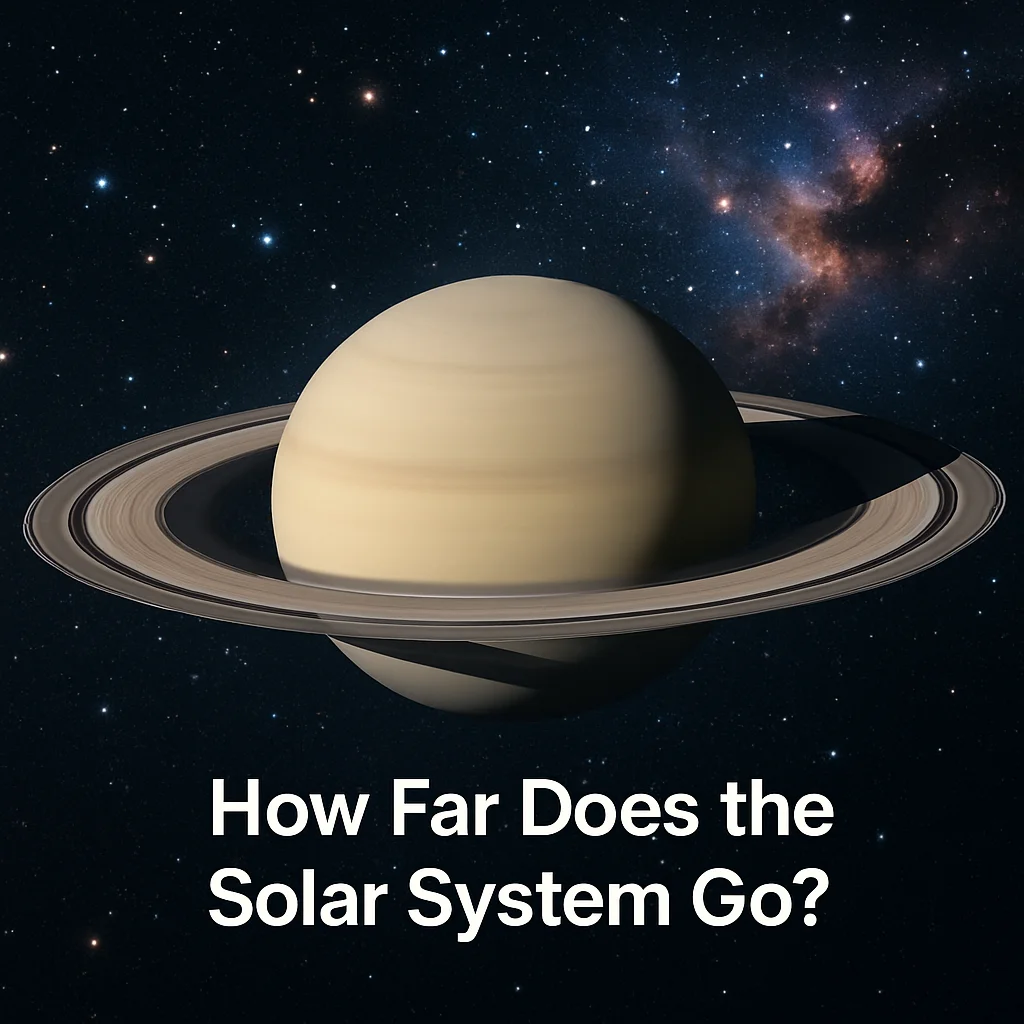
Understanding the Solar System helps us learn about our place in the universe and the conditions that shape planetary environments. Through exploring each component of the Solar System, we gain insight into their formation, structure, and the complex forces that govern them.
In this article, we'll investigate the boundaries of the Solar System and the factors that define its vast expanse. By the end, you'll grasp its scale, its components, and what lies at its outermost reaches.
📍 Where It Is and How Far Away
The Solar System is located in the Milky Way galaxy, one of billions of galaxies in the universe. It resides in one of the galaxy's spiral arms, known as the Orion Arm. Our Solar System is relatively small compared to the vast expanse of the Milky Way.
The size of the Solar System is often measured in astronomical units (AU), where one AU is the average distance from Earth to the Sun, about 93 million miles (150 million kilometers). From the Sun to the outer edge of the Solar System, including the Oort Cloud, it's about 100,000 AU.
This immense distance from the Sun affects how much sunlight and heat reach the outer regions. Objects farther from the Sun receive less heat and light, making them cold and dimly lit compared to the inner planets.
🧱 Size, Mass, and Gravity (Made Simple)
The Solar System contains both massive giants and smaller, rocky worlds. The largest planet, Jupiter, is about 318 times the mass of Earth and could be thought of as a giant gas balloon with immense gravity. In contrast, Mercury, the smallest planet, has much lower mass and gravity.
Gravity in the Solar System varies widely. On Jupiter, you would weigh more than twice what you weigh on Earth. On the other hand, Mars, with about 38% of Earth's gravity, would make you feel lighter.
Planets like Jupiter lack a solid surface; thus, standing on them in the traditional sense isn't possible. Instead, these gas giants have thick atmospheres and increase in density towards the core.
🌡️ Atmosphere and Weather
The atmospheres of planets in the Solar System vary greatly. Earth’s atmosphere is rich in nitrogen and oxygen, supporting life, while Venus has a thick atmosphere rich in carbon dioxide, causing extreme heat through a greenhouse effect.
Gas giants like Jupiter and Saturn are composed mostly of hydrogen and helium. These planets have raging storms and strong winds, like Jupiter's Great Red Spot—a giant storm system larger than Earth itself.
Weather on planets is affected by their distance from the Sun and their atmospheric composition. Farther planets, like Neptune, despite being far colder, also experience violent storms and winds.
🪨 Surface and Interior
Rocky planets, such as Earth, Mars, and Venus, have surfaces marked by features like volcanoes, craters, and mountains. These features are shaped by tectonics, impacts, and erosion.
Planets like Jupiter and Saturn have no solid surfaces. They are composed mostly of thick layers of gas and gradually transition to a dense core. The concept of a "surface" is replaced by layers of clouds and higher pressure systems.
The interiors of planets can include layers such as a core, mantle, and crust. These influence geological activity and magnetic fields.
🌀 Rotation, Orbit, and Seasons
Planets rotate at different speeds. For example, Jupiter has a very short day, lasting about 10 hours, while Venus has a slow and retrograde rotation, taking 243 Earth days for one spin.
The time a planet takes to orbit the Sun defines its year. Earth takes 365 days, while Neptune, much farther from the Sun, takes about 165 Earth years.
Axial tilt can lead to seasons as we experience on Earth. Planets like Uranus, which have extreme tilts, experience unusual seasonal changes.
🧲 Magnetic Field and Radiation
Magnetic fields are created by the movement of molten materials inside planets. Earth's magnetic field protects us from harmful solar and cosmic radiation and causes auroras.
Jupiter has the strongest magnetic field in the Solar System, with intense radiation belts that pose challenges for spacecraft, requiring protective shielding.
Magnetic fields play a vital role in space weather and can influence a planet’s ability to retain an atmosphere.
🌙 Moons, Rings, and Neighbors
The Solar System is home to many moons and impressive ring systems. Saturn is famous for its majestic rings made of ice particles, while Jupiter has the most moons, over 70 known.
Gravitational interactions between planets, moons, and rings can lead to tidal forces, affecting their shapes and rotational dynamics.
Some planets, like Mercury and Venus, lack moons, which is interesting in understanding their formation and history.
🔭 How We Know (Missions and Observations)
Our knowledge of the Solar System has expanded through both telescopic observations and space missions. Telescopes have allowed us to observe planetary motion and surface details from Earth.
Missions like Voyager, Galileo, and Cassini have provided in-depth views of planets and moons, capturing images, measuring gravitational fields, and sampling atmospheres.
Data from these missions help scientists understand the composition, behavior, and history of various celestial bodies.
❓ Common Questions and Misconceptions
Is Pluto a planet? Pluto is classified as a dwarf planet due to its size and the inability to clear its orbit of other debris.
Can you stand on Jupiter? No, Jupiter has no solid surface; it is primarily composed of gas and gradually becomes denser toward the core.
Is Mars habitable? Mars has cold temperatures and a thin atmosphere, making it inhospitable to known life forms without technology.
Is the Solar System the center of the universe? No, the Solar System is just one of many systems in the universe, located in the Milky Way galaxy.
Why is Venus so hot? Venus's thick carbon dioxide atmosphere creates a greenhouse effect, trapping heat and raising surface temperatures.
Do all planets have seasons? Not all planets have seasons like Earth; it depends on their axial tilt and orbit around the Sun.
📌 Summary
- The Solar System is a group of celestial bodies orbiting the Sun.
- It is located in the Orion Arm of the Milky Way galaxy.
- Planetary sizes and gravity vary widely, affecting surface conditions.
- Atmospheres range from Earth's life-supporting air to Venus's greenhouse gases.
- Rocky planets have surfaces; gas giants are mostly gaseous.
- Planets have different rotation speeds and distances from the Sun.
- Magnetic fields protect planets and affect space weather.
- Saturn has rings; many planets have moons, influencing dynamics.
- Our understanding comes from telescopes and space missions.
- One memorable fact: Jupiter's Great Red Spot is a massive, centuries-old storm.