🪐 Comets Explained: Ice, Dust, and Tails
🌌 What It Is
Comets are fascinating celestial objects composed primarily of ice, dust, and rocky material. They are often described as cosmic snowballs that travel through space, developing stunning tails when they approach the Sun. Unlike planets or moons, comets have unpredictable orbits that can take them far out of the regular paths of the Solar System.
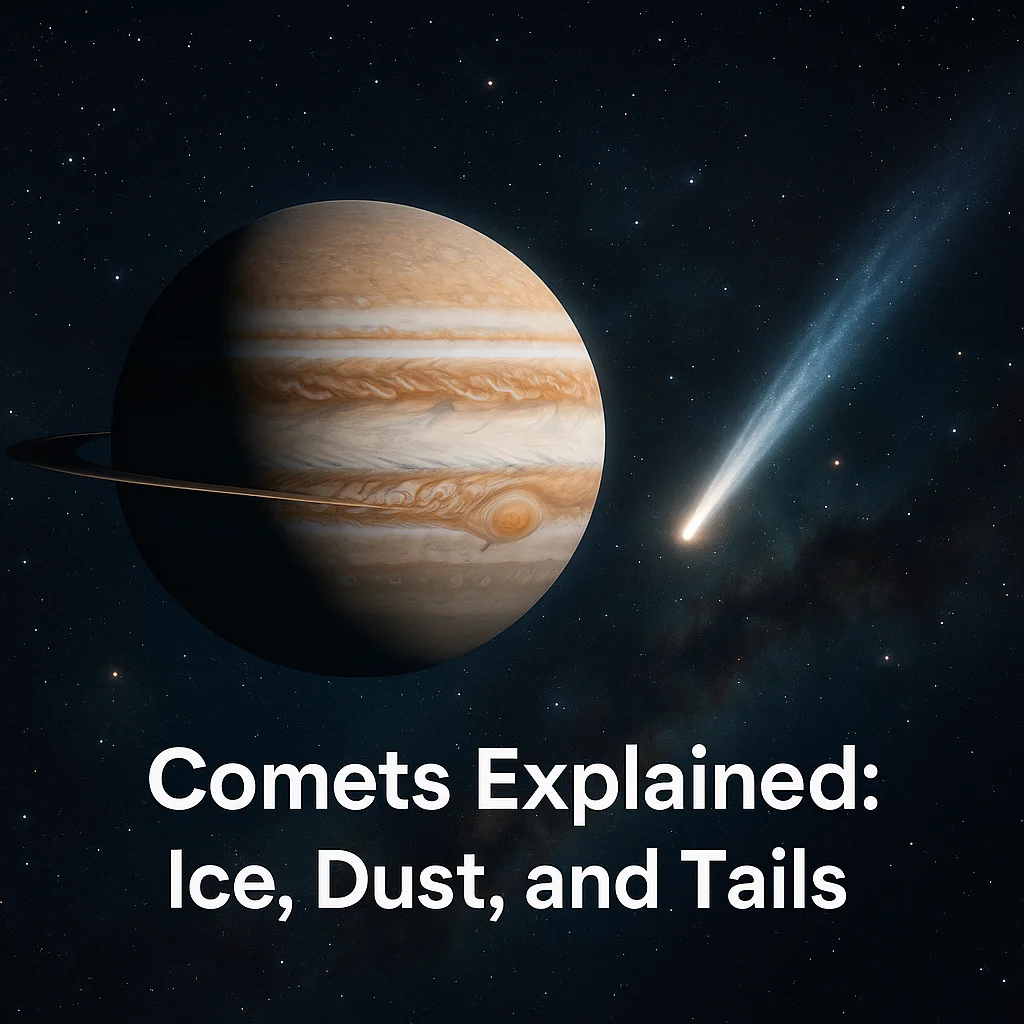
These icy bodies become active when they are heated by the Sun, causing the ice to vaporize and release gas and dust into space. This creates a glowing head known as the coma and the characteristic tails that make comets so visually striking. When observed from Earth, comets can sometimes be seen as bright spots with fan-like streams of light trailing behind them.
In this article, we will explore the basic features of comets, their journey through the Solar System, and the scientific significance they hold. By the end, you'll have a clear understanding of these cosmic wanderers and the role they play in our understanding of the universe.
📍 Where It Is and How Far Away
Comets originate from two main regions in the Solar System: the Kuiper Belt and the Oort Cloud. The Kuiper Belt is a region beyond Neptune filled with icy bodies, whereas the Oort Cloud is a distant spherical shell surrounding the Solar System.
The distance a comet travels is immense. While comets from the Kuiper Belt have shorter orbits, those originating in the Oort Cloud can take thousands of years to complete their journey around the Sun. For scale, one astronomical unit (AU) is the average distance from Earth to the Sun, about 93 million miles. Some comets travel many times this distance.
As comets move closer to the Sun, the increase in temperature causes their ices to evaporate, creating a glowing effect. The sunlight not only makes them visible but also influences their temperature, affecting how active they become during their journey.
🧱 Size, Mass, and Gravity (Made Simple)
Comets can vary greatly in size, typically ranging from a few hundred meters to tens of kilometers in diameter. For comparison, many comets are smaller than Mount Everest but large enough to be impressive when viewed through telescopes.
The mass of a comet is relatively low due to its composition of ice and dust; hence, its gravitational pull is weak. Standing on a comet would feel entirely different from standing on Earth due to this low gravity. You could jump higher and move with more ease on its surface.
Because they lack enough mass, comets don't generate substantial gravitational force to pull in and hold onto a substantial atmosphere. This lack of atmosphere allows their surface material to escape into space, contributing to the formation of comas and tails.
🌡️ Atmosphere and Weather
Comets do not have an atmosphere in the traditional sense. Instead, as they approach the Sun, the heat causes the comet's ices to sublimate, forming a temporary, thin atmosphere called a coma. The coma consists mainly of water vapor, carbon dioxide, and other gases mixed with dust particles.
There are no weather patterns like those found on planets, as comets lack stable atmospheres. However, the solar wind, which is a stream of charged particles emitted by the Sun, can interact with the coma. This interaction shapes the tails of the comet, with the ion tail pointing directly away from the Sun due to solar wind effects.
Given their small size and lack of atmosphere, the temperature on a comet's surface can vary significantly depending on its distance from the Sun. The side facing the Sun can become warm enough to vaporize ice, while the opposite side remains extremely cold.
🪨 Surface and Interior
The surface of a comet is a mixture of ice, dust, and rocky material. It is generally dark, covered in a layer of organic material and carbon-rich compounds. As the comet nears the Sun, this surface begins to sublimate, releasing gas and dust into space.
Comets lack a differentiated structure like Earth's crust, mantle, and core. Instead, they are essentially a compact blend of materials from the early Solar System. The interior is thought to be icy and porous, often described as being similar to a "dirty snowball."
Surface features on comets can include pits, cliffs, and jagged terrain formed from the repeated freezing and thawing cycles as they approach and recede from the Sun. There are no volcanic or tectonic activities on comets, but the sublimation processes can significantly alter their surface.
🌀 Rotation, Orbit, and Seasons
Comets rotate as they orbit the Sun, with rotation periods ranging from a few hours to several days. This rotation influences how material is ejected from the surface, contributing to the shape and direction of the coma and tails.
The orbit of a comet is typically highly elliptical, bringing it very close to the Sun at perihelion and taking it out to great distances at aphelion. This positioning affects their visibility from Earth and the length of time they remain observable during each orbit.
Unlike planets, comets do not have seasons in the traditional sense, as they lack atmospheres and axial tilts that would create distinct climatic changes. However, the stages of their orbital path could be considered as phases of activity based on their proximity to the Sun.
🧲 Magnetic Field and Radiation
Comets do not generate magnetic fields like those of planets and some moons. Instead, any magnetic activity observed in connection with a comet generally results from its interactions with the solar wind.
The interaction of a comet with the solar wind can generate a magnetosphere around the comet, briefly altering the magnetic environment in the vicinity. This interaction can sometimes be observed as changes in the orientation of the comet's ion tail.
The radiation environment around a comet can be hazardous due to charged particles from the Sun. However, since comets lack atmospheres or magnetic fields, they provide no protection to hypothetical spacecraft or astronauts from such cosmic radiation.
🌙 Moons, Rings, and Neighbors
Comets do not have moons or ring systems. This absence is primarily because their gravitational pull is too weak to capture and retain other objects. They are solitary travelers, often interacting with planets and other bodies they encounter.
Sometimes, comets can be temporarily influenced by the gravity of planets, an event which can alter their orbits significantly. These gravitational tugs can send comets into new paths or even eject them from the Solar System entirely.
Despite their solitary nature, comets provide crucial insights into the outer reaches of the Solar System, offering evidence of the conditions and materials present during its formation billions of years ago.
🔭 How We Know (Missions and Observations)
Telescopes and spacecraft have been instrumental in our understanding of comets. Ground-based and space telescopes allow scientists to observe the coma and tail, analyze light spectra, and determine the chemical composition of a comet.
Space missions such as ESA's Rosetta, which studied Comet 67P/Churyumov–Gerasimenko, provided close-up data and images, transforming our understanding of these icy bodies. Such missions can capture high-resolution images, sample comet material, and monitor the changes in activity as a comet approaches and recedes from the Sun.
The data gathered includes gravitational readings, which help infer mass and density, and spectrographic data, revealing the types of ices and gases present. These missions are pivotal in piecing together the early history and evolution of our Solar System.
❓ Common Questions and Misconceptions
Is a comet a star? No, comets are not stars; they are icy bodies that reflect sunlight. Stars generate their own light through nuclear reactions in their cores.
Can you stand on a comet? Comets have a solid surface, but their low gravity and lack of atmosphere would make standing there challenging and dangerous without special equipment.
Are comets habitable? Currently, no evidence suggests that comets can support life as we know it. Their environments are cold, barren, and subject to intense solar radiation.
Why do comets have tails? Comet tails are formed by the solar wind and sunlight pushing dust and gas away from the comet's coma, mostly pointing away from the Sun.
Are comets only in the Solar System? While most observed comets belong to our Solar System, interstellar comets from other systems can also be detected passing through.
Do comets bring water to Earth? Some scientists believe comets may have delivered water and organic material to Earth in its early history, contributing to the development of life.
📌 Summary
- Comets are icy bodies from the outer Solar System.
- They originate in regions like the Kuiper Belt and Oort Cloud.
- Typically small in size, with weak gravity.
- No traditional atmosphere; they develop a coma and tails near the Sun.
- Surface composed of ice, dust, and rocky material.
- Elliptical orbits without typical seasons.
- No inherent magnetic fields, only solar wind interactions.
- Do not possess moons or rings.
- Studied by telescopes and missions like Rosetta.
- Comets provide insights into the early Solar System's composition.