🪐 Near-Earth Objects: What They Are
🌌 What It Is
Near-Earth Objects (NEOs) are small celestial bodies whose orbits bring them close to Earth's path around the sun. This category primarily includes asteroids and comets. Their proximity to Earth makes them subjects of interest for both astronauts planning future space missions and scientists studying the solar system's history and future.
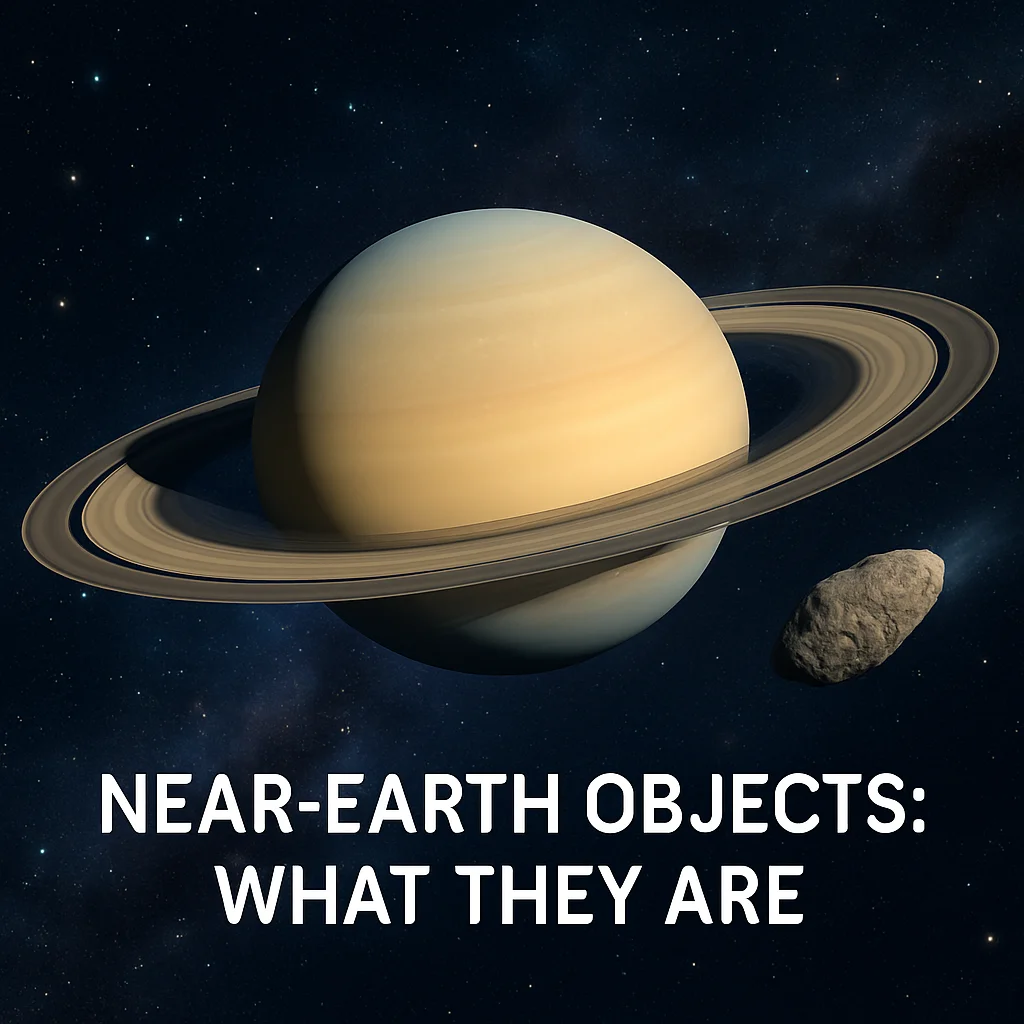
Astronomers classify asteroids as rocky bodies left over from the solar system's formation. Comets, on the other hand, consist mainly of ice and dust. When they approach the sun, they display a visible atmosphere known as a coma and sometimes a tail, due to sublimation. NEOs can tell us a lot about the materials that comprise the solar system and how it evolved over time.
In this article, you will learn about the location of these intriguing objects, their sizes, what they’re made of, and how scientists study them. You’ll also discover why NEOs are crucial for understanding Earth's own history and potential future.
📍 Where It Is and How Far Away
NEOs are found within a certain region of the solar system, orbiting the sun in paths that allow them to come within 1.3 astronomical units (AU) of Earth's orbit. One AU is the average distance from Earth to the sun, about 93 million miles. This positioning means that some of these objects can come quite close to Earth, relatively speaking.
Unlike the planets that have more regular and predictable orbits, NEOs can have orbits that are elongated, bringing them closer to the sun at one end and far away at the other. Their position relative to the sun affects what we can observe about them and also influences their temperature. When closer to the sun, they warm up, sometimes causing cometary tails to become visible.
Their proximity to Earth makes NEOs easier to study with ground-based telescopes and space missions. However, NEOs’ variable distances and elliptical orbits mean their visibility can change over time, sometimes making them hard to track.
🧱 Size, Mass, and Gravity (Made Simple)
NEOs vary considerably in size, ranging from a few meters to several kilometers in diameter. While this might seem small compared to planets, even a small asteroid can have significant mass. For instance, an object as small as 100 meters across can weigh millions of tons.
The gravity on a NEO is much weaker than what we experience on Earth due to their smaller mass. To imagine this, think of how you would feel on a tiny island compared to standing on the mainland; gravity feels weaker the smaller and less massive the body.
For many of these asteroids and comets, you wouldn’t feel much weight if you could stand on them, assuming there is a solid surface. Often, people envision hopping or even floating with minimal effort due to low gravity.
🌡️ Atmosphere and Weather
Most NEOs lack a significant atmosphere, primarily because their gravity is too weak to hold one. Without an atmosphere, there's no weather as we know it. The surface conditions depend directly on exposure to sunlight and space radiation.
When comets, a type of NEO, approach the sun, they begin to develop an atmosphere called a coma and sometimes a tail as icy components vaporize. This process is triggered by solar radiation, and those components become gases.
Temperature on these bodies varies widely. When in direct sunlight, the temperature can rise quickly, while shaded parts or times can be frigid, exposing the extreme contrasts in environments near-Earth objects experience.
🪨 Surface and Interior
NEOs, particularly asteroids, display surfaces riddled with impact craters, indicating a history of collisions. These impacts help astronomers understand the object’s age and geological past. The surface can be rocky, metallic, or a mix, providing clues on the body's origin.
Since most NEOs are not massive enough to form a spherical shape, they often appear irregular. Their internal structure is likewise irregular, often being a 'rubble pile' of rocks and dust held together by weak gravity and, sometimes, electromagnetic forces.
The lack of a solid surface in some NEOs, coupled with minimal internal differentiation, means they do not have layers like Earth with a crust, mantle, and core. However, researchers are keen on understanding the materials they are made of, as they can reveal valuable insights into the early solar system.
🌀 Rotation, Orbit, and Seasons
Many NEOs rotate rapidly, with a single rotation taking anywhere from a few minutes to several hours. Their rapid spins can result in diverse surface phenomena, such as landslides or the distribution of dust and small particles.
Their orbits can be unpredictable due to gravitational interactions with planets, especially Earth. This is why astronomers continuously monitor these objects to predict their paths accurately and understand potential future impacts.
Seasons, as experienced on Earth due to axial tilt, do not occur on most NEOs. If they do have an axial tilt, any "seasonal" changes might relate more to their orbits, but these are not akin to seasons on Earth.
🧲 Magnetic Field and Radiation
NEOs typically do not have magnetic fields of their own, unlike larger planets. Their small size and lack of molten metal core mean they do not generate magnetic fields. As a result, they do not significantly protect from solar and cosmic radiation.
Radiation in space can affect these bodies, sometimes altering surface materials over time. For anything attempting to study or land on a NEO, understanding the radiation environment is essential for planning safe missions.
While they lack magnetic fields, these bodies are affected by the solar wind, a flow of charged particles from the sun. This space weather can help to shape the surface of small bodies over long periods.
🌙 Moons, Rings, and Neighbors
Some NEOs surprisingly host small moons or are part of binary systems, where two bodies orbit a common center. These systems offer unique opportunities for studying gravitational interactions and surface dynamics.
While no NEOs have ring systems akin to Saturn’s, understanding how moons form around small bodies helps scientists learn about planet formation on a larger scale.
The gravitational nudges provided by larger planets, especially Jupiter and Earth, play a significant role in defining the orbits and trajectories of NEOs, sometimes even capturing them or ejecting them from the solar system.
🔭 How We Know (Missions and Observations)
Astronomers use a combination of ground-based telescopes and space missions to study NEOs. Telescopes can track their paths and study their size, shape, and rotation. They capture images and light spectra to determine compositions.
Space missions have approached and, in some cases, landed on or returned samples from NEOs. Notable missions include NASA's OSIRIS-REx and Japan's Hayabusa missions, which gathered direct data from these objects.
Data types retrieved include images and spectra, which tell us about chemical compositions, as well as gravity measurements, which help understand mass distribution and internal structure.
❓ Common Questions and Misconceptions
Is a NEO a star? No, they are small celestial bodies like asteroids or comets, not stars.
Can you stand on a NEO? With low gravity, it might feel more like floating with some effort.
Is it habitable? No, NEOs typically lack atmospheres and conditions needed for life as we know it.
Why are they important? They provide insights into the solar system's formation and can pose impact threats to Earth.
Why is its orbit so erratic? Close interactions with planets and their elongated orbits mean varied paths.
Is it common for comets to have tails? Yes, the tail forms as the comet nears the sun and ice sublimates into gas.
What color are they? Colors depend on materials present; many appear darker due to weathering.
Can they cause extinction? While large impacts are rare, they could have the potential to cause significant damage.
📌 Summary
- Near-Earth Objects (NEOs) include asteroids and comets that orbit close to Earth.
- Located within 1.3 astronomical units of Earth's orbit around the sun.
- NEOs' gravity is weak, making them feel different to stand on compared to Earth.
- Lack significant atmosphere, no Earth-like weather.
- Surfaces show impact craters and varied compositions.
- Varied rotation speeds and elliptical orbits around the sun.
- Usually lack magnetic fields, influenced by solar wind.
- Some NEOs have moons or are part of binary systems.
- Studied through telescopes and space missions like OSIRIS-REx and Hayabusa.
- NEOs help scientists understand the early solar system and potential future impacts.