🪐 The Asteroid Belt: Where It Is and What’s Inside
🌌 What It Is
The asteroid belt is a vast region in our solar system filled with countless rocky bodies. These bodies, known as asteroids, vary greatly in size and shape. Unlike planets, which are large enough to have cleared their orbits of other debris, asteroids remain in a region teeming with fellow space rocks. The asteroid belt is an intriguing boundary between the inner planets, like Earth and Mars, and the outer giants such as Jupiter and Saturn.
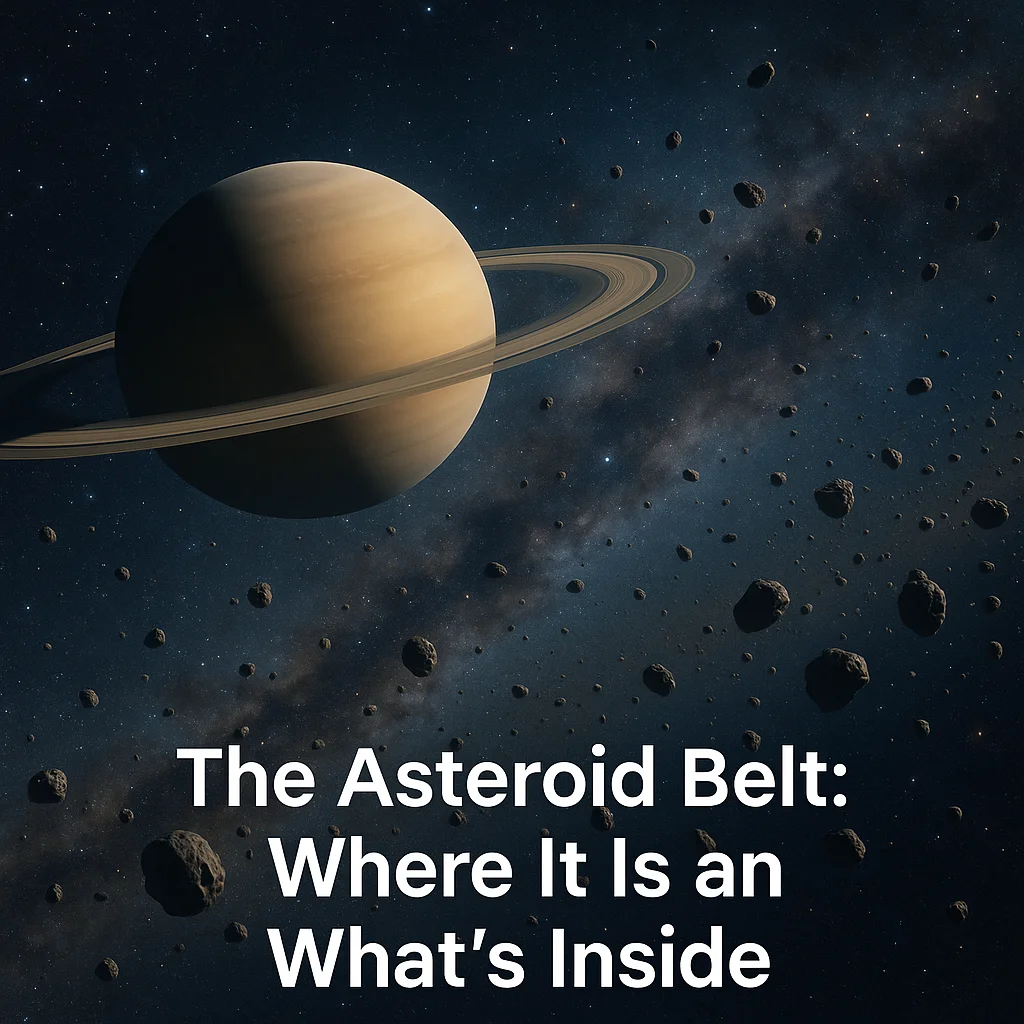
For those new to astronomy, discovering what the asteroid belt contains and why it exists can be fascinating. It serves as a window into the early solar system, providing clues about its formation and evolution. In this article, we will explore the location, composition, and characteristics of the asteroid belt, as well as the scientific missions that have helped us understand it.
From the discovery of these space rocks to the missions sent to study them, the asteroid belt continues to capture the imagination of astronomers and enthusiasts alike. Exploring this intriguing region reveals the dynamic nature of our solar system and its history.
📍 Where It Is and How Far Away
The asteroid belt is located between the orbits of Mars and Jupiter. This region of space stretches over hundreds of millions of kilometers. While distances in the solar system can be difficult to grasp, it's helpful to use astronomical units (AU) as a guide. One AU is the average distance between Earth and the Sun—about 150 million kilometers or 93 million miles.
The asteroid belt lies roughly between 2.1 and 3.3 AU from the Sun. This means it is more than twice as far away from the Sun as the Earth is. Because of its location, the asteroid belt receives significantly less sunlight than Earth, contributing to its cold environment.
The position of the asteroid belt exerts a profound influence on the environment of its constituent asteroids. Temperatures in the region are low, and sunlight is dim, factors which play a role in the physical and chemical processes that occur on these celestial bodies.
🧱 Size, Mass, and Gravity (Made Simple)
Despite encompassing a wide expanse of space, the total mass of the asteroid belt is relatively small. In fact, it's only about 4% the mass of the Moon. This tells us that the belt's asteroids, though numerous, are relatively small compared to the planets and moons in our solar system.
Ceres, the largest object in the asteroid belt, is classified as a dwarf planet and accounts for nearly a third of the belt's total mass. Most other asteroids are much smaller, some only a few meters wide. Because of their small size, the gravity on asteroids is weak, making standing on an asteroid very different from standing on Earth.
If you were to visit a larger asteroid, you might experience a sensation of floating rather than the firm standing you feel on Earth. This is due to the low gravity, which cannot hold you down with the same force we experience on our planet.
🌡️ Atmosphere and Weather
The asteroid belt's atmosphere, or more accurately, lack of one, is a significant factor in its environment. Most asteroids are too small to retain an atmosphere, meaning they exist in the near-vacuum of space without any protective layer of air.
Without an atmosphere, there is no weather on asteroids as we understand it on Earth. There are no clouds, winds, or storms. Temperatures can vary greatly between the sunlit and shadowed sides of an asteroid due to the direct exposure to solar radiation.
The absence of an atmosphere means that any spacecraft or human visitors to an asteroid would need to bring their own life support systems. This stark environment showcases the raw and unfiltered conditions of space.
🪨 Surface and Interior
The surfaces of asteroids are rocky and pocked with craters from countless impacts over billions of years. These features give us insights into the history of the solar system, as each crater tells the story of a collision with another space rock.
While many asteroids are rocky, others may contain metals or even water ice. Their interiors vary, with some being solid throughout, while others are more like "rubble piles," loosely held together by gravity. This diversity indicates asteroids have different origins and evolutionary paths.
Scientists study asteroids to understand what lies beneath their surfaces. Probing these rocky bodies helps to uncover the materials and processes that formed the early solar system.
🌀 Rotation, Orbit, and Seasons
The rotation and orbit of an asteroid can be quite varied. Some rotate quickly, completing a spin in just a few hours, while others may take days. This affects how sunlight warms the surface, creating temperature differences across the asteroid.
Asteroids follow elliptical orbits around the Sun and do not have seasons like Earth. However, their tilts and spins do cause changes in solar exposure over time. By observing these orbits, astronomers learn how gravity and other forces shape the paths asteroids follow.
Their location within the asteroid belt and interactions with passing planets can alter an asteroid's orbit, sometimes causing them to collide with each other or be ejected from the belt altogether.
🧲 Magnetic Field and Radiation
Unlike planets with strong magnetic fields, most asteroids lack significant magnetic fields. This absence means there is little to shield asteroids from solar radiation and cosmic rays, which can alter the surface materials over time.
Radiation exposure can cause changes in the surface color and composition of asteroids, which is critical for understanding their history. Without magnetic fields, asteroids do not have auroras or the protective magnetospheres like those found on Earth.
The space environment around asteroids can be hostile to spacecraft, requiring careful planning for missions intending to visit or study them from orbit.
🌙 Moons, Rings, and Neighbors
While most asteroids travel alone, some have small moons. These moonlets provide valuable clues about the gravitational interactions and the past collisions that shaped the asteroid belt.
No asteroids are known to have ring systems like the giant planets, but their interactions with neighboring asteroids create a dynamic environment. Occasionally, collisions between asteroids can send fragments flying into space.
These moons and the remains of collisions help us understand the complex gravitational influences at play within the asteroid belt, providing a glimpse into its ongoing evolution.
🔭 How We Know (Missions and Observations)
Our knowledge of the asteroid belt comes from telescopic observations and spacecraft missions. Telescopes allow scientists to study the light and spectra from asteroids, revealing their compositions and motions.
The Dawn mission, which visited Vesta and Ceres, provided invaluable data about the geological history and surface compositions of these large asteroid belt residents. NASA's OSIRIS-REx mission visited the asteroid Bennu, returning samples to Earth for detailed study.
These missions and others like them help scientists gather precise measurements—images, spectral data, gravity readings—that unlock the secrets of asteroids and the history they hold within our solar system.
❓ Common Questions and Misconceptions
Is it a star? No, the asteroid belt is made up of rocky bodies, not stars. Stars produce their own light through nuclear fusion.
Can you stand on it? You could technically stand on some of the larger asteroids, but you would need a spacesuit and careful footwork due to low gravity.
Is it habitable? The asteroid belt is not habitable. It lacks an atmosphere and has extreme temperature variations.
Why is it that color? The color of asteroids can vary depending on their composition and the effects of space weathering.
Are collisions common? While collisions do happen, they are relatively infrequent given the vastness of space in the belt.
Is it a planet? The asteroid belt itself is not a planet, but it does contain Ceres, a dwarf planet.
📌 Summary
- The asteroid belt is a region filled with rocky remnants from the early solar system.
- It is located between the orbits of Mars and Jupiter, spanning 2.1 to 3.3 AU from the Sun.
- Although vast, it contains only 4% of the Moon's mass, with weak gravity on its rocks.
- Asteroids have no atmosphere, leading to no weather and high radiation exposure.
- Their surfaces are rocky and cratered; some contain metals or water ice.
- Asteroids spin and orbit the Sun; they lack seasons but have temperature changes.
- Few have weak magnetic fields, exposing them to solar and cosmic radiation.
- Some have small moons, but none have ring systems like larger planets.
- Exploration is conducted using telescopes and missions like Dawn and OSIRIS-REx.
- The asteroid belt gives insights into the early solar system and its dynamics.