🪐 Sun Facts for Beginners
🌌 What It Is
The Sun is the central star of our Solar System, powering life on Earth through its immense energy output. It’s a massive sphere of hot plasma primarily composed of hydrogen and helium.
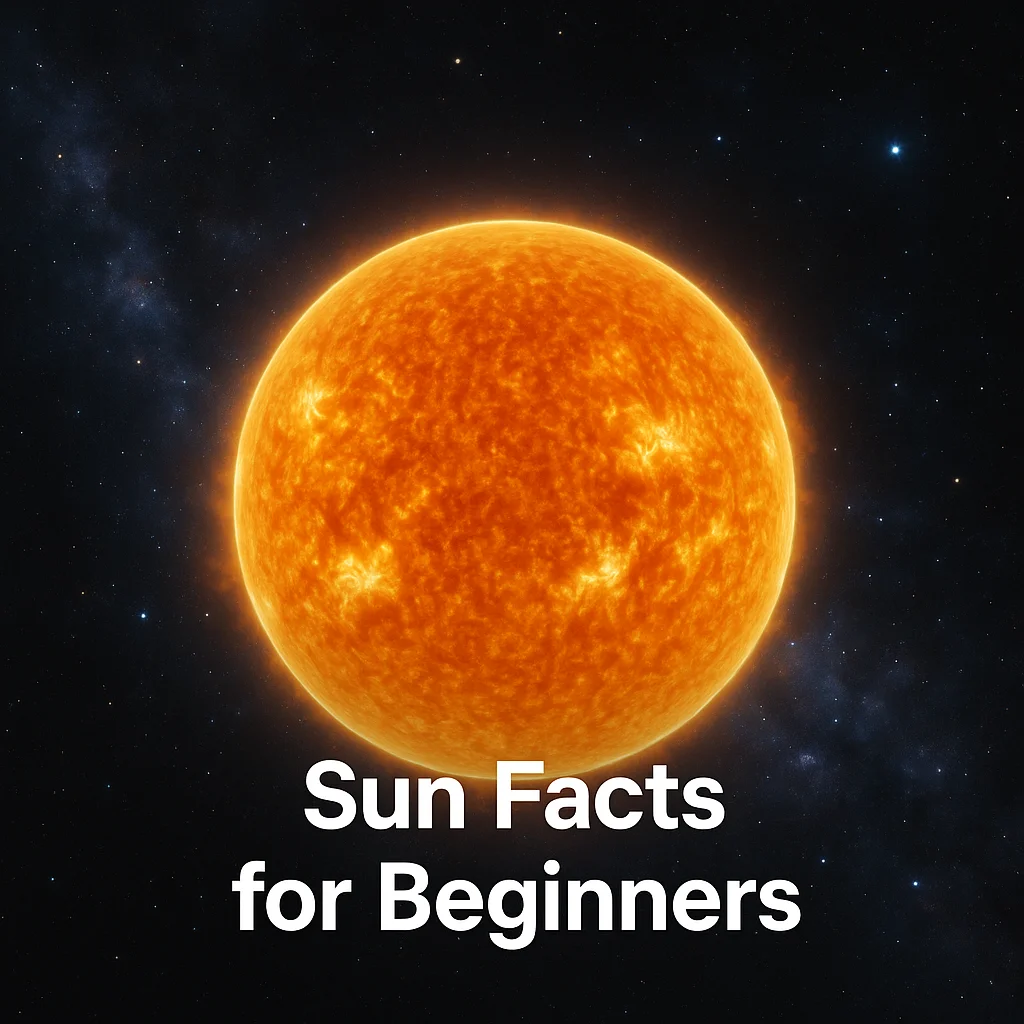
Unlike planets, which orbit stars, the Sun is the gravitational anchor of the Solar System, around which all planets revolve. As a star, it undergoes nuclear fusion in its core, converting hydrogen into helium and releasing energy.
In this article, we will explore key aspects of the Sun, including its location, size, composition, and the vital roles it plays in the Solar System. Understanding these basics will help you appreciate the Sun's significance in the cosmic dance.
📍 Where It Is and How Far Away
The Sun is located at the center of the Solar System, approximately 93 million miles (150 million kilometers) away from Earth. This distance, known as one astronomical unit (AU), serves as a baseline measurement for distances within the Solar System.
Light from the Sun takes about 8 minutes to reach Earth, underscoring the vastness of space, even in our neighborhood. This means that when you look at the Sun, you're seeing it as it was 8 minutes ago.
The Sun's position ensures it provides consistent illumination and heat, essential for maintaining temperatures for life on Earth. Its stable energy output keeps our planet balanced within the “Goldilocks Zone”—not too hot, not too cold.
🧱 Size, Mass, and Gravity (Made Simple)
The Sun is by far the largest object in the Solar System, accounting for over 99.8% of the total mass. It has a diameter of about 864,000 miles (1.4 million kilometers)—large enough to fit over 1 million Earths inside it.
The Sun’s gravitational pull is what keeps the planets, asteroids, and comets in orbit. Its surface gravity is about 28 times that of Earth, meaning an object weighing 100 pounds on Earth would weigh 2,800 pounds on the Sun.
However, the Sun has no solid surface to stand on. If you could venture there, you would find a churning sea of plasma, where the concept of "standing" doesn’t apply.
🌡️ Atmosphere and Weather
The Sun's atmosphere is composed of several layers, each contributing to its dynamic weather. The outermost layer, the corona, is surprisingly hotter than the surfaces beneath and can be seen best during a solar eclipse.
Solar weather includes phenomena like solar flares and sunspots. Solar flares are eruptions that send intense bursts of radiation into space, while sunspots are cooler, darker regions on the Sun’s photosphere caused by magnetic activity.
The Sun’s rotation and intense magnetic field drive these activities, creating a complex and sometimes turbulent environment that affects space weather and can impact Earth’s magnetosphere.
🪨 Surface and Interior
The Sun doesn't have a traditional surface like a planet. Its visible "surface", called the photosphere, is where most of the Sun’s light comes from. This layer is not solid but a thin region of hot gas.
Beneath the photosphere lie the convective and radiative zones, where energy is transported from the core to the outer layers. The core is the Sun's powerhouse, where nuclear fusion occurs, generating the energy that eventually reaches us as sunlight.
The absence of solid ground on the Sun is due to its gaseous nature, meaning there are no mountains, valleys, or solid structures as seen on terrestrial planets.
🌀 Rotation, Orbit, and Seasons
The Sun rotates on its axis approximately once every 27 days. This isn’t uniform because different parts rotate at different rates, a phenomenon known as differential rotation.
Unlike planets, the Sun doesn't orbit other objects. Planets orbit around it, making it the center of our Solar System dynamics. Seasonal changes on Earth are a result of Earth's tilt and orbit, not the Sun's movement.
The Sun doesn’t experience seasons as planets do, but its activities, like the solar cycle, fluctuate over an 11-year period, leading to changes in sunspot numbers and solar activity intensity.
🧲 Magnetic Field and Radiation
The Sun's magnetic field is a complex and powerful force that influences solar activity. It gives rise to solar phenomena such as sunspots, solar flares, and coronal mass ejections.
This magnetic field extends throughout the Solar System, carrying with it charged particles that engage with planetary atmospheres and magnetic fields, leading to phenomena like auroras on Earth.
Radiation from the Sun, including visible light and ultraviolet radiation, is essential for life but also poses challenges for space exploration, requiring careful protection for spacecraft and technology.
🌙 Moons, Rings, and Neighbors
The Sun doesn’t have moons or rings, as those are features of planets. Instead, its cosmic neighbors include the planets, their moons, and countless smaller objects like asteroids and comets.
The gravitational influence of the Sun helps maintain the orbits of these objects, creating a dynamic system with interactions that fascinate astronomers and enthusiasts alike.
Understanding the Sun's role in the Solar System helps to illuminate why its apparent isolation, without moons or rings, is perfectly normal for a star.
🔭 How We Know (Missions and Observations)
Our understanding of the Sun comes from a combination of Earth-based telescopic observations and space missions. Observatories equipped with special filters observe solar activity, studying its various wavelengths and features.
Spacecraft such as the Parker Solar Probe and SOHO (Solar and Heliospheric Observatory) provide crucial data. They send back images, spectra, and information about solar particles and magnetic fields.
These missions help scientists predict solar storms and better understand the Sun's impact on the entire Solar System. From historical observations to cutting-edge space technology, each contributes to our growing knowledge.
❓ Common Questions and Misconceptions
Is the Sun a planet? No, it’s a star, a massive ball of gas undergoing nuclear fusion.
Can you stand on the Sun? No, it doesn’t have a solid surface, and its intense heat and radiation make it impossible.
Is the Sun the closest star to Earth? Yes, it’s our nearest star, providing energy essential for life.
Is the Sun a burning ball of fire? It isn’t burning like fire on Earth but undergoing nuclear fusion, releasing energy.
Why is the Sun yellow? It emits white light, but Earth’s atmosphere scatters shorter wavelengths, making it look yellow.
Could Earth exist without the Sun? No, the Sun’s energy supports life, climate, and planetary orbits.
📌 Summary
- The Sun is the central star of our Solar System.
- It is located about 93 million miles from Earth.
- It’s massive, with over 99.8% of Solar System's mass.
- The atmosphere includes the corona, exhibiting solar weather.
- Lacking a solid surface, the interior powers its energy cycle.
- It rotates every 27 days with an 11-year solar activity cycle.
- The magnetic field causes auroras and influences space weather.
- No moons or rings, but its gravitational influence is vast.
- Telescopes and missions enhance our solar knowledge.
- Its consistent energy is foundational for life on Earth.