🪐 Sunspots and Solar Flares Explained
🌌 What It Is
Sunspots and solar flares are fascinating features of our Sun. Sunspots are temporary phenomena on the Sun's photosphere that appear as spots darker than the surrounding areas. They are caused by magnetic activity inside the Sun, which creates cooler regions. Solar flares, on the other hand, are sudden and intense bursts of radiation that emanate from the release of magnetic energy associated with sunspots.
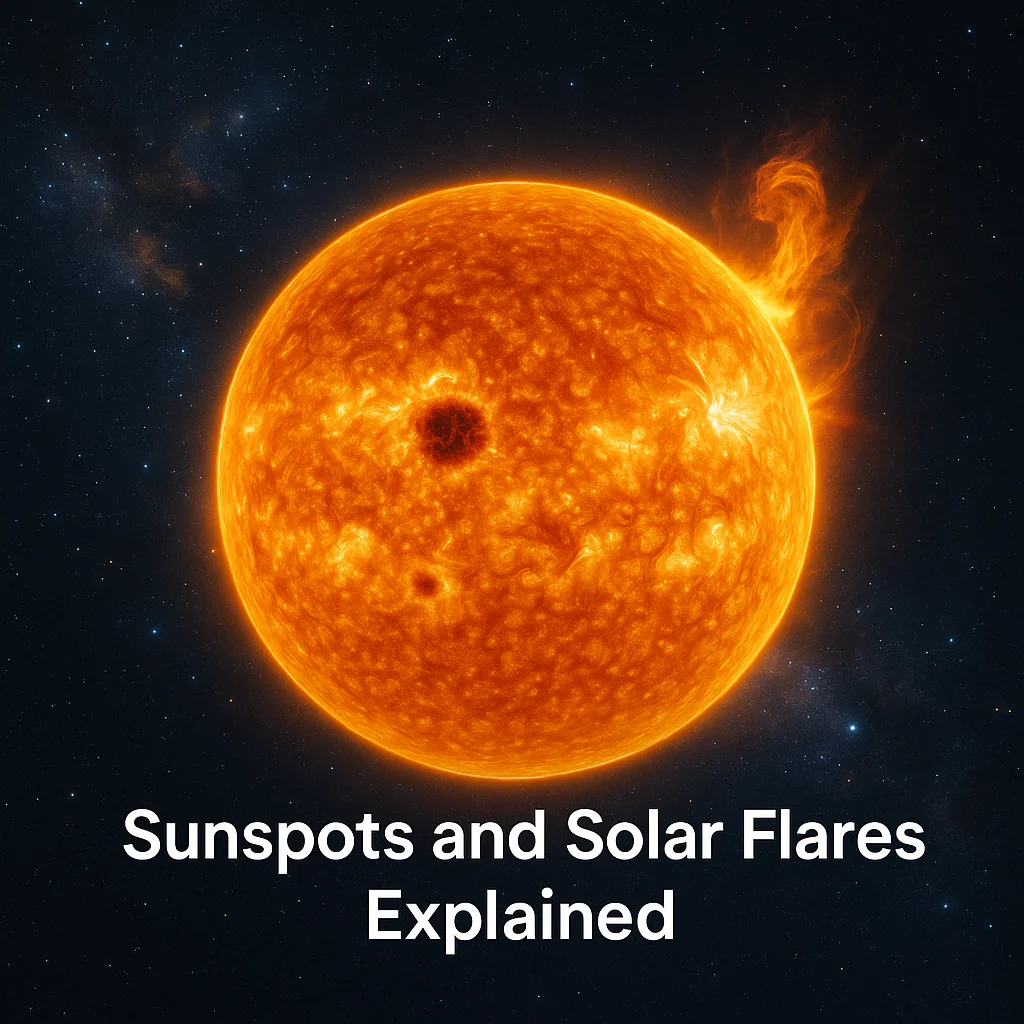
Understanding sunspots and solar flares helps us learn more about solar activity and its impact on the solar system, including its effects on Earth's technology and climate. In this article, we will explore what these features are, where they occur, and how they affect their surroundings.
By the end of this article, you will understand the basic science behind sunspots and solar flares, their characteristics, and their significance in space weather.
📍 Where It Is and How Far Away
Sunspots and solar flares are phenomena that occur on the Sun, our closest star. Situated at the center of our solar system, the Sun is about 93 million miles (150 million kilometers) from Earth, a distance we call 1 astronomical unit (AU). This distance is vital for supporting life on our planet by providing the right amount of light and warmth.
The Sun's position in the solar system ensures that sunlight reaches Earth in about 8 minutes and 20 seconds. This continuous flow of solar energy drives weather patterns and supports the biological processes essential for life. The relative proximity of the Sun makes it an object of intense study for scientists aiming to understand its behavior and impact on our world.
The Sun's position and distance affect the intensity and distribution of sunlight, which influences Earth's climate systems and the variance in sunspot activity over time.
🧱 Size, Mass, and Gravity (Made Simple)
The Sun is the largest object in the solar system, containing over 99.8% of its total mass. With a diameter of about 864,000 miles (1.4 million kilometers), it is around 109 times wider than Earth. Its enormous mass and size create an incredibly strong gravitational pull, holding the solar system's planets in orbit.
Despite its vast volume, the Sun is not a solid body. It is primarily composed of hot plasma and gases, including hydrogen and helium. Because of this gaseous nature, there is no solid surface to stand on, unlike the terrestrial planets. The gravity on the surface of the Sun is about 28 times that of Earth's, meaning that objects would feel incredibly heavy there.
This gravitational force impacts solar phenomena, such as sunspots, by affecting the movement of plasma and magnetic fields within the Sun.
🌡️ Atmosphere and Weather
The Sun's atmosphere is composed of several layers, including the photosphere, chromosphere, and corona. The photosphere is the visible surface of the Sun, where sunspots occur. The temperature here is about 5,500 degrees Celsius, while sunspots are cooler at around 3,800 degrees Celsius.
The chromosphere above the photosphere is where solar flares are often observed. These flares are powerful eruptions caused by the magnetic activity associated with sunspots. They release energy equivalent to millions of hydrogen bombs exploding simultaneously.
The outermost layer, the corona, is an extremely hot area, reaching temperatures of several million degrees Celsius. The temperature and density differences across these layers drive complex weather patterns on the Sun, including the formation and evolution of sunspots and solar flares.
🪨 Surface and Interior
The Sun lacks a traditional surface like rocky planets. It consists of layers of plasma that progressively become denser and hotter as you move inward. The core is the innermost section where nuclear fusion occurs, generating the Sun's energy. Surrounding the core is the radiative zone, where energy gradually moves outward by radiation.
Outside the radiative zone is the convective zone, characterized by circulating currents of hot plasma. This zone is where the Sun's powerful magnetic fields generate sunspots. These fields can occasionally become twisted and tangled, leading to the explosive events known as solar flares.
The lack of a solid surface affects the behavior of sunspots, which appear as temporary features on the Sun's fluid-like surface, driven by the dynamics of the plasma beneath.
🌀 Rotation, Orbit, and Seasons
The Sun rotates on its axis, with different parts of it rotating at different speeds. This differential rotation is faster at the equator (about 25 days) compared to the poles (about 35 days). This rotation contributes to the magnetic activity that creates sunspots and solar flares.
The Sun's orbit around the center of the Milky Way galaxy takes approximately 225 million years. While the Sun’s rotation affects solar magnetic activity, Earth does not experience seasons due to the Sun but due to its axial tilt. However, variations in solar activity can influence Earth's atmospheric conditions over long periods.
The Sun does not experience seasons like Earth, but its magnetic cycle, with a span of approximately 11 years, affects the activity level of sunspots and flares.
🧲 Magnetic Field and Radiation
The Sun possesses a complex magnetic field that extends throughout the solar system. The constant movement of plasma within the Sun generates this magnetic field. Sunspots occur in regions where the magnetic field is particularly strong, and solar flares result from the sudden release of magnetic energy.
These magnetic activities can produce solar storms, which impact space weather. The radiation from solar flares can disrupt communications and navigation systems on Earth and pose a risk to satellites and astronauts.
The Sun's magnetic field also gives rise to the solar wind, a stream of charged particles that travels through space and can create auroras when interacting with Earth's magnetic field.
🌙 Moons, Rings, and Neighbors
The Sun, being the central star of our solar system, does not have moons or rings like planets do. However, it exerts gravitational influence over the planets and other objects within the solar system.
The interactions between the Sun's gravitational field and those of the planets, comets, and asteroids significantly influence their trajectories and can occasionally lead to changes in orbital paths.
These gravitational interactions are essential for maintaining the stability of the solar system's structure and dynamics, ensuring that planets and other celestial bodies remain in stable orbits.
🔭 How We Know (Missions and Observations)
Our understanding of sunspots and solar flares comes from both ground-based telescope observations and a variety of space missions. Instruments on Earth help observe the Sun's surface, allowing scientists to monitor sunspots and flares directly.
Space-based missions such as the Solar Dynamics Observatory (SDO) and the Parker Solar Probe provide deeper insights by capturing high-resolution images and data about the Sun's magnetic field, corona, and solar wind.
These missions help scientists gather critical information, including spectral data and magnetic readings, to better understand the mechanisms driving sunspots and solar flares, and to forecast solar weather events.
❓ Common Questions and Misconceptions
Is the Sun a star? Yes, the Sun is a star. It's a giant ball of gas undergoing nuclear fusion at its core, providing light and heat.
Can you stand on the Sun? No, the Sun doesn't have a solid surface, and standing on it would be impossible due to immense heat and gravity.
Are sunspots dark holes? Sunspots appear dark because they are cooler areas, not holes. They are regions of intense magnetic activity.
Do solar flares make the Sun explode? Solar flares are eruptions of energy, but they don't explode the Sun. They are normal and temporary solar phenomena.
Is it true that more sunspots mean a hotter Sun? Not directly. Sunspots and solar activity can influence solar radiation outputs, but don't make the Sun itself hotter.
Are sunspots permanent features on the Sun? No, sunspots are temporary and evolve over days to weeks as part of the Sun's magnetic cycle.
📌 Summary
- Sunspots and solar flares are phenomena of the Sun.
- They occur at the Sun, 93 million miles from Earth.
- The Sun’s massive size affects its strong gravity.
- Sun weather includes sunspots and flares from magnetic activities.
- Sun lacks a solid surface, composed mostly of plasma.
- Rotates unevenly, driving magnetic cycles and events.
- Magnetic field impacts space weather and Earth’s systems.
- No moons or rings, but strong gravitational influence on planets.
- Studied via telescopes and spacecraft missions like SDO.
- Memorable fact: Sunspots are cooler due to intense magnetism.